Overview
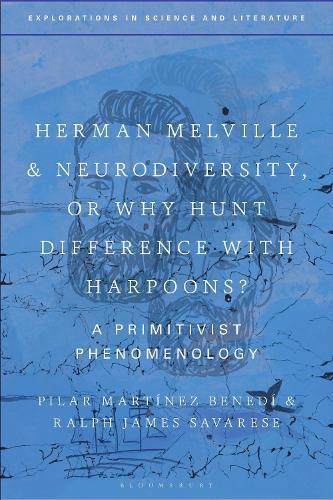
Focusing on the difference between lower-level perceptual processes in the “neural unconscious” and higher-order thought in the frontal lobes, this open access book shows how Herman Melville sought to reclaim the fluid world of the sensory, with its precategorical and radically egalitarian impulses. By studying this previously underexamined facet of Melville’s work, this book offers an essential corrective to the “pathology paradigm,” which demonizes departures from a neurological norm and feasts on pejorative categorization. The neurodiversity movement arose precisely as a response to how so-called “mental disorders” have been described, understood, and treated. Unlike standard neuroscientific or psychiatric investigation, Melville’s work doesn’t strive to explain typical functioning through the negative and, in the process, to shore up a regime of normalcy. To the contrary, it exploits the lack of congealed diagnoses in the 19th Century, much more neutrally asking the question: what can an atypical body-mind do? Steeped in current studies about autism, Alzheimer’s, Capgras and Fregoli syndromes, Mirror-touch synesthesia, phantom limb syndrome, stuttering, and tinnitus, and fully conversant with Melville scholarship, Phenomenological Primitives demonstrates what the humanities can contribute to the sciences and what the sciences can contribute to the humanities. The ebook editions of this book are available open access under a CC BY-NC-ND 4.0 licence on bloomsburycollections.com. Open access was funded in part by Grinnell College.
Full Product Details
Author: Pilar Martinez Benedi ,
Ralph James Savarese (Grinnell College, USA) ,
Ralph James Savarese (Grinnell College USA) ,
John Holmes
Publisher: Bloomsbury Publishing PLC
Imprint: Bloomsbury Academic
Dimensions:
Width: 15.60cm
, Height: 2.80cm
, Length: 23.40cm
Weight: 0.454kg
ISBN: 9781350360907
ISBN 10: 1350360902
Pages: 200
Publication Date: 30 April 2026
Audience:
College/higher education
,
Postgraduate, Research & Scholarly
Format: Paperback
Publisher's Status: Forthcoming
Availability: Manufactured on demand

Reviews
""In this provocative study, Pilar Martínez Benedí and Ralph James Savarese reveal the great anticipator Herman Melville's illumination of the hidden life of the sensory and the neural unconscious. In a work more dialogic than diagnostic, Martínez Benedí and Savarese explore Melville's advocacy for the perceptual and his ardent overcoming of biased categories and limiting social constructs. They cast wildchild and cosmopolitan Melville as the bard of neuroatypicality."" --Professor Suzanne Keen, Scripps College, USA ""Busting the false binary of frontal-lobe rationalism and neural-subject feeling, and demonstrating instead the critical adjacency of the two, Martínez-Benedí and Savarese- in tight, revealing, and always engaging treatments of a full range of Melville writings - blend science, humanities, and the logics of neurodiversity to unpack for us new ways of reading literature and new ways of exploring the sources of Melville's creativity."" --John Bryant, author of 'Melville Unfolding' and 'Herman Melville: A Half Known Life' ""Benedí and Savarese reveal the many ways Melville anticipates and explores embodied cognition, how he builds characters from the senses up, eschewing categorization of the wayward human subject. This is a thoughtful, passionate, and admirable reappraisal of Melville that closes the gap between the humanities and the sciences."" --Richard Ruppel is Professor of English at Chapman University, USA ""So long as the bulk of our mental lives works to forget the sensorial vastness on which we're rocked (from which we're stranded), Melville's assertion of worldly strangeness (not least our own) is needful boon. Herman Melville and Neurodiversity returns us to the exhilaration and discomfiture of this neural field with care and aplomb. The case it makes for tending to Melvillean textuality's disarming noise is a bracing resource for those of us drawn to the obscure infrastructures on which consciousness is waged."" --Michael Snediker, author of Contingent Figure: Chronic Pain and Queer Embodiment and Queer Optimism: Lyric Personhood and Other Felicitous Persuasions ""Makes a significant contribution to Melville studies and shows how cognitive and neurodiversity studies can enhance our understanding of literary works."" --Christopher Ohge, Senior Lecturer in Digital Approaches to Literature, School of Advanced Study University of London, UK
In this provocative study, Pilar Martínez Benedí and Ralph James Savarese reveal the great anticipator Herman Melville’s illumination of the hidden life of the sensory and the neural unconscious. In a work more dialogic than diagnostic, Martínez Benedí and Savarese explore Melville’s advocacy for the perceptual and his ardent overcoming of biased categories and limiting social constructs. They cast wildchild and cosmopolitan Melville as the bard of neuroatypicality. -- Professor Suzanne Keen, Scripps College, USA Busting the false binary of frontal-lobe rationalism and neural-subject feeling, and demonstrating instead the critical adjacency of the two, Martínez-Benedí and Savarese— in tight, revealing, and always engaging treatments of a full range of Melville writings — blend science, humanities, and the logics of neurodiversity to unpack for us new ways of reading literature and new ways of exploring the sources of Melville’s creativity. -- John Bryant, author of 'Melville Unfolding' and 'Herman Melville: A Half Known Life' Benedí and Savarese reveal the many ways Melville anticipates and explores embodied cognition, how he builds characters from the senses up, eschewing categorization of the wayward human subject. This is a thoughtful, passionate, and admirable reappraisal of Melville that closes the gap between the humanities and the sciences. * Richard Ruppel is Professor of English at Chapman University, USA * So long as the bulk of our mental lives works to forget the sensorial vastness on which we’re rocked (from which we’re stranded), Melville’s assertion of worldly strangeness (not least our own) is needful boon. Herman Melville and Neurodiversity returns us to the exhilaration and discomfiture of this neural field with care and aplomb. The case it makes for tending to Melvillean textuality’s disarming noise is a bracing resource for those of us drawn to the obscure infrastructures on which consciousness is waged. * Michael Snediker, author of Contingent Figure: Chronic Pain and Queer Embodiment and Queer Optimism: Lyric Personhood and Other Felicitous Persuasions * Makes a significant contribution to Melville studies and shows how cognitive and neurodiversity studies can enhance our understanding of literary works. * Christopher Ohge, Senior Lecturer in Digital Approaches to Literature, School of Advanced Study University of London, UK *
Author Information
Pilar Martinez Benedi is Assistant Professor of American Literature at the University of L'Aquila, Italy. Ralph James Savarese is Professor of English at Grinnell College, USA.