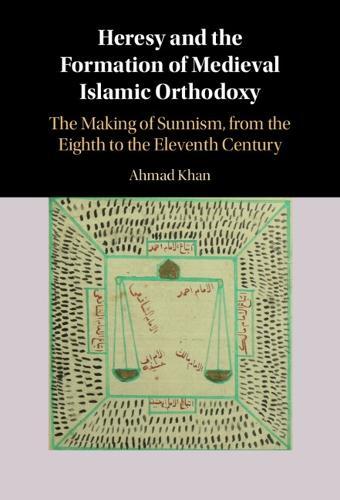
Full Product Details
Author: Ahmad Khan (American University in Cairo)
Publisher: Cambridge University Press
Imprint: Cambridge University Press
Dimensions:
Width: 15.80cm
, Height: 2.90cm
, Length: 23.50cm
Weight: 0.790kg
ISBN: 9781009098373
ISBN 10: 1009098373
Pages: 450
Publication Date: 13 April 2023
Audience:
Professional and scholarly
,
Professional & Vocational
Format: Hardback
Publisher's Status: Active
Availability: Manufactured on demand

We will order this item for you from a manufactured on demand supplier.
Reviews
'In important parts of the Middle East and South Asia's vast Sunni Muslim population, Islam and the school of practice initiated by Abū Ḥanīfa have long been nearly synonymous. However, for the medieval clerics who first spoke of 'Sunni Islam', Abū Ḥanīfa was a heretic. This rich and careful study details how Sunni Islam expanded to admit Abū Ḥanīfa and the broad diversity of thought and practice found in the Muslim world today.' Jonathan A.C. Brown, Georgetown University 'With mastery of a wide range of sources, clarity of expression and methodological insight, Ahmad Khan guides us through the intricate ways in which accusations of heresy were constructed during the early Islamic period, the defensive reactions they provoked and how such processes contributed to the emergence of classical Sunnism.' Maribel Fierro, Spanish National Research Council 'This is a highly original and important study which challenges many assumptions about how ideas around heresy and orthodoxy were articulated by early Sunnis. The book is deeply researched, and its nuanced arguments are supported by an impressively wide range of sources. The conclusions have significant ramifications for the field.' Harry Munt, University of York 'The great merit of this monograph is to show that its integration into the compromise that founded Sunni orthodoxy was not inevitable but, on the contrary, was the result of intense struggles between legal schools.' Jason Dean , Revue d'histoire et de philosophie religieuses
'In important parts of the Middle East and South Asia's vast Sunni Muslim population, Islam and the school of practice initiated by Abu Hanifa have long been nearly synonymous. However, for the medieval clerics who first spoke of 'Sunni Islam', Abu Hanifa was a heretic. This rich and careful study details how Sunni Islam expanded to admit Abu Hanifa and the broad diversity of thought and practice found in the Muslim world today.' Jonathan A.C. Brown, Georgetown University 'With mastery of a wide range of sources, clarity of expression and methodological insight, Ahmad Khan guides us through the intricate ways in which accusations of heresy were constructed during the early Islamic period, the defensive reactions they provoked and how such processes contributed to the emergence of classical Sunnism.' Maribel Fierro, Spanish National Research Council 'This is a highly original and important study which challenges many assumptions about how ideas around heresy and orthodoxy were articulated by early Sunnis. The book is deeply researched, and its nuanced arguments are supported by an impressively wide range of sources. The conclusions have significant ramifications for the field.' Harry Munt, University of York
Author Information
Ahmad Khan is Assistant Professor of Islamic Studies at the American University in Cairo. He previously held positions at Oxford and Hamburg universities and was the Arcapita Visiting Professor at Columbia University in New York. His publications include Reclaiming Islamic Tradition: Modern Interpretations of the Classical Heritage (2016). His research focuses on Islamic thought and history in the pre-modern and modern periods.