Full Product Details
Author: John J Maresca ,
Andreas Umland ,
Hafiz Pashayev
Publisher: ibidem-Verlag, Jessica Haunschild u Christian Schon
Imprint: ibidem-Verlag, Jessica Haunschild u Christian Schon
Weight: 0.302kg
ISBN: 9783838208527
ISBN 10: 3838208528
Pages: 210
Publication Date: 01 March 2016
Audience:
Professional and scholarly
,
Professional & Vocational
Format: Paperback
Publisher's Status: Active
Availability: In Print

This item will be ordered in for you from one of our suppliers. Upon receipt, we will promptly dispatch it out to you. For in store availability, please contact us.
Reviews
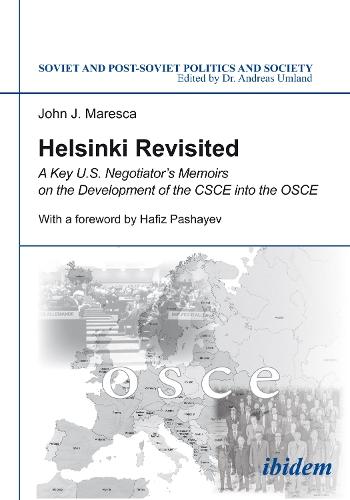
""This book is written as a memoir, and contains new information and many fascinating insights about the development of the CSCE and its evolution into the OSCE. But it also contains some very astute analyses of current events, based on the history of the issues, which surround them. It is, in fact, a commentary on the current situations in these regions, based on the way these situations developed. A must-read for anyone who is interested in the recent history and the current and future state of affairs in Europe, including the Caucasus, Central Asia, and what Russians call their ´Near Abroad.´"" —Hafiz Pashayev, Rector ADA University, Baku, Azerbaijan ""Maresca skilfully captures the reader’s attention when he shares his deep understanding and insights into the dynamics of US foreign policy-making at the interface of domestic and international constraints—of which the CSCE negotiation process is an example. The book not only provides a very personal narrative full of lively anecdotes, but also gives an account of diplomacy and the skill of diplomatic negotiation.""—Stefan Gänzle, Europe-Asia Studies, 1/2017 „Das Buch bietet eine lebendige Darstellung der Entwicklungen im Kontext von KSZE und OSZE, zu denen auch Maresca einen wichtigen Beitrag geleistet hat. […] Diese sehr persönlich gehaltenen, aber zugleich zuverlässigen Erinnerungen sind so interessant, dass man sie nach Beginn der Lektüre nicht mehr aus der Hand legt.“—Jahrbücher für Geschichte Osteuropas. jgo.e-reviews 7 (2017), 4 “Neben den spannenden Anekdoten sind die Memoiren besonders gehaltvoll, wenn sie Rückschlüsse auf die Feinheiten der diplomatischen Arbeit, die schwierige geopolitische Situation in Europa und denvoraussetzungsvollen Wandel der Sowjetunion zu einem demokratischen undkapitalistischen Staat erlauben. Dann wird ersichtlich, wie wichtig die KSZE für einVerständnis des heutigen Europa ist und welche Rolle die OSZE auch in aktuellenKonflikten wie dem in der Ukraine einnehmen kann.”—Anke Rösener, Portal für Politikwissenschaft
"""This book is written as a memoir, and contains new information and many fascinating insights about the development of the CSCE and its evolution into the OSCE. But it also contains some very astute analyses of current events, based on the history of the issues, which surround them. It is, in fact, a commentary on the current situations in these regions, based on the way these situations developed. A must-read for anyone who is interested in the recent history and the current and future state of affairs in Europe, including the Caucasus, Central Asia, and what Russians call their ´Near Abroad.´"" —Hafiz Pashayev, Rector ADA University, Baku, Azerbaijan ""Maresca skilfully captures the reader’s attention when he shares his deep understanding and insights into the dynamics of US foreign policy-making at the interface of domestic and international constraints—of which the CSCE negotiation process is an example. The book not only provides a very personal narrative full of lively anecdotes, but also gives an account of diplomacy and the skill of diplomatic negotiation.""—Stefan Gänzle, Europe-Asia Studies, 1/2017 „Das Buch bietet eine lebendige Darstellung der Entwicklungen im Kontext von KSZE und OSZE, zu denen auch Maresca einen wichtigen Beitrag geleistet hat. […] Diese sehr persönlich gehaltenen, aber zugleich zuverlässigen Erinnerungen sind so interessant, dass man sie nach Beginn der Lektüre nicht mehr aus der Hand legt.“—Jahrbücher für Geschichte Osteuropas. jgo.e-reviews 7 (2017), 4 “Neben den spannenden Anekdoten sind die Memoiren besonders gehaltvoll, wenn sie Rückschlüsse auf die Feinheiten der diplomatischen Arbeit, die schwierige geopolitische Situation in Europa und denvoraussetzungsvollen Wandel der Sowjetunion zu einem demokratischen undkapitalistischen Staat erlauben. Dann wird ersichtlich, wie wichtig die KSZE für einVerständnis des heutigen Europa ist und welche Rolle die OSZE auch in aktuellenKonflikten wie dem in der Ukraine einnehmen kann.”—Anke Rösener, Portal für Politikwissenschaft"
Author Information
Andreas Umland, M.Phil. (Oxford), Dr.Phil. (FU Berlin), Ph.D. (Cambridge), Research Fellow at the Swedish Institute of International Affairs in Stockholm, Senior Expert at the Ukrainian Institute for the Future in Kyiv, and Associate Professor at the National University of Kyiv-Mohyla Academy.