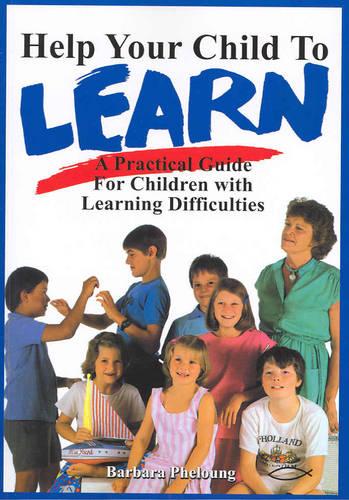
Full Product Details
Author: Barbara Pheloung
Publisher: Jeanette Liljeqvist
Imprint: Jeanette Liljeqvist
Dimensions:
Width: 17.80cm
, Height: 0.80cm
, Length: 25.40cm
Weight: 0.263kg
ISBN: 9780958160810
ISBN 10: 0958160813
Pages: 144
Publication Date: 01 July 2020
Audience:
General/trade
,
General
Format: Paperback
Publisher's Status: Active
Availability: Available To Order

We have confirmation that this item is in stock with the supplier. It will be ordered in for you and dispatched immediately.
Reviews
As is probably becoming evident, identifying the cause(s) of a child's learning difficulties (whether the child has been labeled as dyslexic, dyspraxic, ADHD, ASD etc or is just not doing as well as they should at school) can be a complex, time consuming and financially draining exercise. Barbara Pheloung's first book Help Your Child to Learn was written to help parents who have a child with a learning disability. Written in a straightforward and sympathetic style, the book begins with case histories of a number of children who have passed through The Beach House, describing their difficulties so that parents (or teachers) reading the book will be able to identify those children who suffer from similar difficulties to their own child - or any pupils whose learning, development or behaviour is a cause of concern. A few short questions at the end of each profile then directs parents to chapters that focus on specific areas of development such as the Chapter 8: Eyes that focuses on vision and visual processing, Chapter 7: Communication that includes hearing and auditory processing and speech issues, Chapter 6: Movement (on body awareness and coordination among other relevant issues) while possible medical problems are covered in Chapters 4 and 5: Food and Food Intolerance and Seeing the Doctor and Osteopath/Chiropractor . (Barbara Pheloung recognises that it is vital to identify and eliminate foods and chemicals to which children are sensitive before significant progress can be made in other areas, acknowledging that sensitivities can cause angry outbursts, addiction and inability to concentrate and learn. ) Chapter 9: Organisational Skills focuses identifying problems related to an impaired ability to recognise how much time is passing, problems with learning information that is organised sequentially (such as the days of the week) and difficulties with budgeting time that is crucial to accomplish more complex projects as children progress through the school system. Each of these chapters has a checklist at the end that parents (or teachers) may use to assess whether their child (or pupil) shows any of the symptoms associated with any of the main areas of development listed above. If more than a few indicators are present in a child once the checklist at the end of a chapter has been completed, it is likely that s/he would benefit from an assessment by a professional who has skills in the relevant area. An overview chapter for parents Where and How to Find Help gives a basic overview of the skills of professionals that may be unfamiliar to many parents (such as orthoptists and sound therapists and websites for further information about some specialised forms of therapy.) It also has useful suggestions for how parents can help children develop an understanding of time and games that help with overcoming difficulties with sequencing. Chapter 12 Things to Do at Home also has excellent ideas for games that can be played at home that help children overcome developmental difficulties and begin to fulfill their potential. Much of the information in this book is focused on school aged children. However, there is a chapter specifically for parents and teachers of pre-school aged children that includes a checklist on development of children in this age group so that parents or teachers who are concerned that something may not be quite right about the development of their preschool aged child can identify any areas of concern and get help early. It is a checklist that will prove affirming for parents who have a gut feeling that there is something different about their child that needs addressing who have previously had their concerns dismissed by others on the grounds that they are over-concerned - or some other synonym for neurotic. Katherine Smith, editor of The NZ Journal of Natural Medicine 3 Dec, 2011
"As is probably becoming evident, identifying the cause(s) of a child's learning difficulties (whether the child has been labeled as dyslexic, dyspraxic, ADHD, ASD etc or is just not doing as well as they should at school) can be a complex, time consuming and financially draining exercise. Barbara Pheloung's first book Help Your Child to Learn was written to help parents who have a child with a learning disability. Written in a straightforward and sympathetic style, the book begins with case histories of a number of children who have passed through The Beach House, describing their difficulties so that parents (or teachers) reading the book will be able to identify those children who suffer from similar difficulties to their own child - or any pupils whose learning, development or behaviour is a cause of concern. A few short questions at the end of each profile then directs parents to chapters that focus on specific areas of development such as the Chapter 8: ""Eyes"" that focuses on vision and visual processing, Chapter 7: ""Communication"" that includes hearing and auditory processing and speech issues, Chapter 6: ""Movement"" (on body awareness and coordination among other relevant issues) while possible medical problems are covered in Chapters 4 and 5: ""Food and Food Intolerance"" and ""Seeing the Doctor and Osteopath/Chiropractor"". (Barbara Pheloung recognises that it is vital to identify and eliminate foods and chemicals to which children are sensitive before significant progress can be made in other areas, acknowledging that sensitivities can cause ""angry outbursts, addiction and inability to concentrate and learn."") Chapter 9: ""Organisational Skills"" focuses identifying problems related to an impaired ability to recognise how much time is passing, problems with learning information that is organised sequentially (such as the days of the week) and difficulties with budgeting time that is crucial to accomplish more complex projects as children progress through the school system. Each of these chapters has a checklist at the end that parents (or teachers) may use to assess whether their child (or pupil) shows any of the symptoms associated with any of the main areas of development listed above. If more than a few indicators are present in a child once the checklist at the end of a chapter has been completed, it is likely that s/he would benefit from an assessment by a professional who has skills in the relevant area. An overview chapter for parents ""Where and How to Find Help"" gives a basic overview of the skills of professionals that may be unfamiliar to many parents (such as orthoptists and sound therapists and websites for further information about some specialised forms of therapy.) It also has useful suggestions for how parents can help children develop an understanding of time and games that help with overcoming difficulties with sequencing. Chapter 12 ""Things to Do at Home"" also has excellent ideas for games that can be played at home that help children overcome developmental difficulties and begin to fulfill their potential. Much of the information in this book is focused on school aged children. However, there is a chapter specifically for parents and teachers of pre-school aged children that includes a checklist on development of children in this age group so that parents or teachers who are concerned that something may not be quite right about the development of their preschool aged child can identify any areas of concern and get help early. It is a checklist that will prove affirming for parents who have a gut feeling that there is something different about their child that needs addressing who have previously had their concerns dismissed by others on the grounds that they are ""over-concerned"" - or some other synonym for neurotic. Katherine Smith, editor of The NZ Journal of Natural Medicine 3 Dec, 2011"
As is probably becoming evident, identifying the cause(s) of a child's learning difficulties (whether the child has been labeled as dyslexic, dyspraxic, ADHD, ASD etc or is just not doing as well as they should at school) can be a complex, time consuming and financially draining exercise. Barbara Pheloung's first book Help Your Child to Learn was written to help parents who have a child with a learning disability. Written in a straightforward and sympathetic style, the book begins with case histories of a number of children who have passed through The Beach House, describing their difficulties so that parents (or teachers) reading the book will be able to identify those children who suffer from similar difficulties to their own child - or any pupils whose learning, development or behaviour is a cause of concern. A few short questions at the end of each profile then directs parents to chapters that focus on specific areas of development such as the Chapter 8: Eyes that focuses on vision and visual processing, Chapter 7: Communication that includes hearing and auditory processing and speech issues, Chapter 6: Movement (on body awareness and coordination among other relevant issues) while possible medical problems are covered in Chapters 4 and 5: Food and Food Intolerance and Seeing the Doctor and Osteopath/Chiropractor . (Barbara Pheloung recognises that it is vital to identify and eliminate foods and chemicals to which children are sensitive before significant progress can be made in other areas, acknowledging that sensitivities can cause angry outbursts, addiction and inability to concentrate and learn. ) Chapter 9: Organisational Skills focuses identifying problems related to an impaired ability to recognise how much time is passing, problems with learning information that is organised sequentially (such as the days of the week) and difficulties with budgeting time that is crucial to accomplish more complex projects as children progress through the school system. Each of these chapters has a checklist at the end that parents (or teachers) may use to assess whether their child (or pupil) shows any of the symptoms associated with any of the main areas of development listed above. If more than a few indicators are present in a child once the checklist at the end of a chapter has been completed, it is likely that s/he would benefit from an assessment by a professional who has skills in the relevant area. An overview chapter for parents Where and How to Find Help gives a basic overview of the skills of professionals that may be unfamiliar to many parents (such as orthoptists and sound therapists and websites for further information about some specialised forms of therapy.) It also has useful suggestions for how parents can help children develop an understanding of time and games that help with overcoming difficulties with sequencing. Chapter 12 Things to Do at Home also has excellent ideas for games that can be played at home that help children overcome developmental difficulties and begin to fulfill their potential. Much of the information in this book is focused on school aged children. However, there is a chapter specifically for parents and teachers of pre-school aged children that includes a checklist on development of children in this age group so that parents or teachers who are concerned that something may not be quite right about the development of their preschool aged child can identify any areas of concern and get help early. It is a checklist that will prove affirming for parents who have a gut feeling that there is something different about their child that needs addressing who have previously had their concerns dismissed by others on the grounds that they are over-concerned - or some other synonym for neurotic. Katherine Smith, editor of The NZ Journal of Natural Medicine - 3 Dec, 2011
Author Information
Barbara Pheloung, B.A., Dip.Ed.(Spec.Ed.), was a resource teacher, born in Canada, who spent over 35 years specialising in working in the field of special education in Australia. In 1987 she set up a specialised treatment centre in Manly, Australia, known as 'The Beach House'. This was a private centre for those with Learning Difficulties and Hyperactivity in which Teachers, Physiotherapists, Occupational Therapists and a Physical Education Teacher worked together sharing their expertise. Barbara's team proved that by working together, starting with the professional who met the most basic needs of a particular child, results could be quick and permanent. The success of The Beach House also demonstrated that similar centres could be set up in any community and with a minimum of financial support. Barbara went on to become a pioneer in the field of learning difficulties; authoring four books, producing two educational DVDs and working with thousands of students, parents and teachers across the world. She and her associates refined and perfected a sequential movement program that can be done with an individual, a small group or with a whole class and requires little in terms of training or equipment. The movement sequences seem to act as a 'neurological kick-start', helping children to reach learning readiness and removing the obstacles that had blocked them in the past. In 2004 Barbara was nominated for Australian of the Year.