Overview
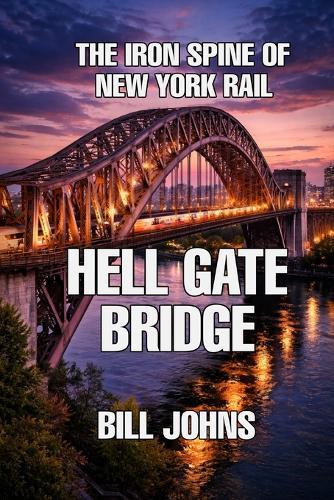
Hell Gate Bridge history, New York rail infrastructure, and the Northeast Corridor converge in this authoritative cultural history of one of America's greatest engineering achievements. Discover the steel arch that transformed East Coast rail travel and still carries the pulse of New York today. Hell Gate Bridge: The Iron Spine of New York Rail is a deeply researched narrative of the monumental rail bridge spanning the East River, tracing its origins, construction, decline, and restoration within the evolving life of New York City. Rising above the turbulent waters of Hell Gate, the bridge was conceived as a permanent solution to a fragmented rail system, replacing ferries and inefficiencies with a single, uninterrupted connection between New England and the rest of the nation. Its immense steel arch-at the time the longest of its kind-was not simply an engineering triumph but a declaration of industrial ambition, civic identity, and the belief that infrastructure could reshape geography itself. Set within the broader story of the New York Connecting Railroad and the expansion of the Pennsylvania Railroad system, this book situates the bridge within the rise of early twentieth-century rail dominance, when steel, capital, and coordination converged to produce structures of unprecedented scale. It follows the vision of engineer Gustav Lindenthal, whose insistence on permanence and structural clarity shaped a design that would influence later icons such as the Sydney Harbour Bridge. Through detailed reconstruction of construction methods, material challenges, and the hazardous conditions of the East River, the narrative brings the bridge into being as both object and process. Yet the story does not end with completion. As highways expanded and aviation rose, the bridge entered a long period of neglect, its steel weathering under deferred maintenance even as trains continued to cross. The book traces this quiet decline alongside the shifting priorities of American infrastructure, revealing how even the most monumental structures can fade from institutional focus without losing their functional necessity. The eventual restoration-led within the modern framework of Amtrak and federal oversight-reasserted the bridge's place within the Northeast Corridor, renewing its surfaces and reaffirming its role as a critical link in one of the busiest rail systems in the world. Beyond engineering, Hell Gate Bridge emerges as a cultural presence-seen more often than entered, embedded in the skyline, carried through film, photography, and memory. It is a structure that defines space without demanding attention, its arch cutting across the horizon as trains pass overhead, their movement heard as much as seen. The bridge becomes part of the lived environment of New York, its presence constant yet peripheral, shaping perception without occupying the center of it. Blending engineering history, urban studies, and cultural analysis, this book offers a comprehensive account of Hell Gate Bridge as both infrastructure and symbol. It is a story of ambition and endurance, of neglect and renewal, of a structure that continues to carry not only trains but the accumulated weight of time, labor, and decision. For readers drawn to bridge engineering, New York City history, railroad development, and the hidden systems that sustain modern life, this work provides a richly detailed and immersive account. Stand at the edge of the East River, look up at the arch, and consider what it means for a structure to remain-not as monument alone, but as a living part of the world it continues to carry forward.
Full Product Details
Author: Bill Johns
Publisher: Independently Published
Imprint: Independently Published
Dimensions:
Width: 15.20cm
, Height: 1.50cm
, Length: 22.90cm
Weight: 0.376kg
ISBN: 9798257113079
Pages: 280
Publication Date: 12 April 2026
Audience:
General/trade
,
General
Format: Paperback
Publisher's Status: Active
Availability: Available To Order

We have confirmation that this item is in stock with the supplier. It will be ordered in for you and dispatched immediately.