Overview
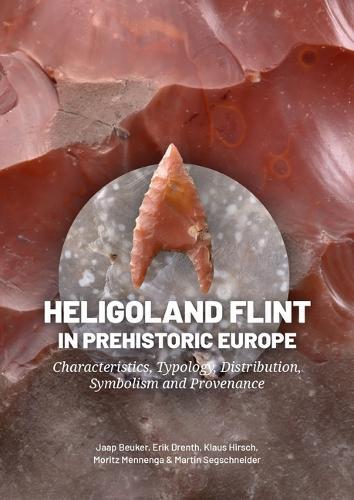
During a considerable part of prehistory stone tools were indispensable. Flint in particular had properties that made it very suitable for making razor-sharp implements and could often, but not always, be collected locally. Hunters, gatherers and fishers mostly used small tools but with the transition to an agricultural way of living this situation changed, as larger implements became necessary, to cut down trees and work wood for instance. The raw material suitable for this was often not available locally, so was imported from areas where good raw material was available. It was sometimes extracted on an almost industrial scale and even by underground mining. There are many known places in Europe where this extraction took place thousands of years ago. In the first half of the 1980s it became clear that the island of Heligoland also played a role as a large-scale supplier of flint. Prehistoric tools made from red Heligoland flint and also from tabular Heligoland flint have been found in Denmark, Germany and the Netherlands, sometimes at a distance of more than 300 km from Heligoland. In this book we will describe the research undertaken on various aspects of the use of this flint. The characteristics of the different types, as distinct from flint that does not come from Heligoland, will be discussed. Furthermore, the tools that were made from it, their dating, their possible social and symbolic meanings, and the transport that took place partly by sea, more than 5000 years ago, will be described. This book is intended for archaeologists, archaeological curators but also for anybody else who has an interest in the story of a fascinating prehistoric flint source.
Full Product Details
Author: Jaap Beuker ,
Erik Drenth ,
Klaus Hirsch ,
Moritz Mennenga
Publisher: Sidestone Press
Imprint: Sidestone Press
ISBN: 9789464264135
ISBN 10: 9464264136
Pages: 240
Publication Date: 04 December 2025
Audience:
Professional and scholarly
,
College/higher education
,
Professional & Vocational
,
Postgraduate, Research & Scholarly
Format: Hardback
Publisher's Status: Active
Availability: In Print

This item will be ordered in for you from one of our suppliers. Upon receipt, we will promptly dispatch it out to you. For in store availability, please contact us.
Author Information
Jaap Beuker (1952) was curator of archaeology and head curator at the Drents Museum in Assen (Netherlands). Since his retirement in 2017 he has carried out research on various archaeological subjects such as flint technology and prehistoric use of exotic materials. Since the mid-1980s he has worked on the prehistoric import of flint from Heligoland. He has written several articles and books on stone artefacts and especially about the use of red and tabular Heligoland flint. Erik Drenth works as a specialist in prehistoric inorganic material culture (flint, hand-made pottery, metal and stone) at the Dutch archaeological research company BAAC. He has written numerous articles, including contributions to several handbooks on Dutch archaeology, such as ‘Nederland in de prehistorie’. Klaus Hirsch (1964) has worked since 2006 as a field archaeologist in the archaeological department of Museum Sønderjylland in Haderslev, Southern Jutland (Denmark). Prior to his work in Denmark, he was employed as a field archaeologist in the State of Mecklenburg-Vorpommern in northeastern Germany. He is a trained prehistoric archaeologist with a special interest in the Late Palaeolithic as well as experimental archaeology, flint sourcing and the prehistoric distribution and exchange of flint in Northern Europe. He has written several articles on various topics, such as experimental archaeology. Moritz Mennenga (1985) is an archaeologist with a focus on the Neolithic of Northern and Northwestern Europe and a research associate at the Lower Saxony Institute for Historical Coastal Research (NIhK) in Wilhelmshaven. He conducts research on the Neolithic settlement and burial landscape in particular, with a special focus on the analysis of Stone Age sites, landscape reconstruction and human-land relationships. In addition to his archaeological focus, he works in the field of digital archaeology. Dr. Martin Segschneider (1966) specialises in coastal and maritime archaeology and works as a senior researcher at the Lower Saxony Institute for Historical Coastal Research (NIhK) in Wilhelmshaven/Germany. He has published various articles and books about the archaeology of the North Frisian Islands and Heligoland, including the topics of the historic role of Heligoland red flint and prehistoric seafaring.