Overview
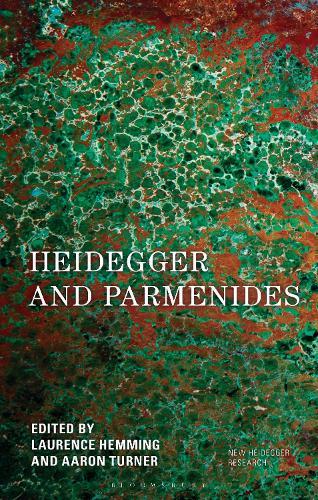
This collection of original essays brings together leading scholars from a range of disciplines to explore the influence and importance of Parmenides to Heidegger’s quest to bring about the end of philosophy according to its own beginning. While the significance of Plato and Aristotle to Martin Heidegger’s philosophical development in the 1920s and 1930s is well documented, the role of Parmenides remains relatively obscure. From Heidegger’s thinking prior to Being and Time and after it, toward his thought of The Event, Parmenides is a constant presence within Heidegger’s developing concern to overcome metaphysics, and so restore for thinking the original question of being. This book makes the case that, without Parmenides, philosophy could not be philosophy, and Heidegger could not be Heidegger.
Full Product Details
Author: Laurence Hemming (Lancaster University, UK) , Aaron Turner (University of London, UK)
Publisher: Bloomsbury Publishing Plc
Imprint: Rowman & Littlefield
Dimensions:
Width: 15.20cm
, Height: 2.20cm
, Length: 23.20cm
Weight: 0.600kg
ISBN: 9781538186015
ISBN 10: 1538186012
Pages: 310
Publication Date: 30 April 2026
Audience:
Professional and scholarly
,
College/higher education
,
Professional & Vocational
,
Postgraduate, Research & Scholarly
Format: Hardback
Publisher's Status: Active
Availability: Manufactured on demand 
We will order this item for you from a manufactured on demand supplier.
Table of Contents
Introduction, Laurence Hemming (University of London, UK) and Aaron Turner (University of London, UK) Part I. Early Engagements with Parmenides 1. Heidegger's Parmenides, Laurence Hemming (University of London, UK) 2. Heidegger’s Initial Interpretation of Parmenides: An ‘Excursus’ in the 1922 Lectures on Aristotelian Texts, Daniel O. Dahlstrom (Boston University, USA) 3. No Evil Fate: Heidegger's Parmenides and the Phenomenology of Excess, Alberto Moreiras (Texas A&M University, USA) 4. Seyn as Difference and Seyn as Anfang: Parmenides’ Hén and Heidegger’s Seyn, Yuqi Zhang (Lancaster University, UK) Part II. Parmenides Toward the Beiträge 5. Parmenides in Freiburg: Varieties of the Question of Being, Panagiotis Thanassas (University of Athens, Greece) 6. Der Abbruch und Anfang des Philosophierens: Heidegger’s ‘Turn’ to Ground, Aaron Turner (University of London, UK) 7. The Echo of Parmenides and the Grounding Question of Metaphysics, Lasha Kharazi (Georgian-American University, Tblisi, Georgia) 8. Thinking and Being: Heidegger’s 1935 Reading of Parmenides and Sophocles, Charles Bambach (University of Texas at Dallas, USA) 9. Tò Gàr Autò: Heidegger on Identity in Parmenides B3, Jussi Backman (University of Helsinki, Finland) 10. Heidegger’s Reading of Parmenides in the context of Contributions to Philosophy (Of the Event), Daniela Vallega-Neu (University of Oregon, USA) Part II. Parmenides Beyond the Beiträge 11. Heidegger’s Parmenides: On Truth, Being and Thinking in the Didactic Poem, W. Julian Korab-Karmowicz (Zayed University, Dubai) 12. Etymology and Metaphor: Aletheia in Heidegger’s 1942/43 Parmenides Lectures, Daniel O. Dahlstrom (Boston University, USA) 13. For This Impossible, Andrew Haas (Higher School of Economics, Moscow, Russia) Appendix. Principal Discussions of Parmenides in the Heidegger Gesamtausgabe in Chronological Order Bibliography Index About the Contributors
Reviews
The provocations of Parmenides’s texts for Heidegger’s own project have long been alluded to, but seldom carefully considered. Likewise, Heidegger’s quite original interpretations of Parmenides have typically been ignored. This welcome collection of essays by leading scholars—animated both by real philological rigor and genuine philosophical imagination—is rich with insights to be found in the bringing together these two figures. -- Dennis Schmidt, Western Sydney University, Australia Hemming and Turner’s volume is not the first to address Heidegger’s reading of Parmenides, but it is certainly the most comprehensive and philosophically ambitious volume that has yet appeared. It synthesizes much of the work that has gone before at the same time as it advances important reinterpretations of both Parmenides and Heidegger, as well as the relation between them. -- Jeff Malpas, Emeritus Distinguished Professor, University of Tasmania, Australia, and author of <i>Rethinking Dwelling: Heidegger, Place, Architecture</i> As this volume makes eminently clear, Heidegger maintained a serious and philologically rigorous engagement with Parmenides throughout his career. The essays in Heidegger and Parmenides open up fresh vistas on each of these thinkers, and on the crucial relationship between them. -- David Schur, Associate Professor of Classics, Brooklyn College and The Graduate Center, CUNY, USA This excellent collection gathers essays by leading scholars to explore the significance of Parmenides for Heidegger. Philosophically and philologically attentive, it shows the range of Heidegger’s engagement with Parmenides, beginning in the 1920s and extending to Heidegger’s later thinking of Beyng. The collection will remain an important and comprehensive resource for anyone interested in Heidegger and the Greeks. -- Julia Ireland, Professor and Chair of German Studies and Philosophy, Whitman College, USA Laurence Hemming and Aaron Turner have gathered an international group of distinguished scholars to reflect on the importance of Parmenides for Heidegger’s thinking. Hemming and Turner have been especially diligent in providing a thorough bibliography on Heidegger’s involvement with Parmenides, which stretches from the 1920s to the end of Heidegger’s life. The volume will be an important source for the growing number of scholars who recognise the importance of early Greek thinking in general, and Parmenides in particular, for Heidegger’s 'other beginning.' -- David Krell, Professor Emeritus of Philosophy, DePaul University, USA
The provocations of Parmenides’s texts for Heidegger’s own project have long been alluded to, but seldom carefully considered. Likewise, Heidegger’s quite original interpretations of Parmenides have typically been ignored. This welcome collection of essays by leading scholars—animated both by real philological rigor and genuine philosophical imagination—is rich with insights to be found in the bringing together these two figures. -- Dennis Schmidt, Western Sydney University, Australia Hemming and Turner’s volume is not the first to address Heidegger’s reading of Parmenides, but it is certainly the most comprehensive and philosophically ambitious volume that has yet appeared. It synthesizes much of the work that has gone before at the same time as it advances important reinterpretations of both Parmenides and Heidegger, as well as the relation between them. -- Jeff Malpas, Emeritus Distinguished Professor, University of Tasmania, Australia, and author of <i>Rethinking Dwelling: Heidegger, Place, Architecture</i>
The provocations of Parmenides’s texts for Heidegger’s own project have long been alluded to, but seldom carefully considered. Likewise, Heidegger’s quite original interpretations of Parmenides have typically been ignored. This welcome collection of essays by leading scholars—animated both by real philological rigor and genuine philosophical imagination—is rich with insights to be found in the bringing together these two figures. -- Dennis Schmidt, Western Sydney University, Australia
Author Information
Laurence Hemming is the director of the Knapp Foundation and an honorary professor in Lancaster University’s Philosophy, Politics and Religion Department. He has published a number of books and translations, including Heidegger’s Atheism, Postmodernity’s Transcending, and Heidegger and Marx: A Productive Dialogue over the Language of Humanism. He edited and co-translated Ernst Jünger’s 1932 text The Worker: Dominion and Form. Aaron Turner is the Assistant Director of the Knapp Foundation and a Research Associate in the Department of Classics at Royal Holloway, University of London. He is the editor of several edited volumes, including Reconciling Ancient and Modern Philosophies of History and Heidegger and Classical Thought, and The Essence of History.
Tab Content 6
Author Website:
Countries Available
All regions
|