Overview
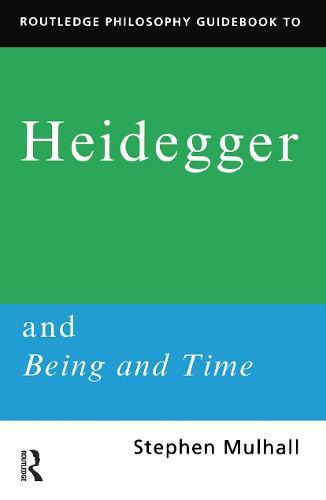
This Routledge Philosophy GuideBook introduces Martin Heidegger and his major work, Being and Time . One of the most important works of philosophy to have appeared this century, Being and Time is a challenging text. It holds a key place in what has become known as continental philosophy. Indeed, important areas such as phenomenology, hermenuetics and deconstruction are all indebted to Heidegger. Stephen Mulhall guides the reader through the complexities of Heidegger's thought in Being and Time . The work is placed in context both in terms of Heidegger's own philosophical project and in terms of the history of philosophy. The author explains the many technical terms found within the book and uncovers the structure of Being and Time to help the first-time reader. Each section of the book is analysed in detail, addressing the criticisms and problems that arise from them and explaining how the sections contribute to the work as a whole. Heidegger and Being and Time is essential reading for students coming to Heidegger for the first time and an ideal starting point for anyone interested in continental tradition in philosophy. It has been designed to show the revelance of Heidegger's thought to all philosophers and not just those concerned with the phenomenological tradition from which Heidegger wrote.
Full Product Details
Author: Stephen Mulhall
Publisher: Taylor & Francis Ltd
Imprint: Routledge
Dimensions:
Width: 12.90cm
, Height: 1.90cm
, Length: 19.80cm
Weight: 0.249kg
ISBN: 9780415100939
ISBN 10: 0415100933
Pages: 214
Publication Date: 02 May 1996
Audience:
College/higher education
,
Undergraduate
,
Postgraduate, Research & Scholarly
Format: Paperback
Publisher's Status: Active
Availability: Temporarily unavailable 
The supplier advises that this item is temporarily unavailable. It will be ordered for you and placed on backorder. Once it does come back in stock, we will ship it out to you.
Table of Contents
Introduction: Heidegger’s project (Being and Time, §§1–8); Chapter 1 The human world: scepticism, cognition and agency (Being and Time, §§9–24); Chapter 2 The human world: society, selfhood and self-interpretation (Being and Time, §§25–32); Chapter 3 Language, truth and reality (Being and Time, §§33–34, 43–44); Chapter 4 Conclusion to Division One: the uncanniness of everyday life (Being and Time, §§34–42); Chapter 5 Theology secularized: mortality, guilt and conscience (Being and Time, §§45–60); Chapter 6 Heidegger's (re)visionary moment: time as the human horizon (Being and Time, §§61–71); Chapter 7 Fate and destiny: human natality and a brief history of time (Being and Time, §§72–82); Chapter 8 Conclusion to Division Two: Philosophical endings – the horizon of Being and Time (Being and Time, §83);
Reviews
The book is a very clear and concise introduction to Being and Time. It will prove most helpful to students struggling to understand Heidegger's difficult work. <br>-Simon Evnine, UCLA <br>
The book is a very clear and concise introduction to Being and Time. It will prove most helpful to students struggling to understand Heidegger's difficult work. -Simon Evnine, UCLA
Author Information
Stephen Mulhall
Tab Content 6
Author Website:
Countries Available
All regions
|