Overview
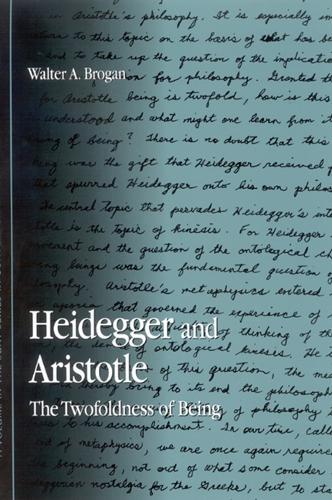
Interprets Heidegger's phenomenological reading of Aristotle's philosophy.
Full Product Details
Author: Walter A. Brogan
Publisher: State University of New York Press
Imprint: State University of New York Press
Dimensions:
Width: 15.20cm
, Height: 2.50cm
, Length: 22.90cm
Weight: 0.508kg
ISBN: 9780791464915
ISBN 10: 0791464911
Pages: 226
Publication Date: 25 August 2005
Audience:
Professional and scholarly
,
Professional & Vocational
Format: Hardback
Publisher's Status: Active
Availability: Manufactured on demand

We will order this item for you from a manufactured on demand supplier.
Reviews
The substantive and rigorous readings offered by Brogan-conveyed in exemplary philosophical prose, lucid and precise-clarify many murky aspects and unveil some unexpected and truly radical positions in the thinking of the early Heidegger's Aristotle. Indeed, Brogan's interpretation is careful, rich, and provocative. - Continental Philosophy Review This study provides a masterful exegesis of central texts in which Heidegger presents his reading of Aristotle's thought ... Anyone seeking a thoughtful elaboration of Heidegger's positive reading of Aristotle's philosophy need look no further. - Ancient Philosophy ...Brogan provides an especially clear exposition to parts of Heidegger's Aristotle interpretation. Any serious student of Heidegger should give this book careful scrutiny for the way in which it gives fresh meaning to core issues in Heidegger's understanding of phusis and techne, the ontological difference, Heidegger's understanding of the Greeks generally, and especially how Aristotle's ontology wrestles with the problems inherited from his predecessors. - Review of Metaphysics This is, by far, the most extensive study of the 'dialogue' between Heidegger and Aristotle, and one that will be consulted as the authoritative study on the topic. It takes giant steps to challenge the usual reading of Aristotle, and does so in a persuasive way, which partisans of the more traditional view will ignore only at their peril. - Drew A. Hyland, author of Questioning Platonism: Continental Interpretations of Plato
""The substantive and rigorous readings offered by Brogan-conveyed in exemplary philosophical prose, lucid and precise-clarify many murky aspects and unveil some unexpected and truly radical positions in the thinking of the early Heidegger's Aristotle. Indeed, Brogan's interpretation is careful, rich, and provocative."" - Continental Philosophy Review ""This study provides a masterful exegesis of central texts in which Heidegger presents his reading of Aristotle's thought ... Anyone seeking a thoughtful elaboration of Heidegger's positive reading of Aristotle's philosophy need look no further."" - Ancient Philosophy ""...Brogan provides an especially clear exposition to parts of Heidegger's Aristotle interpretation. Any serious student of Heidegger should give this book careful scrutiny for the way in which it gives fresh meaning to core issues in Heidegger's understanding of phusis and techne, the ontological difference, Heidegger's understanding of the Greeks generally, and especially how Aristotle's ontology wrestles with the problems inherited from his predecessors."" - Review of Metaphysics ""This is, by far, the most extensive study of the 'dialogue' between Heidegger and Aristotle, and one that will be consulted as the authoritative study on the topic. It takes giant steps to challenge the usual reading of Aristotle, and does so in a persuasive way, which partisans of the more traditional view will ignore only at their peril."" - Drew A. Hyland, author of Questioning Platonism: Continental Interpretations of Plato
This is, by far, the most extensive study of the 'dialogue' between Heidegger and Aristotle, and one that will be consulted as the authoritative study on the topic. It takes giant steps to challenge the usual reading of Aristotle, and does so in a persuasive way, which partisans of the more traditional view will ignore only at their peril.
Author Information
Walter A. Brogan is Professor of Philosophy at Villanova University. He is the coeditor (with James Risser) of American Continental Philosophy: A Reader and the cotranslator (with Peter Warnek) of Martin Heidegger's Aristotle's Metaphysics (theta) 1-3: On the Essence and Actuality of Force.