|
|
|||
|
||||
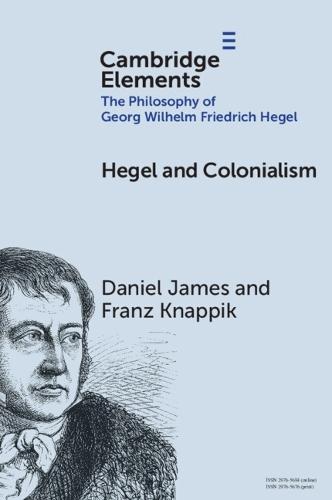
OverviewThis Element offers the first comprehensive study of Hegel's views on European colonialism. In surprisingly detailed discussions scattered throughout much of his mature oeuvre, Hegel offers assessments that legitimise colonialism in the Americas, the enslavement of Africans, and British rule in India. The Element reconstructs these discussions as being held together by a systematic account of colonialism as racial domination, underpinned by central elements of his philosophy and situated within long-overlooked contexts, including Hegel's engagement with British abolitionism and Scottish four-stages theories of social development. Challenging prevailing approaches in scholarship, James and Knappik show that Hegel's accounts of issues like freedom, personhood and the dialectic of lordship and bondage are deeply entangled with his disturbing views on colonialism, slavery, and race. Lastly, they address Hegel's ambivalent legacy, examining how British Idealists and others adopted his pro-colonial ideas, while thinkers like C. L. R. James and Angela Davis transformed them for anti-colonial purposes. This title is also available as open access on Cambridge Core. Full Product DetailsAuthor: Daniel James (Technische Universität Dresden) , Franz Knappik (University of Bergen, Department of Philosophy)Publisher: Cambridge University Press Imprint: Cambridge University Press Weight: 0.133kg ISBN: 9781009587167ISBN 10: 1009587161 Pages: 82 Publication Date: 04 December 2025 Audience: General/trade , General Format: Paperback Publisher's Status: Active Availability: Manufactured on demand We will order this item for you from a manufactured on demand supplier. Table of ContentsIntroduction; 1. Neo-republicanism; 1.1 Equal Non-Domination; 1.2 The Mixed Constitution; 1.3 The Virtue of Contestation; 2. Labor Republicanism; 2.1 Labor Republicanism in the 19th and 21st Centuries; 2.2 Hegel in Relation to the Labor Republican Tradition; 2.2.1 The Project of Expanding Political Participation; 2.2.2 The Challenge of Economic Relations; 2.2.3 Cooperation as Non-Domination; 3. Civic Republicanism; 3.1 A Higher Sphere Than Politics; 3.2 Political Participation; 3.3 The Role of the Militia; 3.4 A Non-Religious Source of Freedom; 3.5 Full Freedom as Possible Only in the State; 3.6 Freedom as a Fragile Achievement; 3.7 The Mixed Constitution; Conclusion; Acknowledgements; Bibliography.ReviewsAuthor InformationTab Content 6Author Website:Countries AvailableAll regions |
||||