Overview
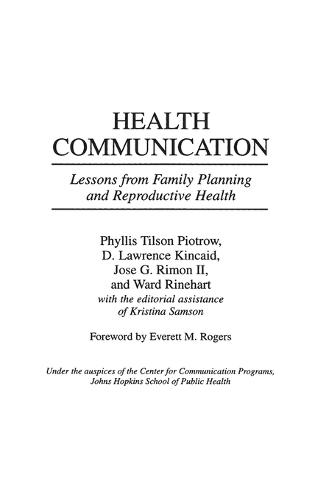
Effective communication is the key to encouraging healthy behavior. Documenting a revolution in both theory and practice, Johns Hopkins University experts show that communication leads the way to healthy reproductive health and family planning behavior. They explain why communication makes so much difference and how communication programs can be made to work. This book presents a compilation of lessons learned by the Johns Hopkins Center for Communication Programs and its partners over 15 years of developing and implementing family planning communication projects campaigns in Africa, Asia, Latin America, and the Near East. An introductory essay provides an overview of family planning and communication worldwide and outlines the role of theory-based communication programs. The main part of the book presents lessons learned in the field about the process of designing and carrying out family planning communication projects. More than 60 lessons are presented, with descriptions and analysis of projects illustrating each lesson. A final essay explores the current and future challenges confronting family planning educators and other public health communicators.
Full Product Details
Author: D Lawrence Kincaid ,
Phyllis Piotrow ,
Jose Rimon ,
Ward Rinehart
Publisher: Bloomsbury Publishing Plc
Imprint: Praeger Publishers Inc
Weight: 0.635kg
ISBN: 9780275955779
ISBN 10: 027595577
Pages: 328
Publication Date: 16 October 1997
Recommended Age: From 7 to 17 years
Audience:
College/higher education
,
Professional and scholarly
,
Undergraduate
,
Postgraduate, Research & Scholarly
Format: Hardback
Publisher's Status: Active
Availability: Manufactured on demand

We will order this item for you from a manufactured on demand supplier.
Reviews
As the first of its kind, the book is a must-read for everyone involved or interested in using the art and science of communication to motivte change in human behavior, especially with respect to family planning and reproductive health. -Studies in Family Planning This book is important in the filed of health communication, and should be read by all health communication and public health practioners. -Journal of Biosocial Science ?This book is important in the filed of health communication, and should be read by all health communication and public health practioners.?-Journal of Biosocial Science ?As the first of its kind, the book is a must-read for everyone involved or interested in using the art and science of communication to motivte change in human behavior, especially with respect to family planning and reproductive health.?-Studies in Family Planning A landmark contribution to the health communication field that documents the revolutionary changes that have occurred over the past 25 years, and sets out 'best practice' standards that will be useful to program planners in any field of public health. -Craig Lefebvre Chief Technical Officer, Prospect Associates President, Society for Social Marketing This book is essential reading not only for the population and reproductive health communities. It is also perhaps the most important single contribution to our knowledge of how to stimulate social change through international development cooperation. -Steven W. Sinding Director, Population Sciences, The Rockefeller Foundation
As the first of its kind, the book is a must-read for everyone involved or interested in using the art and science of communication to motivte change in human behavior, especially with respect to family planning and reproductive health. -Studies in Family Planning This book is important in the filed of health communication, and should be read by all health communication and public health practioners. -Journal of Biosocial Science ?As the first of its kind, the book is a must-read for everyone involved or interested in using the art and science of communication to motivte change in human behavior, especially with respect to family planning and reproductive health.?-Studies in Family Planning ?This book is important in the filed of health communication, and should be read by all health communication and public health practioners.?-Journal of Biosocial Science A landmark contribution to the health communication field that documents the revolutionary changes that have occurred over the past 25 years, and sets out 'best practice' standards that will be useful to program planners in any field of public health. -Craig Lefebvre Chief Technical Officer, Prospect Associates President, Society for Social Marketing This book is essential reading not only for the population and reproductive health communities. It is also perhaps the most important single contribution to our knowledge of how to stimulate social change through international development cooperation. -Steven W. Sinding Director, Population Sciences, The Rockefeller Foundation
A landmark contribution to the health communication field that documents the revolutionary changes that have occurred over the past 25 years, and sets out 'best practice' standards that will be useful to program planners in any field of public health. -Craig Lefebvre Chief Technical Officer, Prospect Associates President, Society for Social Marketing
Author Information
PHYLLIS TILSON PIOTROW is Director, Johns Hopkins Center for Communications Programs and Principal Investigator, Population Communications Services Project and Population Information Program. She is also Senior Associate, Department of Population Dynamics in the Johns Hopkins School of Public Health. D. LAWRENCE KINCAID is Associate Director for Research, Johns Hopkins Center for Communication Programs and Associate Scientist, Department of Health Policy and Management in the Johns Hopkins School of Public Health. JOSE G. RIMON II is Project Director, Population Communication Services, deputy Director, Johns Hopkins Center for Communication Programs, and Associate, Department of Population Dynamics in the Johns Hopkins School of Public Health. WARD RINEHART is Project Director, Population Information Program, a project of the Center for Communication Programs at the Johns Hopkins School of Public Health. All have written extensively on reproductive health and family planning issues.