Overview
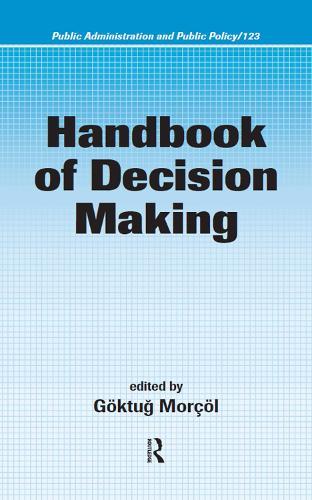
Over time, thought processes and decision making styles evolved and were shaped by theological, philosophical, political, social, and environmental factors and trends. Recently, advances in technology have borne an unprecedented influence on our social environment. Contemporary thinking inevitably reflects this influence and moves us from a linear, cause -effect rationale to broader perspectives that encompass new methodologies and an understanding of networked and complex social relations. Handbook of Decision Making is the first text of its kind to include the mainstream methods and theories of decision making, describe the influence of theological and philosophical traditions, and offer contemporary scientific theories. Decision making styles and processes vary with context and no single theory is comprehensive enough to capture the complexity involved. The editor identifies common patterns and the variations that different contexts may generate. The text covers the mainstream methods of decision making such as cost-benefit analysis, linear programming, and queuing. It also explains alternative and emerging methods such as geographic information systems, Q-methodology, narrative policy analysis, methods of creative thinking, and conflict management. Practical applications of the methods discussed are illustrated by examples of decision making practices in budgeting, public administration, drug trafficking, and information systems. Handbook of Decision Making offers an understanding of decision making processes in a broader social context, which will enable decision makers to find the best methods for a given circumstances.
Full Product Details
Author: Goktug Morcol ,
Goktug Morcol (Penn State at Harrisburg, Middletown, PA, USA) ,
Jack Rabin (Pennsylvania State University - Harrisburg, Middletown, USA) ,
Ofer Meilich (California State University at San Marcos, CA, USA)
Publisher: Taylor & Francis Inc
Imprint: CRC Press Inc
Volume: 123
Dimensions:
Width: 17.80cm
, Height: 3.80cm
, Length: 25.40cm
Weight: 1.390kg
ISBN: 9781574445480
ISBN 10: 1574445480
Pages: 664
Publication Date: 01 November 2006
Audience:
College/higher education
,
Professional and scholarly
,
Tertiary & Higher Education
,
Professional & Vocational
Format: Hardback
Publisher's Status: Active
Availability: In Print

This item will be ordered in for you from one of our suppliers. Upon receipt, we will promptly dispatch it out to you. For in store availability, please contact us.
Reviews
The handbook is the first text of its kind to include the mainstream methods and theories of decision making as well as the influence of theological and philosophical traditions, and contemporary scientific theories. Decision making styles and processes vary with context and no single theory is comprehensive enough to capture the complexity involved. The editor identifies common patterns and variations that different contexts may generate. The text covers mainstream methods of decision making such as cost benefit analysis, linear programming, and queuing. It also explains alternative and emerging methods such as GIS, Q-methodology, narrative policy analysis, methods of creative thinking, and conflict management. Practical applications of the methods discussed are illustrated by examples of decision making practices in budgeting, public administration, drug trafficking, and information systems. Presenting a variety of different perspectives on rationality in decision making, this handbook offers an understanding of those processes in a broader social context, which will enable decision makers to find the best methods for a given circumstance. -- Abstracts of Public Administration, Development, and Environment, October 2010