Overview
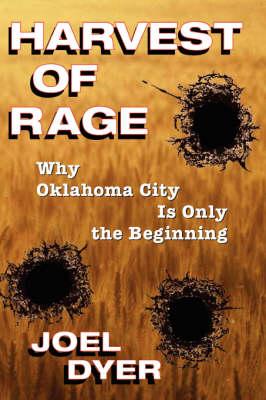
Timothy McVeigh is not alone. The 1995 bombing of the federal building in Oklahoma City killed 168 innocent people and shattered the complacency of a nation. But this event, horrible as it was, may well be only the beginning of an unprecedented wave of terror in America. This is the chilling conclusion reached by Joel Dyer in Harvest of Rage , the first book to explore the surprisingly deep rural roots of today's growing and increasingly deadly anti-government movement. As a reporter who has spent years investigating the personal and social devastation facing rural Americans, Dyer has documented the tragic, lingering aftermath of the 1980s farm crisis that we have all but forgotten. But our shattered heartland is still there, collapsing like a black hole, pulling an entire way of life down with it and distorting rural America's perceptions of economic and political reality. In its destructive wake, only the question Why? remains. That is a hard question to answer for people who have lived right, invested all they had, and believed that the American dream would come by the sweat of their brows, only to find themselves driven to the wall by impersonal and incomprehensible forces. Some in rural America cannot overcome their deep sense of personal failure. They are ending their lives at a rate that has made suicide overtake accidents as the leading cause of death on America's farms. But others have discovered an alternative. They are drawn in by the gravitational pull of radical right-wing movements offering support, friendship, and paranoid explanations for Washington's flawed rural policies and the global economy that has crushed so many. It's the Jews, they whisper, it's the United Nations, it's the Black Helicopters. And most of all, it's the federal government. Harvest of Rage explains why many otherwise decent people have joined an alternate America"" that seems to defy rational comprehension, until you begin to see the grains of truth that reside in the big lies of the radical anti-government movement. Dyer shows us the complex arguments that anti-government proponents use to justify their actions. Based on unprecedented and often intimate interviews with the leaders and the foot soldiers of these groups, his research reveals a complicated and often contradictory amalgam of politically and religiously based forces. Some, like the Republic of Texas, have already seceded"" from the United States and declared war on the U.S. government. Others have set up a secret system of courts, supposedly based in Anglo-Saxon common law, that judges and sentences perceived enemies. Meanwhile, armed militias and independent terrorist cells stand ready to carry out those sentences, including the death penalty. As the year 2000 approaches, many of these groups s
Full Product Details
Author: Joel Dyer
Publisher: Basic Books
Imprint: Basic Books
Edition: New edition
Dimensions:
Width: 15.60cm
, Height: 2.10cm
, Length: 23.10cm
Weight: 0.472kg
ISBN: 9780813332932
ISBN 10: 0813332931
Pages: 336
Publication Date: 04 September 1998
Audience:
College/higher education
,
Professional and scholarly
,
Undergraduate
,
Postgraduate, Research & Scholarly
Format: Paperback
Publisher's Status: Active
Availability: Manufactured on demand

We will order this item for you from a manufactured on demand supplier.
Reviews
An impassioned and articulate, but not entirely convincing, examination of the militia movement and related phenomena by a veteran investigative reporter. Dyer ascribes the rise of radical antigovernment activity to the farm crisis that began in the late '70s with the Federal Reserve Board's harsh anti-inflationary policies and has proceeded through the relentless conglomeration of agriculture. He argues that farmers, unlike urban workers, are so psychologically tied to their occupation that when they lose that, they lose their identity. So many families have been driven off the land in the past generation, he says, that the rural culture has developed a sort of group psychosis that leads people to turn violent toward either themselves or others; he notes that suicide has overtaken accidents as the leading cause of unnatural death in rural areas and that domestic violence there has risen dramatically. Throw Christian fundamentalism, fear of gun control, and more than a trace of white supremacist ideology into the pot, and America faces the threat of civil war in the heartland, with the Oklahoma City bombing merely an early warning signal. Dyer has spent a great deal of time talking to the militants and trying to understand their writings, and his exegeses of their bizarre legal and political theories bring as much lucidity to them as one could expect. He diminishes his credibility, however, by relying on very few sources to support either his psychological theories or his apocalyptic predictions, and his left-populist political analysis is scarcely more sophisticated (even if far more rational) than the conspiracy theories he ridicules. He persistently speaks of the government as if it were a fairy-tale king that could make the poor folks' lives better by fiat, if only it would listen to their plaint. Despite its faults, this look at unrest in the heartland is valuable and often perceptive. (Kirkus Reviews)
Author Information
Joel Dyer is a former editor of Boulder Weekly. His work has been featured in the New York Times, Utne Reader, and numerous other national magazines. He is the author of Harvest of Rage: Why Oklahoma City Is Only the Beginning.