Overview
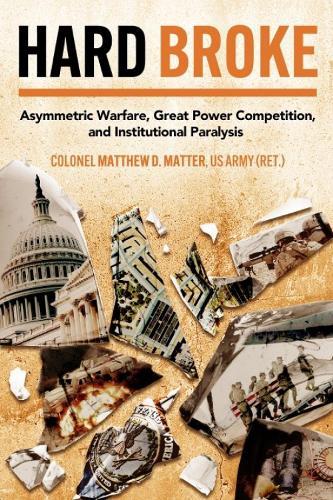
The American way of war is enabled by the concept of massing all available firepower-when done correctly it makes US forces hard to beat. However improvised explosive devices have increasingly enabled a new kind of asymmetric warfare, one that conventional forces continue to struggle to counter. This book offers a counter-IED playbook, one based upon the author's experiences of over 90 months of combat operations, working the problem sets of Fires, Effects, IEDs, Close Target Reconnaissance, Tracking-Tagging-Locating (TTL), and Information Operations. This text offers insights into the ways through some of the most complicated problems that have tested the Department of Defense, and the Army-the problems of how a conventional force is organized, manned, equipped, and trained to deal with the problem of IEDs; and how the Army is doctrinally organized to deal with an emerging revolution of military affairs. AUTHOR: Colonel Matthew D. Matter (ret.) is a native of Koloa, Hawaii. His education includes a B.A. in Political Science from Colorado State University, a M.A. in International Relations from Webster University, a Masters in Military Arts and Sciences from the US Army War College, and a Masters in Science in Aeronautics from Embry Riddle Aeronautical University. He enlisted in the Army in 1984 and was commissioned in 1986. He served for 31 years, of which 12 he spent spent in combat zones. He held multiple positions in numerous special operations formations, including the Rangers, Special Forces, and Special Mission Units. He was a by name request by the Commanding General Multi National Force Iraq during the Surge, and he was a by name request to support the Marines in Afghanistan during their Surge in 2009. From 2011 to 2013 he served as the Deputy to the Deputy Commanding General, J35/J5, in the Office of Defense Representative Pakistan running cross-border operations, as well as leading interagency US C-IED efforts. He has held critical positions in multiple organizations as a commander and fires and information operations coordinator. Since late 2015, he has served as a Civilian Chief of Staff for the United States Navy at Naval Aviation Warfighting at Naval Air Station, Fallon, Northern Nevada. 40 diagrams
Full Product Details
Author: Matthew M D Matter
Publisher: Casemate Publishers
Imprint: Casemate Publishers
ISBN: 9781636244433
ISBN 10: 1636244432
Pages: 288
Publication Date: 30 April 2025
Audience:
General/trade
,
General
Format: Hardback
Publisher's Status: Active
Availability: Out of stock

The supplier is temporarily out of stock of this item. It will be ordered for you on backorder and shipped when it becomes available.
Reviews
""Matt skilfully lays the IED's life cycle out for the reader: emerge, defend, defeat, and destroy. If the reader spent any time driving around Iraq or Afghanistan in a thin-skinned vehicle, this part of the text will feel very personal... If you served in Iraq or Afghanistan and drove around, you must read this book.""--Colonel (Ret.) Mark T. Lisi, Plank Owner, 3rd Platoon, Company B, 2nd Battalion (Ranger), 75th Infantry Regiment At a time when we are closely examining programs and processes across the Department of Defense, this excellent book by Matt Matter is a valuable resource for planners, policymakers, and leaders across the Defense enterprise. Having watched closely our struggle to contend with and eventually overcome the devastating effects of the improvised explosive device threat, Matt is well qualified to share observations and specific recommendations on not just how we approach asymmetry but, more importantly, how this plays into the future of great power competition and our imperative to prevail in this existential challenge.--Joseph L. Votel General (Ret.), U.S. Army ""In Hard Broke retired Army Colonel Matt Matter shares his participation in the overall effort to defeat Improvised Explosive Devices (IEDs) in Iraq. His personal experiences blaze through the pages; anyone who deployed to Iraq or Afghanistan will find it compelling. However, Matter gives us more than just 'I was there.' He dissects many of the shortcomings of the US military during the Global War on Terror and, more importantly, provides recommendations on how to mitigate the effect of those shortcomings. Of particular interest is the section on 'understanding' (without which we cannot be victorious) and the discussion of how to organize at the operational level, a topic usually ignored by military writers. Anyone who deployed after 9/11 and anyone who has an interest in how to approach wicked problems in combat will profit by reading this book."" --G. Alexander Crowther, PhD, Retired Army Infantry Colonel/Strategist
Author Information
Colonel Matthew D. Matter (ret.) is a native of Koloa, Hawaii. His education includes a B.A. in Political Science from Colorado State University, a M.A. in International Relations from Webster University, a Masters in Military Arts and Sciences from the US Army War College, and a Masters in Science in Aeronautics from Embry Riddle Aeronautical University. He enlisted in the Army in 1984 and was commissioned in 1986. He served for 31 years, of which 12 he spent spent in combat zones. He held multiple positions in numerous special operations formations, including the Rangers, Special Forces, and Special Mission Units. He was a by name request by the Commanding General Multi National Force Iraq during the Surge, and he was a by name request to support the Marines in Afghanistan during their Surge in 2009. From 2011 to 2013 he served as the Deputy to the Deputy Commanding General, J35/J5, in the Office of Defense Representative Pakistan running cross-border operations, as well as leading interagency US C-IED efforts. He has held critical positions in multiple organizations as a commander and fires and information operations coordinator. Since late 2015, he has served as a Civilian Chief of Staff for the United States Navy at Naval Aviation Warfighting at Naval Air Station, Fallon, Northern Nevada.