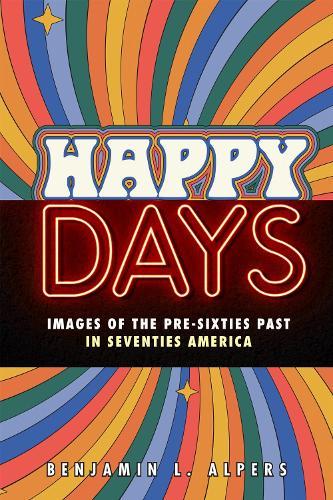
Full Product Details
Author: Benjamin L. Alpers
Publisher: Rutgers University Press
Imprint: Rutgers University Press
Dimensions:
Width: 15.20cm
, Height: 2.00cm
, Length: 22.90cm
Weight: 0.068kg
ISBN: 9781978830547
ISBN 10: 1978830548
Pages: 238
Publication Date: 12 January 2024
Recommended Age: From 16 to 99 years
Audience:
General/trade
,
College/higher education
,
Professional and scholarly
,
General
,
Tertiary & Higher Education
Format: Hardback
Publisher's Status: Active
Availability: To order

Stock availability from the supplier is unknown. We will order it for you and ship this item to you once it is received by us.
Reviews
""In a lucid and entertaining volume, intellectual historian Ben Alpers' has offered us a rich and much-needed analysis of a decade too often portrayed as an 'age of innocence' that gave way to the more troubled 1960s and 1970s. Delivering nuanced readings of music, film, television, and popular politics, Alpers delivers not just a fresh take on the 1950s, but also demonstrates that nostalgia is a form of popular historical thinking, permitting Americans to accommodate the present by way of the past."" -- Claire Bond Potter * author of Political Junkies: From Talk Radio to Twitter, How Alternative Media Hooked Us on Politics * ""Alpers exhibits a fine facility for analyzing closely a wide range of revealing artifacts, including music, film criticism, and public commemoration. The result is a history of popular culture that productively probes the meanings of history itself, for individuals contending with personal identity, for scholars seeking to avoid easy generalizations, and for American society as a whole."" -- Joan Shelley Rubin * author of The Making of Middlebrow Culture *
"""In a lucid and entertaining volume, intellectual historian Ben Alpers' has offered us a rich and much-needed analysis of a decade too often portrayed as an 'age of innocence' that gave way to the more troubled 1960s and 1970s. Delivering nuanced readings of music, film, television, and popular politics, Alpers delivers not just a fresh take on the 1950s, but also demonstrates that nostalgia is a form of popular historical thinking, permitting Americans to accommodate the present by way of the past."" — Claire Bond Potter, author of Political Junkies: From Talk Radio to Twitter, How Alternative Media Hooked Us on Politics ""Alpers exhibits a fine facility for analyzing closely a wide range of revealing artifacts, including music, film criticism, and public commemoration. The result is a history of popular culture that productively probes the meanings of history itself, for individuals contending with personal identity, for scholars seeking to avoid easy generalizations, and for American society as a whole.""— Joan Shelley Rubin, author of The Making of Middlebrow Culture"
"""Alpers exhibits a fine facility for analyzing closely a wide range of revealing artifacts, including music, film criticism, and public commemoration. The result is a history of popular culture that productively probes the meanings of history itself, for individuals contending with personal identity, for scholars seeking to avoid easy generalizations, and for American society as a whole.""— Joan Shelley Rubin, author of The Making of Middlebrow Culture ""In a lucid and entertaining volume, intellectual historian Ben Alpers' has offered us a rich and much-needed analysis of a decade too often portrayed as an 'age of innocence' that gave way to the more troubled 1960s and 1970s. Delivering nuanced readings of music, film, television, and popular politics, Alpers delivers not just a fresh take on the 1950s, but also demonstrates that nostalgia is a form of popular historical thinking, permitting Americans to accommodate the present by way of the past."" — Claire Bond Potter, author of Political Junkies: From Talk Radio to Twitter, How Alternative Media Hooked Us on Politics"
"""In a lucid and entertaining volume, intellectual historian Ben Alpers' has offered us a rich and much-needed analysis of a decade too often portrayed as an 'age of innocence' that gave way to the more troubled 1960s and 1970s. Delivering nuanced readings of music, film, television, and popular politics, Alpers delivers not just a fresh take on the 1950s, but also demonstrates that nostalgia is a form of popular historical thinking, permitting Americans to accommodate the present by way of the past."" -- Claire Bond Potter * author of Political Junkies: From Talk Radio to Twitter, How Alternative Media Hooked Us on Politics * ""Alpers exhibits a fine facility for analyzing closely a wide range of revealing artifacts, including music, film criticism, and public commemoration. The result is a history of popular culture that productively probes the meanings of history itself, for individuals contending with personal identity, for scholars seeking to avoid easy generalizations, and for American society as a whole."" -- Joan Shelley Rubin * author of The Making of Middlebrow Culture *"
""In a lucid and entertaining volume, intellectual historian Ben Alpers' has offered us a rich and much-needed analysis of a decade too often portrayed as an 'age of innocence' that gave way to the more troubled 1960s and 1970s. Delivering nuanced readings of music, film, television, and popular politics, Alpers delivers not just a fresh take on the 1950s, but also demonstrates that nostalgia is a form of popular historical thinking, permitting Americans to accommodate the present by way of the past."" — Claire Bond Potter, author of Political Junkies: From Talk Radio to Twitter, How Alternative Media Hooked Us on Politics ""Alpers exhibits a fine facility for analyzing closely a wide range of revealing artifacts, including music, film criticism, and public commemoration. The result is a history of popular culture that productively probes the meanings of history itself, for individuals contending with personal identity, for scholars seeking to avoid easy generalizations, and for American society as a whole.""— Joan Shelley Rubin, author of The Making of Middlebrow Culture
Author Information
BENJAMIN L. ALPERS is a Reach for Excellence Associate Professor of History in the Honors College at the University of Oklahoma. He is the author of Dictators, Democracy, and American Public Culture: Envisioning the Totalitarian Enemy, 1920s–1950s.