Overview
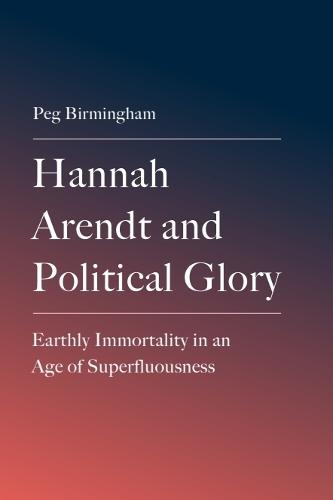
In this book, Peg Birmingham argues that privileging the event of natality and new beginnings in Hannah Arendt's political thought overlooks her central problematic with the modern and contemporary production of economic and political superfluousness, treating all life and the earth itself as disposable. In the face of this unrelenting production, that will not stop until it has destroyed all worlds and the earth itself, Birmingham shows that Arendt's primary concern is with radically rethinking the Greek notion of immortality and its heroic glory as earthly immortality. This is rooted in a new form of universal solidarity with those who have been produced as superfluous and consigned to holes of oblivion at sea, desert crossings, prisons and camps.
Full Product Details
Author: Peg Birmingham (Professor of Philosophy, DePaul University)
Publisher: Edinburgh University Press
Imprint: Edinburgh University Press
ISBN: 9781399552523
ISBN 10: 139955252
Pages: 264
Publication Date: 30 November 2025
Audience:
College/higher education
,
Postgraduate, Research & Scholarly
Format: Hardback
Publisher's Status: Active
Availability: Not yet available

This item is yet to be released. You can pre-order this item and we will dispatch it to you upon its release.
Reviews
Peg Birmingham's original and masterful study of Hannah Arendt revolutionises our interpretations of Arendt's project. Scholarship to-date largely focuses on the generative concepts of natality and the new as creating political possibilities, but these readings overlook contemporary forms of superfluousness--a key concern for Arendt. Birmingham shows how Arendt's thought focuses instead on earthly immortality, and it is within this framework that multiplex forms of contemporary superfluousness can be resisted and combatted. New forms of solidarity and political affect arise. This book is unquestionably a game-changer. Birmingham single-handedly shifts how we are to understand and read Arendt.--Antonio Calcagno, King's University College at Western University Hannah Arendt and Political Glory is a powerful work of critical political thought. Peg Birmingham challenges the received view that Arendt was primarily interested in the human condition of natality and new beginnings. This concern, she argues, only makes sense in the context of Arendt's broader worry about the unrelenting production of ""superfluousness,"" the condition that places human and non-human life under the threat of imminent annihilation. Action in concert is a call for solidarity with those who have been targeted for elimination through consignment to various ""holes of oblivion."" Birmingham captures the sheer urgency of Arendt's unique voice for facing and resisting the reality of our political present. A tour de force.--Linda M. G. Zerilli, University of Chicago
Peg Birmingham's original and masterful study of Hannah Arendt revolutionises our interpretations of Arendt's project. Scholarship to-date largely focuses on the generative concepts of natality and the new as creating political possibilities, but these readings overlook contemporary forms of superfluousness--a key concern for Arendt. Birmingham shows how Arendt's thought focuses instead on earthly immortality, and it is within this framework that multiplex forms of contemporary superfluousness can be resisted and combatted. New forms of solidarity and political affect arise. This book is unquestionably a game-changer. Birmingham single-handedly shifts how we are to understand and read Arendt.--Antonio Calcagno, King's University College at Western University
Author Information
Peg Birmingham is Professor of Philosophy at DePaul University. She is the author of Hannah Arendt and Human Rights: The Predicament of Common Responsibility (Indian UP, 2006), co-editor (with Philippe van Haute), Dissensus Communis: Between Ethics and Politics (Koros, 1996) and co-editor (with Anna Yeatman), Aporia of Rights: Citizenship in an Era of Human Rights (Bloomsbury, 2014). She is the author of numerous articles and book chapters on Agamben, Arendt, Derrida, Foucault, Heidegger, Hobbes, and Rousseau. She is the editor of Philosophy Today.