Overview
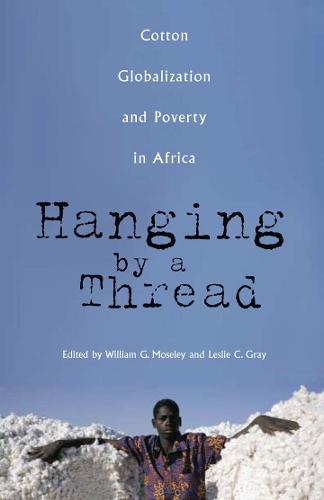
The textile industry was one of the first manufacturing activities to become organized globally, as mechanized production in Europe used cotton from the various colonies. Africa, the least developed of the world\u2019s major regions, is now increasingly engaged in the production of this crop for the global market, and debates about the pros and cons of this trend have intensified. Hanging by a Thread: Cotton, Globalization, and Poverty in Africa illuminates the connections between Africa and the global economy. The editors offer a compelling set of linked studies that detail one aspect of the globalization process in Africa, the cotton commodity chain. From global policy debates, to impacts on the natural environment, to the economic and social implications of this process, Hanging by a Thread explores cotton production in the postcolonial period from different disciplinary perspectives and in a range of national contexts. This approach makes the globalization process palpable by detailing how changes at the macroeconomic level play out on the ground in the world\u2019s poorest region. Hanging by a Thread offers new insights on the region in a global context and provides a critical perspective on current and future development policy for Africa.
Full Product Details
Author: William G. Moseley ,
Leslie C. Gray
Publisher: Ohio University Press
Imprint: Ohio University Press
Volume: 9
Dimensions:
Width: 14.00cm
, Height: 1.80cm
, Length: 21.60cm
Weight: 0.363kg
ISBN: 9780896802605
ISBN 10: 0896802604
Pages: 312
Publication Date: 01 April 2008
Audience:
Professional and scholarly
,
Professional & Vocational
Format: Paperback
Publisher's Status: Active
Availability: In Print

This item will be ordered in for you from one of our suppliers. Upon receipt, we will promptly dispatch it out to you. For in store availability, please contact us.
Reviews
""Moseley and Gray have assembled a uniquely comprehensive picture of the way cotton connects poor farmers, wealthy consumers, activist organizations, industrial giants, and agronomic laboratories. Contributors use commodity chain analysis, national case histories, community scale studies, household production research, and examples of both successes and failures to point to ongoing changes among people, soil, crops, and companies in the global economy. This is more than a book for specialists on Africa; it provides a kaleidoscopic window into the pressing complexities of environment and development."" - Paul Robbins, University of Arizona ""Drawing on data from several African countries and localities, the editors should be lauded for the way in which they tie this information into a coherent volume... I would warmly recommend this book to any student or scholar who is interested in commodity production and livelihoods that are dependent on commodity production."" - The Professional Geographer ""This book illuminates key points of power, contention, and uncertainty in African cotton and commodity chains... (T)hese essays are designed to promote debate, and will be particularly useful for teaching."" - International Journal of African Historical Studies
This book illuminates key points of power, contention, and uncertainty in African cotton and commodity chains.... (T)hese essays are designed to promote debate, and will be particularly useful for teaching. -- International Journal of African Historical Studies
Moseley and Gray have assembled a uniquely comprehensive picture of the way cotton connects poor farmers, wealthy consumers, activist organizations, industrial giants, and agronomic laboratories. Contributors use commodity chain analysis, national case histories, community scale studies, household production research, and examples of both successes and failures to point to ongoing changes among people, soil, crops, and companies in the global economy. This is more than a book for specialists on Africa; it provides a kaleidoscopic window into the pressing complexities of environment and development. - Paul Robbins, University of Arizona Drawing on data from several African countries and localities, the editors should be lauded for the way in which they tie this information into a coherent volume... I would warmly recommend this book to any student or scholar who is interested in commodity production and livelihoods that are dependent on commodity production. - The Professional Geographer This book illuminates key points of power, contention, and uncertainty in African cotton and commodity chains... (T)hese essays are designed to promote debate, and will be particularly useful for teaching. - International Journal of African Historical Studies
Author Information
William G. Moseley is an associate professor of geography at Macalester College in Saint Paul, Minnesota. He is the author of two editions of Taking Sides: Clashing Views on African Issues; and coeditor of The Introductory Reader in Human Geography: Contemporary Debates and Classic Writings and African Environment and Development: Rhetoric, Programs, Realities. Leslie C. Gray is an associate professor of environ mental studies at Santa Clara University. She has published articles on environment and development in journals such as World Development, Africa, African Studies Review, Development and Change, Geoforum, and Geographical Journal.