Overview
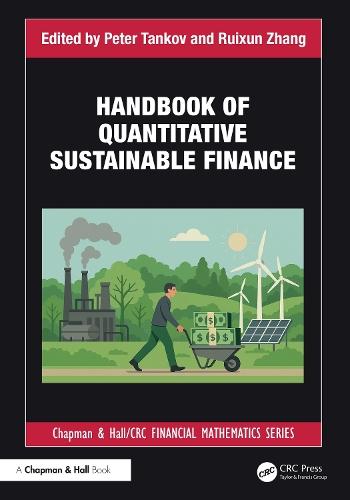
Handbook of Quantitative Sustainable Finance is an edited collection concerning the integration of sustainability and climate risk considerations into mathematical and quantitative finance. This comprehensive handbook provides a valuable resource for researchers, practitioners, policymakers, and students who are interested in understanding the practical role of quantitative techniques in delivering sustainable finance and investment. The book is divided into four main parts: Risks and Regulation; Asset Pricing and Portfolio Management; Data, Measurement, and AI; and Product Design and Specific Markets. Although this structure offers a coherent, unifying structure to the book, each chapter has been written so as to be self-contained and useful to readers interested in any specific aspect of quantitative sustainable finance. Every chapter has been written by leading experts in their field, and offers a useful, authoritative window into the state of research and practice. Features · Numerous contributions from leading experts in sustainable finance · Cutting edge analysis of recent technological advances in areas such as artificial intelligence · Practical tools and ideas for working quants, as well as valuable material for academic study.
Full Product Details
Author: Peter Tankov ,
Ruixun Zhang
Publisher: Taylor & Francis Ltd
Imprint: Chapman & Hall/CRC
Weight: 1.110kg
ISBN: 9781032627922
ISBN 10: 1032627921
Pages: 498
Publication Date: 11 December 2025
Audience:
College/higher education
,
Professional and scholarly
,
Tertiary & Higher Education
,
Professional & Vocational
Format: Hardback
Publisher's Status: Active
Availability: Not yet available

This item is yet to be released. You can pre-order this item and we will dispatch it to you upon its release.
Author Information
Peter Tankov is professor of quantitative finance at ENSAE, the French National School for Statistics and Economic Administration, having previously worked at Paris-Cite university and Ecole Polytechnique. He is a mathematician, specialist in applied probability and quantitative finance. He earned his PhD in applied mathematics from Ecole Polytechnique in 2004. His current research focuses on green and sustainable finance, where he aims to develop quantitative methodologies. Peter is the author of over 60 research articles on these and other topics and of the widely read book, Financial Modelling with Jump Processes. He is the recipient of the 2016 Best Young Researcher in Finance award of the Europlace Institute of Finance and the 2024 Louis Bachelier Prize of London Mathematical Society, SMAI, and Natixis Foundation. Professor Tankov is the scientific director of the Paris Agreement Research Commons foundation at Louis Bachelier Institute, where he leads data-oriented initiatives, and member of editorial boards of the main quantitative finance journals: Mathematical Finance and Finance and Stochastics. Ruixun Zhang is an associate professor with tenure at Peking University. Ruixun earned a PhD in Applied Mathematics from MIT in 2015, and bachelor's degrees in Mathematics and Applied Mathematics, and Economics (double degree) from Peking University in 2011. Ruixun’s research interests include green finance, machine learning, market microstructure, and evolutionary models of financial behavior. His research has appeared in leading journals such as Proceedings of the National Academy of Sciences, Operations Research, Management Science, and Journal of the American Statistical Association. His work has been recognized by the S&P Global Academic ESG Research Award, the International Centre for Pension Management (ICPM) Research Award, the Commodity and Energy Markets Association (CEMA) Questrom-CEMA Best Paper Prize, the SIAM Activity Group on Financial Mathematics and Engineering Conference Paper Prize, and the CFRI&CIRF-China Finance Review International Research Excellence Award. He serves on the editorial board of Digital Finance and International Journal of Financial Engineering.