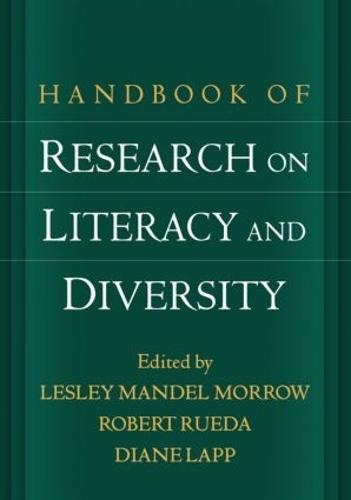
Full Product Details
Author: Lesley Mandel Morrow ,
Robert Rueda ,
Diane Lapp ,
Edmund W. Gordon
Publisher: Guilford Publications
Imprint: Guilford Publications
Dimensions:
Width: 17.40cm
, Height: 4.60cm
, Length: 24.60cm
Weight: 1.044kg
ISBN: 9781606232460
ISBN 10: 1606232460
Pages: 464
Publication Date: 27 May 2009
Audience:
College/higher education
,
Professional and scholarly
,
Postgraduate, Research & Scholarly
,
Professional & Vocational
Format: Hardback
Publisher's Status: Out of Print
Availability: In Print

Limited stock is available. It will be ordered for you and shipped pending supplier's limited stock.
Reviews
'Powerful. The editors have brought together brilliant researchers who make a tremendous contribution to building knowledge about instruction that capitalizes on students' social and cultural contexts. Perhaps most important, they point the way toward taking action that is evidence based and holds potential for making a difference in the literacy lives of our students.' - Victoria J. Risko, Department of Teaching and Learning, Vanderbilt University, USA
Powerful. The editors have brought together brilliant researchers who make a tremendous contribution to building knowledge about instruction that capitalizes on students' social and cultural contexts. Perhaps most important, they point the way toward taking action that is evidence based and holds potential for making a difference in the literacy lives of our students.--Victoria J. Risko, EdD, Department of Teaching and Learning, Vanderbilt University A much-needed resource, this handbook addresses both the promises and challenges of working with the richly diverse students attending schools today. Respected scholars provide thorough overviews of existing research and theory, highlight what is still to be learned, and offer recommendations for educational policy and practice. Readers will find the focus on English language learners, minority students, and other marginalized groups particularly useful. This volume should be added to the reference shelves of all literacy researchers, and can offer a strong grounding for graduate coursework.--Kristen H. Perry, PhD, Department of Curriculum and Instruction, University of Kentucky This comprehensive volume challenges the deficit model of diversity and argues for a resource orientation toward difference that is essential to effective teaching for minority children. The book covers a wide range of critical concerns related to literacy and diversity, including policy issues, theoretical developments, instructional strategies, assessment, multiple literacies, social attitudes, and formal and informal learning. Addressing the complexities of the topic in a way that is invaluable, this is an important resource for teacher educators, graduate students, and university researchers, as well as inservice teachers.--Guofang Li, PhD, Department of Teacher Education, Michigan State University - Recommended. Graduate, research, and professional collections. --Choice, 12/3/2009ffA welcome addition to the conversations that dominate contemporary literacy research and graduate studies....The extremely high quality of the contributions, the structure of each chapter, and the issues addressed make this book a 'must have' for literacy researchers and university professors. It is one I will use in my own graduate teaching and from which I will recommend specific chapters to teacher professional learning communities.--Educational Review, 11/24/2011
Author Information
Edited by Lesley Mandel Morrow, PhD, Department of Learning and Teaching, Graduate School of Education, Rutgers University, USA, Robert Rueda, PhD, Rossier School of Education, University of Southern California, USA, and Diane Lapp, EdD, School of Teacher Education, San Diego State University, USA