|
|
|||
|
||||
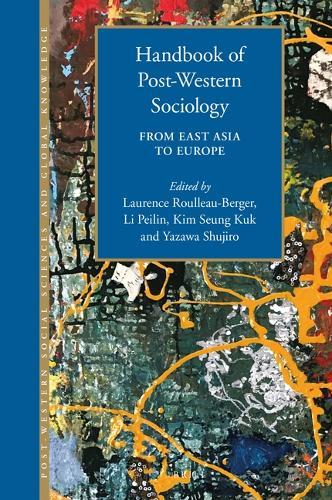
OverviewBeyond hegemonic thoughts, the Post-Western sociology enables a new dialogue between East Asia (China, Japan, Korea) and Europe on common and local knowledge to consider theoretical continuities and discontinuities, to develop transnational methodological spaces, and co-produce creolized concepts. With this new paradigm in social sciences we introduce the multiplication of epistemic autonomies vis-à-vis Western hegemony and new theoretical assemblages between East-Asia and European sociologies. From this ecology of knowledge this groundbreaking contribution is to coproduce a post-Western space in a cross-pollination process where “Western” and “non-Western” knowledge do interact, articulated through cosmovisions, as well as to coproduce transnational fieldwork practices. Full Product DetailsAuthor: Laurence Roulleau-Berger , Peilin Li , Seung Kuk Kim , Shujiro YasawaPublisher: Brill Imprint: Brill Volume: 5 Dimensions: Width: 15.50cm , Height: 5.90cm , Length: 23.50cm Weight: 2.059kg ISBN: 9789004529311ISBN 10: 9004529314 Pages: 1054 Publication Date: 30 March 2023 Audience: Professional and scholarly , Professional & Vocational Format: Hardback Publisher's Status: Active Availability: Manufactured on demand We will order this item for you from a manufactured on demand supplier. Table of ContentsContents Preface Acknowledgments List of Figures and Tables Notes on Contributors Introduction: Post-Western Sociology Laurence Roulleau-Berger part 1: Post-Western Social Sciences: From East Asia to Europe section 1: Toward Post-Western Social Sciences 1 Toward Post-Western Sociology Laurence Roulleau-Berger 2 The Emergence and Characteristics of Chinese Sociology Li Peilin 3 What Are Post-Western Sociologies? Xie Lizhong 4 The Oneness Logic: Toward an East Asian General Theory Kim Seung Kuk 5 To Create a Post-Western Sociology: A Brief Sketch of Japanese Sociology Yazawa Shujiro section 2: Non-hegemonic Traditions and Pluralism in Asian Social Sciences 6 Chinese Sociology: Traditions and Dialogues – Localized Knowledge Production as Post-Western Sociology Li Youmei 7 Development of Sociological Thought in the Early Modern Period of Japan Yama Yoshiyuki 8 Sociological Sinicization: A Chinese Effort in Post-Western Sociology Zhou Xiaohong and Feng Zhuqin 9 Proposing a Global Sociology Based on Japanese Theories Shoji Kōkichi 10 De-Westernization or Re-Easternization: Towards Post-Western Conceptualization and Theorization in the Sociology of Korea Lim Hyun-Chin 11 Cosmopolitan Sociology: A Significant Step But Not the Final Task for Post-Western Sociology Kim Mun Cho section 3: Heritages and “Re-Asiatization” of Social Sciences 12 Chinese Economic Sociology: From the Perspective of Post-Western Sociology Yang Dian 13 Thirty Years of Labor Sociology in China Shen Yuan 14 Voice of the Dead: Hibakusha Collective Memory against the Western Ethos Nomiya Daishiro 15 COVID-19 and Hegemonic Modernity: Post-Western Sociological Imaginations Han Sang-Jin 16 Wanderers and the Settled: Perspectives of Kunio Yanagita and Kazuko Tsurumi on Social Change Okumura Takashi section 4: Epistemic Autonomies and Located Knowledge 17 Case Studies towards the Analysis of Total Social Construction Qu Jingdong 18 Risk Governance, Publicness, and the Quality of the Social Yee Jaeyeol 19 The Korean Wave as a Glocal Cultural Phenomenon: Addressing the New Trends in Korean Studies Jang Wonho 20 Development of Critical Theory Based on the Analysis of Literary Works on Tenderness: Habermas’s Thesis and Akira Kurihara’s Work Deguchi Takeshi 21 From Social Equilibrium to Self-Production of Society: The Transition of China’s Sociological Recognition on China’s Society Sun Feiyu 22 Sociology without Society: The Dreyfus Affair, the Taigyaku Affair, and the Sociology of Life Kikutani Kazuhiro 23 Weber “Fever” in China (1980–2020): Scholarly Communication and Discipline Construction He Rong Part 2: Translation and Ecologies of Knowledge: Dialogues East–West Section 5: Globalization and Social Classes 24 Wealthization and Housing Wealth Inequality in China Li Chunling 25 Squeezing the Western Middle Class: Precarization, Uncertainty and Tensions of Median Socioeconomic Groups in the Global North Louis Chauvel 26 A New Approach to Social Inequality: Inequality of Income and Wealth Shin Kwang-Yeong 27 Globalization and Social Inequality in the Context of Japan Sato Yoshimichi Section 6: Youth and Education 28 Educational Expansion and Its Impacts on Youth in Transitional China Wu Yuxiao 29 Exploring Educational Institutions’ Major Roles and Norms to Understand Their Effects: The Example of France Agnès van Zanten 30 Youth and Transition from School to Work in Japan Asano Tomohiko 31 Education as an Institution and a Practice: Issues and Perspectives in Korean Sociology Kim Byoung-Kwan Section 7: State and Governance 32 Urban Renewal, Urban Restructuring: The City as Inescapable Western Representation Agnès Deboulet 33 State and Society in Urban Renewal and Social Governance Shi Yunqing 34 The State, Civil Society, and Citizens through Local Governance in Japan Yamamoto Hidehiro Section 8: Ethnicity and Space 35 The Border of Ethnicity Worlds Ahmed Boubeker 36 Ethnicity, Space, and Boundary-Making among the Hui in Nanjing Fan Ke 37 Considering Super-diversity in Immigration: Post-Western Sociology and the Japanese Case Tarumoto Hideki 38 Spatial Confinement of Migrant Workers in Korea Choi Jongryul Section 9: Social Movements and Collective Action 39 Contributions of Japanese Environmental Sociology in Non-Western Contexts Hasegawa Koichi 40 Social Movements and Collective Action Lilian Mathieu 41 State’s Temperament and the Control of Collective Action in Contemporary China Feng Shizheng Section 10: Gender and Inequalities 42 Gender and Inequalities in France Christine Détrez 43 Changing Gender Dynamics and Family Reinstitutionalization in Contemporary China Ji Yingchun 44 Revisiting Comparative Frameworks and Gender Inequality in Japan Nemoto Kumiko 45 Two Contradictory Trends in Korea in the COVID-19 Era: “Condensed Radicalization of Individualization” and “Community Orientation” Shim Young-Hee Section 11: Environment and Mistrust Crisis 46 How Ecological Civilization Contributes to Post-Western Sociology Wang Xiaoyi and Anier 47 The Post-Western Anthropocene Paul Jobin 48 East Asian Compressed Ecological Modernization: Modus of Developmental State and Technological Response to the Environmental Crisis Satoh Keiichi 49 The Legacy of the Developmental State and the Rise of Fragmented Green Growth Hong Deokhwa and Ku Dowan Section 12: Individuation, Self, and Emotions 50 Management, Experience, and Performance: Emotional Regimes in Contemporary Society Cheng Boqing and Wang Jiahui 51 The Individual and Society: The End of an Alliance and the Burden of Emotions François Dubet 52 From the Deepest Dimension to Society Yazawa Shujiro 53 Emotions of Fear, Anger, and Disgust in Contemporary Korean Society Kim Wang-Bae Section 13: Cities, Migration, and Work 54 Beyond “Post-Western” Urban Studies Machimura Takashi 55 Sociology of Migration and Post-Western Knowledge Laurence Roulleau-Berger 56 Social Integration of China’s Floating Population Wang Chunguang and Lu Wen Section 14: Global Health and New Future 57 Global Health Challenges and a New Future Zhao Yandong and Hong Yanbi 58 East–West Dialogue for Global Health Care Challenges in the Era of COVID-19 and Beyond Hosoda Miwako 59 Expanding Epidemic Preparedness to Include Population Memory: A Key for Better Epidemic Management Frédéric Le Marcis 60 South Korea Has Controlled the COVID-19 Outbreak But Failed to Prepare Accountable Hospitals and Doctors Cho Byong-Hee Conclusion Laurence Roulleau-Berger, Li Peilin, Kim Seung Kuk and Yazawa Shujiro Postface Sari Hanafi IndexReviewsAuthor InformationLaurence Roulleau-Berger, Ph.D. University Lyon 2 (1982) and Ph.D. Supervisor in sociology (2001), is Research Director at French National Center for Scientific Research (CNRS), École Normale Supérieure of Lyon. She has published many books, articles and chapters, including Post-Western Revolution in Sociology. From China to Europe (2016), Young Chinese Migrants, Compressed Individual and Global Condition (2021), and Sociology of Migration and Post-Western Theory, co-edited with Liu Yuzhao (2022). LI Peilin, Ph.D. University Paris 1 (1987), is Chair Professor of sociology at University of Chinese Academy of Social Sciences, Academic member and Director of law, social and political division of CASS. He has published many books, articles and chapters, including in English: Social transformation and Chinese Experience (2017), Urban Village Renovation: The Stories of Yangcheng Village (2020), and Handbook of Social Stratification in the BRIC Countries (co-editor, 2013). KIM Seung Kuk, Ph.D. Indiana University, is Professor emeritus of Pusan National University. He served as the President of Korean Association of Ocean Sociology, East Asian Sociological Association, Korean Sociological Association, and Korean Society for Social Theory. He has published many books, articles and chapters, including: Toward an Ocean of Hybridisation (2022), Solipsist and Spiritualist Individualism (2018), and The Rise of Hybrid Society and Its Friends (2015). He won the Korean Academy of Sciences Award (2017). YAZAWA Shujiro is Emeritus Professor of Hitotsubashi University and Seijo University, Tokyo. He served as the President of Japan Sociological Society and is the President of East Asian Sociological Association. He has published many books, articles and chapters, including: Theories about and Strategies against Hegemonic Social Science: Beyond the Social Sciences with M.Kuhn (2015), The Frontiers of Reflexive Sociology (2017), and ""The Indigenization of American Sociology and Universalization of Japanese Sociology,"" Journal of History of Sociology (2021). Tab Content 6Author Website:Countries AvailableAll regions |
||||