Overview
such questions for centuries (unrestricted by the capabilities of any ha- ware). Theprinciplesgoverningtheinteractionofseveralprocesses, forexample, are abstract an similar to principles governing the cooperation of two large organisation. A detailed rule based e?ective but rigid bureaucracy is very much similar to a complex computer program handling and manipulating data. My guess is that the principles underlying one are very much the same as those underlying the other. Ibelievethedayisnotfarawayinthefuturewhenthecomputerscientist will wake up one morning with the realisation that he is actually a kind of formal philosopher! The projected number of volumes for this Handbook is about 18. The subjecthasevolvedanditsareashavebecomeinterrelatedtosuchanextent that it no longer makes sense to dedicate volumes to topics. However, the volumes do follow some natural groupingsof chapters. Iwould liketothank our authorsand readersfor their contributionsand their commitment in making this Handbook a success. Thanksalso to our publication administrator Mrs J. Spurr for her usual dedication and excellence and to Kluwer Academic Publishers (now Springer) for their continuing support for the Handbook. Dov Gabbay King's College London 10 Logic IT Natural Program Arti?cial in- Logicp- language control spec- telligence gramming processing i?cation, veri?cation, concurrency Temporal Expressive Expressive Planning. Extension of logic power of tense power for re- Time depen- Horn clause operators. current events. dent data. with time Temporal Speci?cation Eventcalculus. capability. indices. Sepa- of tempo- Persistence Event calculus. ration of past ral control. through time- Temporal logic from future Decision prob- theFrame programming. lems. Model Problem. T- checking. poral query language. temporal transactions.
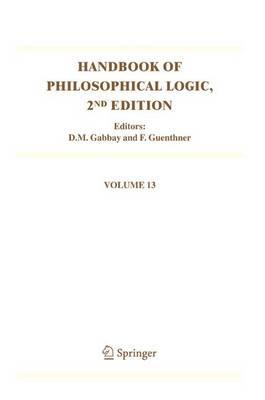
Full Product Details
Author: D.M. Gabbay ,
Franz Guenthner
Publisher: Springer-Verlag New York Inc.
Imprint: Springer-Verlag New York Inc.
Edition: Second Edition 2005
Volume: 13
Dimensions:
Width: 15.50cm
, Height: 2.20cm
, Length: 23.50cm
Weight: 1.550kg
ISBN: 9781402035203
ISBN 10: 1402035209
Pages: 370
Publication Date: 29 August 2005
Audience:
College/higher education
,
Professional and scholarly
,
Postgraduate, Research & Scholarly
,
Professional & Vocational
Format: Hardback
Publisher's Status: Active
Availability: In Print

This item will be ordered in for you from one of our suppliers. Upon receipt, we will promptly dispatch it out to you. For in store availability, please contact us.
Reviews
The best starting point for exploring any of the topics in logic Encyclopaedia Britannica
The best starting point for exploring any of the topics in logic <br> Encyclopaedia Britannica
The best starting point for exploring any of the topics in logic Encyclopaedia Britannica
The best starting point for exploring any of the topics in logic Encyclopaedia Britannica
""The best starting point for exploring any of the topics in logic"" Encyclopaedia Britannica