Awards
- Runner-up for George R. Terry Book Award 2002.
- Winner of Runner up with special mention for the Terry Book Award, Academy of Management, Denver 2002, 'for the most outstanding contribution to the advancement of management knowledge'..
Overview
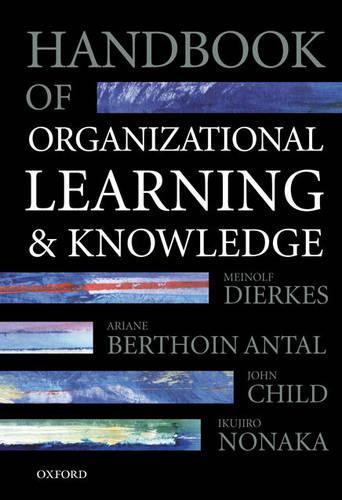
This handbook provides a comprehensive overview of the concept of organisational learning and related issues of knowledge in organisations. It explains its origins, current applications, and where it may be going, and provides a full account of varied disciplinary approaches.
Full Product Details
Author: Meinolf Dierkes , Ariane Berthoin Antal , Ikujiro Nonaka , John Child
Publisher: Oxford University Press
Imprint: Oxford University Press
Dimensions:
Width: 17.20cm
, Height: 5.00cm
, Length: 24.50cm
Weight: 1.727kg
ISBN: 9780198295822
ISBN 10: 0198295820
Pages: 1008
Publication Date: 27 March 2003
Audience:
Professional and scholarly
,
Professional & Vocational
Format: Paperback
Publisher's Status: Active
Availability: To order 
Stock availability from the supplier is unknown. We will order it for you and ship this item to you once it is received by us.
Table of Contents
A. Berthoin Antal, M. Dierkes, J. Child, and I. Nonaka: Introduction: Finding Paths through the Handbook Part I: Insights from Major Social Science Disciplines 1: G. W. Maier, C. Prange, and L. von Rosenstiel: Psychological Perspectives of Organizational Learning 2: S. Gherardi and D. Nicolini: The Sociological Foundations of Organizational Learning 3: P. Pawlowsky: The Treatment of Organizational Learning in Management Science 4: C. Boerner, J. T. Macher and D. J. Teece: A Review and Assessment of Organizational Learning in Economic Theories 5: B. Czarniawska: Anthropology and Organizational Learning 6: J. LaPalombara: The Underestimated Contributions of Political Science to Organizational Learning 7: J. Fear: Thinking Historically about Organizational Learning Part II: External Triggers for Learning 8: L. von Rosenstiel and S. Koch: Change in Socioeconomic Values as a Trigger of Organizational Learning 9: J. Kadtler: Social Movements and Interest Groups as Triggers for Organizational Learning 10: H. Merkens, M. Geppert, and D. Antal: Triggers of Organizational Learning during the Transformation Process in Central European Countries 11: J. Stopford: Organizational Learning as Guided Responses to Market Signals 12: M. Dierkes, L. Marz, and C. Teele: Technological Visions, Technological Development, and Organizational Learning Part III: Factors and Conditions Shaping Organizational Learning 13: J. Child and S. Heavens: The Social Constitution of Organizations and its Implications for Organizational Learning 14: W. Starbuck and B. Hedberg: How Organizations Learn from Success and Failure 15: C. Weber and A. Berthoin Antal: The Role of Time in Organizational Learning 16: K. Scherer and V. Tran: Effects of Emotions on the Process of Organizational Learning Part IV: Agents of Organizational Learning 17: V. Friedman: The Individual as Agent of Organizational Learning 18: P. Sadler: Leadership and Organizational Learning 19: R. Tainio, K. Lilja, and T. Santalainen: The Role of Boards in Facilitating or Limiting Learning in Organizations 20: A. Drinkuth, C. Riegler, and R. Wolff: Labor Unions as Learning Organizations and Learning Facilitators 21: A. Berthoin Antal and C. Krebsbach-Gnath: Consultants as Agents of Organizational Learning: The importance of marginality Part V: Processes of Organizational Learning and Knowledge Creation 22: I. Nonaka, R. Toyama, and P. Byosiere: A Theory of Organizational Knowledge Creation: Understanding the dynamic process of creating knowledge 23: B. Buchel and S. Raub: Media Choice and Organizational Learning 24: B. Hedberg and R. Wolff: Organizing, Learning, and Strategizing: From construction to delivery 25: J. LaPalombara: Power and Politics in Organizations: Public and private sector comparisons 26: J. Rothman and V. Friedman: Identity, Conflict, and Organizational Learning 27: A. Kieser, N. Beck, and R. Tainio: Rules and Organizational Learning: The behavioural theory approach Part VI: Interorganizational Learning and Knowledge in a Global Context 28: K. Macharzina, M. J. Oesterle, and D. Brodel: Learning in Multinationals 29: J. Child: Learning Through Strategic Alliances 30: M. Lyles: Organizational Learning in International Joint Ventures: The case of Hungary 31: C. Lane: Organizational Learning in Supplier Networks 32: L. S. Tsui-Auch: Learning in Global and Local Networks: Experience of Chinese firms in Hong Kong, Singapore, and Taiwan 33: B. Hedberg and M. Holmqvist: Learning in Imaginary Organizations Part VII: Developing Learning Practices 34: V. Friedman, R. Lipshitz, and W. Overmeer: Creating Conditions for Organizational Learning 35: P. Pawlowsky, J. Forslin, and R. Reinhardt: Practices and Tools of Organizational Learning 36: R. Reinhardt, M. Bornemann, P. Pawlowsky, and U. Schneider: Intellectual Capital and Knowledge Management: Perspectives on measuring knowledge Part VIII: Putting Learning into Practice 37: I. Nonaka, P. Reinmoeller, and R. Toyama: Integrated Information Technology Systems for Knowledge Creation 38: G. Galer and K. van der Heijden: Scenarios and Their Contribution to Organizational Learning: From practice to theory 39: A. Berthoin Antal, U. Lenhardt, and R. Rosenbrock: Barriers to Organizational Learning 40: C. Krebsbach-Gnath: Applying Theory to Organizational Transformation 41: C. de Haen, L. S. Tsui-Auch, and M. Alexis: Multimodal Organizational Learning: From misbehaviour to good laboratory practice in the pharmaceutical industry Part IX: Conclusion 42: A. Berthoin Antal, M. Dierkes, J. Child, and I. Nonaka: Organizational Learning and Knowledge: Reflections on the dynamics of the field and challenges for the future
Reviews
Finalist for the 2002 Terry Book Award, Academy of Management. An excellent and monumental volume edited by a distinguished group of scholars Professor Walter Nord, Chairman, Terry Book Award Committee For knowledge-based societies like ours, this Handbook is an invaluable and stimulating resource. Volker Hauff, Member of the Board, BearingPoint GmbH, and former German Federal Minister of Research and Technology This edited volume provides an exhaustive overview of cutting edge scholarship on organizational learning. David Vogel, Editor, California Management Review A very comprehensive tool for students of organizational behaviour in business schools and companies around the world. Jeffrey Garten, Dean, Yale University School of Management
Finalist for the 2002 Terry Book Award, Academy of Management. An excellent and monumental volume edited by a distinguished group of scholars Professor Walter Nord, Chairman, Terry Book Award Committee For knowledge-based societies like ours, this Handbook is an invaluable and stimulating resource. Volker Hauff, Member of the Board, BearingPoint GmbH, and former German Federal Minister of Research and Technology This edited volume provides an exhaustive overview of cutting edge scholarship on organizational learning. David Vogel, Editor, California Management Review A very comprehensive tool for students of organizational behaviour in business schools and companies around the world. Jeffrey Garten, Dean, Yale University School of Management
Author Information
Meinolf Dierkes is Director of the Research Unit on Organization and Technology at the Wissenschaftszentrum Berlin fur Sozialforschung (Social Science Research Centre, Berlin), and Professor at the Technical University of Berlin.; Ariane Berthoin Antal is Program Leader for Organizational Learning in the Research Unit on Organization and Technology at the Wissenschaftszentrum Berlin fur Sozialforschung (Social Science Research Centre, Berlin), and Visiting Professor at Henley Management College.; John Child is Professor of Commerce at the University of Birmingham.; Ilujiro Nonaka is Professor at the Graduate School of International Corporate Strategy, Hitotsubashi, Tokyo.
Tab Content 6
Author Website:
Countries Available
All regions
|