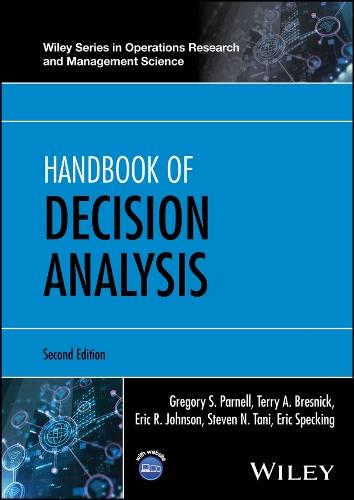
Handbook of Decision Analysis

Author:   Gregory S. Parnell (United States Military Academy, West Point, NY) ,  Terry A. Bresnick (Innovative Decisions, Inc.; Innovative Decision Analysis, Inc.) ,  Eric R. Johnson (Bristol-Myers Squibb) ,  Steven N. Tani (Strategic Decisions Group)
Publisher:   John Wiley & Sons Inc
Edition:   2nd edition
ISBN:  

9781394283880


Pages:   400
Publication Date:   23 April 2025
Format:   Hardback
Availability:   Available To Order   Availability explained
We have confirmation that this item is in stock with the supplier. It will be ordered in for you and dispatched immediately.

Our Price $207.95 Quantity:  
Add to Cart

Share |

Handbook of Decision Analysis


Overview

Qualitative and quantitative techniques to apply decision analysis to real-world decision problems, supported by sound mathematics, best practices, soft skills, and more With substantive illustrations based on the authors’ personal experiences throughout, Handbook of Decision Analysis describes the philosophy, knowledge, science, and art of decision analysis. Key insights from decision analysis applications and behavioral decision analysis research are presented, and numerous decision analysis textbooks, technical books, and research papers are referenced for comprehensive coverage. This book does not introduce new decision analysis mathematical theory, but rather ensures the reader can understand and use the most common mathematics and best practices, allowing them to apply rigorous decision analysis with confidence. The material is supported by examples and solution steps using Microsoft Excel and includes many challenging real-world problems. Given the increase in the availability of data due to the development of products that deliver huge amounts of data, and the development of data science techniques and academic programs, a new theme of this Second Edition is the use of decision analysis techniques with big data and data analytics. Written by a team of highly qualified professionals and academics, Handbook of Decision Analysis includes information on: Behavioral decision-making insights, decision framing opportunities, collaboration with stakeholders, information assessment, and decision analysis modeling techniques Principles of value creation through designing alternatives, clear value/risk tradeoffs, and decision implementation Qualitative and quantitative techniques for each key decision analysis task, as opposed to presenting one technique for all decisions. Stakeholder analysis, decision hierarchies, and influence diagrams to frame descriptive, predictive, and prescriptive analytics decision problems to ensure implementation success Handbook of Decision Analysis is a highly valuable textbook, reference, and/or refresher for students and decision professionals in business, management science, engineering, engineering management, operations management, mathematics, and statistics who want to increase the breadth and depth of their technical and soft skills for success when faced with a professional or personal decision.

Full Product Details

Author:   Gregory S. Parnell (United States Military Academy, West Point, NY) ,  Terry A. Bresnick (Innovative Decisions, Inc.; Innovative Decision Analysis, Inc.) ,  Eric R. Johnson (Bristol-Myers Squibb) ,  Steven N. Tani (Strategic Decisions Group)
Publisher:   John Wiley & Sons Inc
Imprint:   John Wiley & Sons Inc
Edition:   2nd edition
Dimensions:   Width: 17.50cm , Height: 2.50cm , Length: 25.40cm
Weight:   0.885kg
ISBN:  

9781394283880


ISBN 10:   1394283881
Pages:   400
Publication Date:   23 April 2025
Audience:   Professional and scholarly ,  Professional & Vocational
Format:   Hardback
Publisher's Status:   Active
Availability:   Available To Order   Availability explained
We have confirmation that this item is in stock with the supplier. It will be ordered in for you and dispatched immediately.

Table of Contents

Foreword to the 1st Edition xvii Foreword to the 2nd Edition xxiii Preface xxvii About the Companion Website xxxi 1 Introduction to Decision Analysis and Analytics 1 1.1 Introduction 1 1.2 Decision Analysis is a Social-Technical Process 3 1.3 Decision Analysis Applications 8 1.4 Decision Analysis Practitioners and Professionals 12 1.5 Handbook Overview and Illustrative Examples 14 1.6 Summary 17 2 Decision-Making Challenges 21 2.1 Introduction 22 2.2 Human Decision-Making 22 2.3 Decision-Making Challenges 23 2.4 Organizational Decision Processes 24 2.5 Credible Problem Domain Knowledge 28 2.6 Behavioral Decision-Analysis Insights 29 2.7 Two Anecdotes: Long-Term Success and a Temporary Success of Supporting the Human Decision-Making Process 34 2.8 Setting the Human Decision-making Context for the Illustrative Example Problems 35 2.9 Summary 37 3 Foundations of Decision Analysis and Analytics 41 3.1 Introduction 41 3.2 Brief History of the Foundations of Decision Analysis 42 3.3 Five Rules -- Theoretical Foundation of Decision Analysis 43 3.4 Scope of Decision Analysis 46 3.5 Decision Analysis and Data Analytics 47 3.6 Taxonomy of Decision Analysis Practice 49 3.7 Value-Focused Thinking 55 3.8 Summary 57 4 Decision Analysis Soft Skills 61 4.1 Introduction 62 4.2 Thinking Strategically 62 4.3 Leading Decision Analysis Teams 63 4.4 Managing Decision Analysis Projects 64 4.5 Researching 65 4.6 Interviewing Individuals 65 4.7 Conducting Surveys 68 4.8 Facilitating Groups 70 4.9 Aggregating across Experts 75 4.10 Communicating Analysis Insights 76 4.11 Summary 76 5 Use the Appropriate Decision Process 79 5.1 Introduction 79 5.2 What Is a Good Decision? 80 5.3 Selecting the Appropriate Decision Process 83 5.4 Decision Processes in Illustrative Examples 89 5.5 Organizational Decision Quality 91 5.6 Decision-Maker’s Bill of Rights 92 5.7 Summary 92 6 Frame the Decision Opportunity 95 6.1 Introduction 96 6.2 Declaring a Decision 96 6.3 What Is a Good Decision Frame? 97 6.4 Achieving a Good Decision Frame 98 6.5 Using an Influence Diagram for Decision Framing 103 6.6 Framing the Decision Opportunities for the Illustrative Examples 106 6.7 Using Decision-Analysis Techniques to Frame Analytics Projects 113 6.8 Summary 115 7 Craft the Decision Objectives and Value Measures 117 7.1 Introduction 118 7.2 Shareholder and Stakeholder Value 118 7.3 Challenges in Identifying Objectives 120 7.4 Identifying the Decision Objectives 121 7.5 The Financial or Cost Objective 123 7.6 Developing Value Measures 124 7.7 Structuring Multiple Objectives 124 7.8 Illustrative Examples 130 7.9 Summary 132 8 Design Creative Alternatives 135 8.1 Introduction 135 8.2 Characteristics of a Good Set of Alternatives 136 8.3 Obstacles to Creating a Good Set of Alternatives 137 8.4 The Expansive Phase of Creating Alternatives 139 8.5 The Reductive Phase of Creating Alternatives 140 8.6 Improving the Set of Alternatives 143 8.7 Illustrative Examples 143 8.8 Summary 146 9 Perform Deterministic Analysis and Develop Insights 149 9.1 Introduction 149 9.2 Planning the Model Using Influence Diagrams 151 9.3 Spreadsheet Software as the Modeling Platform 152 9.4 Deterministic Modeling with Net Present Value 154 9.5 Two Illustrative NPV Examples 156 9.6 Deterministic Modeling Using Multiple-Objective Decision Analysis 170 9.7 Illustrative MODA Problem -- Data Center Location 179 9.8 Summary 194 10 Quantify Uncertainty 197 10.1 Introduction 197 10.2 Use the Influence Diagram to Develop Probability Distributions 198 10.3 Probability Assessment with Data 199 10.4 Elicit and Document Subject Matter Expert Assessments 203 10.5 Box Assessment Protocols with Artificial Intelligence Tools 210 10.6 Illustrative Examples 211 10.7 Summary 211 11 Perform Probabilistic Analysis and Identify Insights 215 11.1 Introduction 216 11.2 Exploration of Uncertainty: Simulation, Decision Trees, and Influence Diagrams 216 11.3 Value of Information and Value of Control 238 11.4 Risk Attitude 242 11.5 Illustrative Examples 246 11.6 Summary 248 12 Portfolio Resource Allocation 251 12.1 Introduction to Portfolio Decision Analysis 251 12.2 Socio-technical Challenges with Portfolio Decision Analysis 252 12.3 Portfolio Analysis Using Benefit--Cost Ratios 253 12.4 Net Present Value Portfolio Analysis with Resource Constraints 254 12.5 Multiobjective Portfolio Analysis with Resource Constraints 260 12.6 Summary 264 13 Communicate with Decision-Makers and Stakeholders 267 13.1 Introduction 267 13.2 Determining Communication Objectives 269 13.3 Communicating with Senior Leaders 269 13.4 Communicating Decision-Analysis Results 273 13.5 Communicating Insights in the Illustrative Examples 280 13.6 Summary 281 14 Enable Decision Implementation 285 14.1 Introduction 285 14.2 Barriers to Involving Decision Implementers 286 14.3 Involving Decision Implementers in the Decision Process 287 14.4 Using Decision Analysis for Decision and Strategy Implementation 289 14.5 Illustrative Examples 292 14.6 Summary 293 15 Summary of Major Themes 295 15.1 Overview 296 15.2 Decision Analysis Helps Answer Important Decision-Making Questions 296 15.3 The Purpose of Decision Analysis Is to Identify and Create Value for Shareholders and Stakeholders 297 15.4 Decision Analysis Is a Sociotechnical Process 298 15.5 Decision Analysts Need Decision-Making Knowledge and Soft Skills 298 15.6 The Decision-Analysis Process Must Be Tailored to the Decision and the Organization 300 15.7 Decision Analysis Enables Data-Driven Decision-Making 301 15.8 Decision Analysis Offers Powerful Analytic Tools to Support Decision-Making 301 15.9 Conclusion 304 Appendix A Probability Theory 305 A.1 Introduction 305 A.2 Distinctions and the Clairvoyance Test 305 A.3 Possibility Tree Representation of a Distinction 306 A.4 Probability as an Expression of Degree of Belief 307 A.5 Inferential Notation 307 A.6 Multiple Distinctions 307 A.7 Joint, Conditional, and Marginal Probabilities 307 A.8 Calculating Joint Probabilities 308 A.9 Dependent and Independent Probabilities 309 A.10 Reversing Conditional Probabilities -- Bayes’ Rule 310 A.11 Probability Distributions 311 A.12 Combining Uncertain Quantities 312 Appendix B Decision Conferencing 315 B.1 Introduction 315 B.2 Decision Conference Process and Format 317 B.3 Location, Facilities, and Equipment 317 B.4 Use of Group Processes 318 B.5 Advantages and Disadvantages 319 B.6 Best Practices 321 B.7 Summary 322 Appendix C Resource Allocation with Incremental Benefit/Cost Analysis 325 C.1 Multiple Objective Portfolio Analysis with Resource Constraints 325 C.2 Summary 338 Appendix D Roughneck North American Strategy 341 D.1 Context 341 D.2 Decision Process 342 D.3 Framing 342 D.4 Objectives and Value Measures 342 D.5 Alternatives 344 D.6 Uncertainty Structuring 344 D.7 Uncertainty Quantification 347 D.8 Evaluation Logic (Spreadsheet Model) 347 D.9 Probabilistic Analysis 349 D.10 Real Options 355 D.11 Portfolio Resource Allocation 358 Reference 360 Index 361

Reviews

Author Information

Gregory S. Parnell, PhD, is a Professor of Practice in the Department of Industrial Engineering at the University of Arkansas in Fayetteville, AR. Terry A. Bresnick, MBA, is President of Innovative Decision Analysis, and Lecturer in the Department of Industrial Engineering at the University of Arkansas. Eric R. Johnson, PhD, is Director of Decision Science at GSK, where he supports drug development decision making. Steven N. Tani, PhD, is a retired Partner and Fellow of Strategic Decisions Group. Eric Specking, PhD, is a Principal Engineer for Infinity Labs and a Lecturer in the College of Engineering at the University of Arkansas in Fayetteville, AR.

Tab Content 6

Author Website:  

Countries Available

All regions
Latest Reading Guide

NOV RG 20252


Shopping Cart
Your cart is empty
Shopping cart
Mailing List