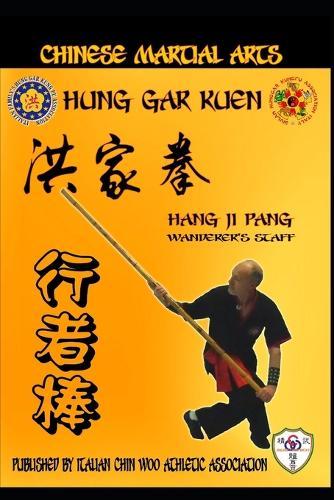
Han Ji Pang - Wanderer's Staff

Author:   Giuseppe Cucci
Publisher:   Independently Published
Volume:   12
ISBN:  

9798289882776


Pages:   216
Publication Date:   27 June 2025
Format:   Paperback
Availability:   Available To Order   Availability explained
We have confirmation that this item is in stock with the supplier. It will be ordered in for you and dispatched immediately.

Our Price $92.82 Quantity:  
Add to Cart

Share |

Han Ji Pang - Wanderer's Staff


Overview

Seung Tow Gwan (double-headed staff Shuāng tóu gùn), Hau Ji Pang (monkey staff Hóuzi bàng), Chai Mei Gwan (eyebrow-high staff Gāo méi gùn). And the basic tool of defense, the staff is known as the father of all weapons. Every culture develops a fighting staff. In Southern Shaolin (Hung Gar) the eyebrow-high staff is the most common (Seung Tow Gwan / Chai Mei Gwan / Hang Ji Pang / Hau Ji Pang). However, there are many variations, some as long as nine feet (Ng Lung Pa Kwa Gwan) and other short staffs (Pang). The long staffs are usually tapered and bear a resemblance to the spear. The tapered ones are nicknamed Shu Wei Ba (rat tail). Otherwise they are straight from start to finish. The Staffs are made of rattan, white wax wood, hard wood like oak or teak, and occasionally iron. Sometimes they are locked with metal ends, either inflicting more damage or increasing the weight for training. According to legends the most renowned masters of the staff are the Shaolin Monks and the Lau/Liu family (Lau Gar Gwan). The weapons are simply extensions of the limbs. Chinese weapon training unites the mind and body as one unit because all the essential components must be perfectly completed in a harmonious interaction. The weapon teaches a meaning of control, timing, distance and flexibility as one unit because the practitioner is required to possess speed, coordination, strength and stamina in using the respective weapons. The stance in Chinese weapons and weapon forms is lower and more pronounced than in unarmed hand forms. Weapon techniques and forms with a strong affinity to the Shaolin style suggest that the weapon art was probably compiled, developed and spread during the Yuan Dynasty (1206/1333). Some weapons, however, predate the Shaolin Monastery, although the Buddhist contribution represented a systematic development of weapons as an art form. Chinese weapons are classified into three categories: long, medium and short range with each weapon utilizing a Yin Yang balance of natural opposites of offensive and defensive maneuvers. The Chinese method of circular techniques and synchronous attacks is more all-inclusive than the limited European straight line style.

Full Product Details

Author:   Giuseppe Cucci
Publisher:   Independently Published
Imprint:   Independently Published
Volume:   12
Dimensions:   Width: 15.20cm , Height: 1.20cm , Length: 22.90cm
Weight:   0.295kg
ISBN:  

9798289882776


Pages:   216
Publication Date:   27 June 2025
Audience:   General/trade ,  General
Format:   Paperback
Publisher's Status:   Active
Availability:   Available To Order   Availability explained
We have confirmation that this item is in stock with the supplier. It will be ordered in for you and dispatched immediately.

Table of Contents

Reviews

Author Information

Tab Content 6

Author Website:  

Countries Available

All regions
Latest Reading Guide

NOV RG 20252


Shopping Cart
Your cart is empty
Shopping cart
Mailing List