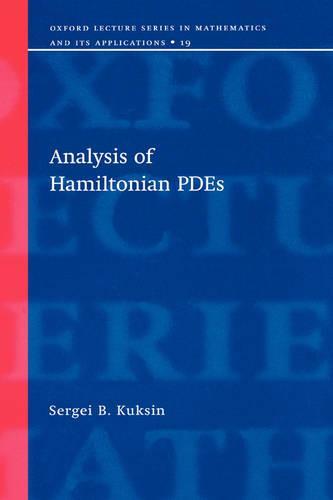
Overview
For the last 20-30 years, interest among mathematicians and physicists in infinite-dimensional Hamiltonian systems and Hamiltonian partial differential equations has been growing strongly, and many papers and a number of books have been written on integrable Hamiltonian PDEs. During the last decade though, the interest has shifted steadily towards non-integrable Hamiltonian PDEs. Here, not algebra but analysis and symplectic geometry are the appropriate analysing tools. The present book is the first one to use this approach to Hamiltonian PDEs and will be an invaluable source of information for postgraduate mathematics and physics students and researchers.
Full Product Details
Author: Sergei B. Kuksin (Professor of Mathematics, Professor of Mathematics, Heriot-Watt University, Edinburgh, and Steklov Mathematical Institute, Moscow)
Publisher: Oxford University Press
Imprint: Oxford University Press
Volume: 19
Dimensions:
Width: 16.10cm
, Height: 1.70cm
, Length: 24.10cm
Weight: 0.463kg
ISBN: 9780198503958
ISBN 10: 0198503954
Pages: 224
Publication Date: 07 September 2000
Audience:
Professional and scholarly
,
Professional & Vocational
Format: Hardback
Publisher's Status: Active
Availability: Manufactured on demand

We will order this item for you from a manufactured on demand supplier.
Reviews
The aim of this book is to present the following form of the proof of Kolmogorov-Arnold-Moser (KAM) theorem: most of the space-periodic finite-gap solutions of a Lax-integrable Hamiltonian partial differential equations (PDE) persist under a small perturbation of the equation as timequasiperiodic solutions of the perturbed equation. This theorem provides an important tool for an effective study of PDEs. --EMS The book was written to present a complete proof of the following infinite-dimensional KAM theorem: most space-periodic finite-gap solutions of a Lax-integrable partial differential equation persist under a small Hamiltonian perturbation of the equation as time-periodic solutions of the perturbed equation. . .The book provides a very useful source of information for both integrable and non-integrable differential equations. --MATH This is the first monograph where KAM-theory for PDEs is discussed systematically; most journal publications on the subject deal with particular examples rather than with general settings. The author succeeds in presenting a harmonic combination of general theory with nontrivial examples such as KdV (including KdV hierarchy) and sine-Gordon equations ... the book is carefully written ... --Mathematical Reviews The aim of this book is to present the following form of the proof of Kolmogorov-Arnold-Moser (KAM) theorem: most of the space-periodic finite-gap solutions of a Lax-integrable Hamiltonian partial differential equations (PDE) persist under a small perturbation of the equation as timequasiperiodic solutions of the perturbed equation. This theorem provides an important tool for an effective study of PDEs. --EMS The book was written to present a complete proof of the following infinite-dimensional KAM theorem: most space-periodic finite-gap solutions of a Lax-integrable partial differential equation persist under a small Hamiltonian perturbation of the equation as time-periodic solutions of the perturbed equation. . .The book provides a very useful source of information for both integrable and non-integrable differential equations. --MATH This is the first monograph where KAM-theory for PDEs is discussed systematically; most journal publications on the subject deal with particular examples rather than with general settings. The author succeeds in presenting a harmonic combination of general theory with nontrivial examples such as KdV (including KdV hierarchy) and sine-Gordon equations ... the book is carefully written ... --Mathematical Reviews The aim of this book is to present the following form of the proof of Kolmogorov-Arnold-Moser (KAM) theorem: most of the space-periodic finite-gap solutions of a Lax-integrable Hamiltonian partial differential equations (PDE) persist under a small perturbation of the equation as timequasiperiodic solutions of the perturbed equation. This theorem provides an important tool for an effective study of PDEs. --EMS The book was written to present a complete proof of the following infinite-dimensional KAM theorem: most space-periodic finite-gap solutions of a Lax-integrable partial differential equation persist under a small Hamiltonian perturbation of the equation as time-periodic solutions of the perturbed equation. . .The book provides a very useful source of information for both integrable and non-integrable differential equations. --MATH This is the first monograph where KAM-theory for PDEs is discussed systematically; most journal publications on the subject deal with particular examples rather than with general settings. The author succeeds in presenting a harmonic combination of general theory with nontrivial examples such as KdV (including KdV hierarchy) and sine-Gordon equations ... the book is carefully written ... --Mathematical Reviews The aim of this book is to present the following form of the proof of Kolmogorov-Arnold-Moser (KAM) theorem: most of the space-periodic finite-gap solutions of a Lax-integrable Hamiltonian partial differential equations (PDE) persist under a small perturbation of the equation as timequasiperiodicsolutions of the perturbed equation. This theorem provides an important tool for an effective study of PDEs. --EMS The book was written to present a complete proof of the following infinite-dimensional KAM theorem: most space-periodic finite-gap solutions of a Lax-integrable partial differential equation persist under a small Hamiltonian perturbation of the equation as time-periodic solutions of the perturbedequation. . .The book provides a very useful source of information for both integrable and non-integrable differential equations. --MATH This is the first monograph where KAM-theory for PDEs is discussed systematically; most journal publications on the subject deal with particular examples rather than with general settings. The author succeeds in presenting a harmonic combination of general theory with nontrivial examples such asKdV (including KdV hierarchy) and sine-Gordon equations ... the book is carefully written ... --Mathematical Reviews
<br> The aim of this book is to present the following form of the proof of Kolmogorov-Arnold-Moser (KAM) theorem: most of the space-periodic finite-gap solutions of a Lax-integrable Hamiltonian partial differential equations (PDE) persist under a small perturbation of the equation as timequasiperiodic solutions of the perturbed equation. This theorem provides an important tool for an effective study of PDEs. --EMS<br> The book was written to present a complete proof of the following infinite-dimensional KAM theorem: most space-periodic finite-gap solutions of a Lax-integrable partial differential equation persist under a small Hamiltonian perturbation of the equation as time-periodic solutions of the perturbed equation. . .The book provides a very useful source of information for both integrable and non-integrable differential equations. --MATH<br> This is the first monograph where KAM-theory for PDEs is discussed systematically; most journal publications on the subject deal with parti
The aim of this book is to present the following form of the proof of Kolmogorov-Arnold-Moser (KAM) theorem: most of the space-periodic finite-gap solutions of a Lax-integrable Hamiltonian partial differential equations (PDE) persist under a small perturbation of the equation as timequasiperiodic solutions of the perturbed equation. This theorem provides an important tool for an effective study of PDEs. --EMS<br> The book was written to present a complete proof of the following infinite-dimensional KAM theorem: most space-periodic finite-gap solutions of a Lax-integrable partial differential equation persist under a small Hamiltonian perturbation of the equation as time-periodic solutions of the perturbed equation. . .The book provides a very useful source of information for both integrable and non-integrable differential equations. --MATH<br> This is the first monograph where KAM-theory for PDEs is discussed systematically; most journal publications on the subject deal with particular examples rather than with general settings. The author succeeds in presenting a harmonic combination of general theory with nontrivial examples such as KdV (including KdV hierarchy) and sine-Gordon equations ... the book is carefully written ... --Mathematical Reviews<br>
Author Information
Sergei B. Kuksin, Professor of Mathematics, Heriot-Watt University, Edinburgh, and Steklov Mathematical Institute, Moscow