Overview
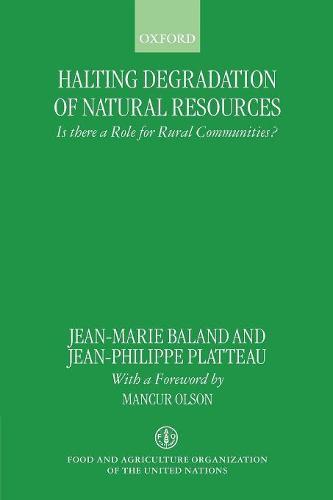
This wide-ranging book, based on a report to the Food and Agriculture Organization of the United Nations, bridges the gap between the enormous amount of empirical literature documenting efforts at managing local-level resources and the quickly growing body of theoretical knowledge dealing with natural resource management. By building a unifying framework, the authors aim to better define the conditions of success or failure of various forms of resource management at the village level. Contrary to a common view according to which mismanagement of such resources is to be ascribed to direct users falling prey to the Tragedy of the Commons', they convincingly argue that there are other important potential explanations, such as lack of awareness about ecological effects of human activities, poverty and heavy discounting of future income streams, uncertainty over future property rights and prices of natural products, and availability of more attractive income opportunities. Moreover, even when mismanagement practices obviously result from strategic interactions among users, many anthropological writings have pointed at crucial aspects that are bypassed by the characterization in terms of the classical Prisoner's Dilemma. Among these aspects, problems of leadership, co-ordination, and heterogeneity are given special emphasis in this book. The theoretical analysis specifies the various economic conditions (such as the extent of resource scarcity and market penetration, the size of user communities, and the nature of different parties' interests in the resource) and social considerations (such as the state of interpersonal communication, the frequency of interactions, the type of leadership, and the extent of mutual trust) under which these problems can possibly be overcome by local user groups. Stress is then laid on the global context within which user groups operate, including the nature and the forms of state intervention and the effects of increasing market integration. To date, this context has generally been uncongenial to community-based resource management; therefore, the authors recommend that, whenever a co-management approach is feasible, the concrete institutional form adopted is tailored to the specific features of local cultures.
Full Product Details
Author: Jean-Marie Baland (Lecturer, Faculty of Economics, Lecturer, Faculty of Economics, Facultés Universitaires Notre Dame de la Paix, Namur, Belgium) ,
Jean-Philippe Platteau (Professor of Economics, Professor of Economics, Facultés Universitaires Notre Dame de la Paix, Namur, Belgium)
Publisher: Oxford University Press
Imprint: Oxford University Press
Dimensions:
Width: 15.60cm
, Height: 2.40cm
, Length: 23.40cm
Weight: 0.626kg
ISBN: 9780198290612
ISBN 10: 0198290616
Pages: 440
Publication Date: 16 March 2000
Audience:
Professional and scholarly
,
Professional & Vocational
Format: Paperback
Publisher's Status: Active
Availability: To order

Stock availability from the supplier is unknown. We will order it for you and ship this item to you once it is received by us.
Reviews
We are in deep and grateful debt to Baland and Platteau for a work of clarity, analytical prudence, interdisciplinary consciousness, synthetic reach and insight, and expositional felicity. --Journal of Economic Literature<br>