Awards
- Long-listed for Templer Medal 2013
- Long-listed for Templer Medal 2013.
Overview
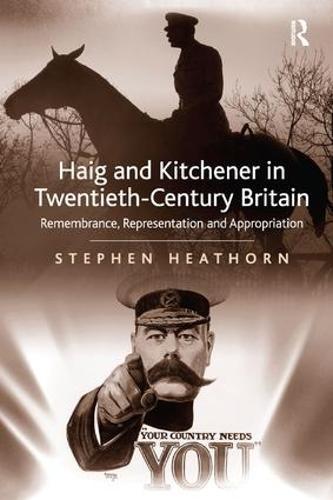
Lord Kitchener and Lord Haig are two monumental figures of the First World War. Their reputations, both in their lifetimes and after their deaths, have been attacked and defended, scrutinized and contested. They have been depicted in film, print and public memorials in Britain and the wider world, and new biographies of both men appear to this day. The material representations of Haig and Kitchener were shaped, used and manipulated for official and popular ends by a variety of groups at different times during the twentieth century. The purpose of this study is not to discover the real individual, nor to attack or defend their reputations, rather it is an exploration of how both men have been depicted since their deaths and to consider what this tells us about the nature and meaning of First World War commemoration. While Haig's representation was more contested before the Second World War than was Kitchener's, with several constituencies trying to fashion and use Haig's memory - the Government, the British Legion, ex-servicemen themselves, and bereaved families - it was probably less contested, but overwhelmingly more negative, than Kitchener's after the Second World War. The book sheds light on the notion of 'heroic' masculinity - questioning, in particular, the degree to which the image of the common soldier replaced that of the high commander in the popular imagination - and explores how the military heritage in the twentieth century came into collision with the culture of modernity. It also contributes to ongoing debates in British historiography and to the larger debates over the social construction of memory, the problematic relation between what is considered 'heritage' and 'history', and the need for historians to be sensitive and attentive to the interconnections between heritage and history and their contexts.
Full Product Details
Author: Stephen Heathorn
Publisher: Taylor & Francis Ltd
Imprint: Routledge
Edition: New edition
Dimensions:
Width: 15.60cm
, Height: 1.80cm
, Length: 23.40cm
Weight: 0.453kg
ISBN: 9780754669654
ISBN 10: 0754669653
Pages: 278
Publication Date: 03 April 2013
Audience:
Professional and scholarly
,
General/trade
,
Professional & Vocational
,
General
Format: Hardback
Publisher's Status: Active
Availability: In Print

This item will be ordered in for you from one of our suppliers. Upon receipt, we will promptly dispatch it out to you. For in store availability, please contact us.
Reviews
'This is an excellent and enjoyable book that makes readers think afresh about what they already know and persuade them of its interpretation. The direction and the methodology is innovative and makes a real contribution to the fields of modern British history and the study of the remembrance of the First World War. Heathorn is particularly to be congratulated on his ability to match the history of the memorialisation of Kitchener and Haig into a broader history of Britain in the twentieth century - an impressive achievement.'Dan Todman, Queen Mary University of London, UK
Author Information
Stephen Heathorn is Professor of British History and Director of Graduate Studies of the Department of History at McMaster University, Canada. He is the author of For Home, Country and Race (University of Toronto Press, 2000) and more than two dozen academic articles on the history of nationalism, commemoration and heritage in Britain.