Overview
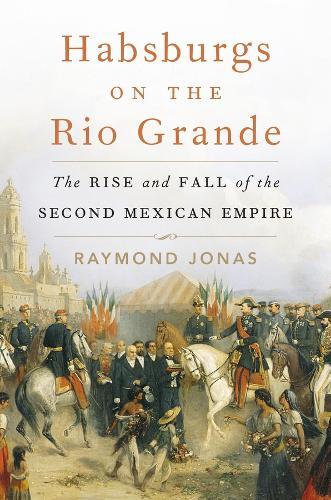
“Vividly reconstructs how Maximilian’s power was forged and maintained by the sharp end of a French bayonet.” —New York Times Book Review The story of how nineteenth-century European rulers conspired with Mexican conservatives in an outlandish plan to contain the rising US colossus by establishing Old World empire on its doorstep. The outbreak of the US Civil War provided an unexpected opportunity for political conservatives across continents. On one side were European monarchs eager to counter growing US power, which threatened their hegemony. On the other, Mexican antidemocrats needed backers to fend off the republicanism of Benito Juárez. When these two groups found each other, the Second Mexican Empire was born. Raymond Jonas argues that the empire, often dismissed as a historical sideshow, is critical to appreciating the global effects of US power in the nineteenth century. In 1862, at the behest of Mexican reactionaries and with the initial support of Spain and Britain, Napoleon III sent French troops to Mexico. There, he installed Austrian archduke Ferdinand Maximilian as a ruler who could resist democracy in North America. But the French were routed at the Battle of Puebla, and republican guerrillas spent the next four years bleeding the would-be empire. After the Civil War, African American troops were dispatched to Mexico to hasten the French withdrawal. Habsburgs on the Rio Grande fundamentally rewrites narratives of global history. Far from a footnote, the Second Mexican Empire was central to great-power struggles that set the terms of twentieth-century rivalry.
Full Product Details
Author: Raymond Jonas
Publisher: Harvard University Press
Imprint: Harvard University Press
Dimensions:
Width: 14.00cm
, Height: 2.40cm
, Length: 21.00cm
Weight: 0.346kg
ISBN: 9780674305007
ISBN 10: 0674305000
Pages: 384
Publication Date: 12 May 2026
Audience:
Professional and scholarly
,
Professional & Vocational
Format: Paperback
Publisher's Status: Forthcoming
Availability: Not yet available

This item is yet to be released. You can pre-order this item and we will dispatch it to you upon its release.
Reviews
Adds to our understanding of the Second Mexican Empire by giving us a fuller account of both its rise and dissolution, and...helps us to see anew the importance of an episode, so near the U.S., that is routinely overshadowed by the drama of the Civil War.--Steven McGregor ""Wall Street Journal"" (4/18/2024 12:00:00 AM) One of the few detailed studies of a subject little known to most readers in North America or Europe: the short-lived Mexican Empire of 1863/67.--Randall Newnham ""German Politics and Society"" (3/1/2025 12:00:00 AM) Vividly reconstructs how Maximilian's power was forged and maintained by the sharp end of a French bayonet...Jonas is astute and judicious in navigating the kaleidoscope of contradictory political ideologies that came together in the Second Mexican Empire, before all too quickly coming apart again.--Natasha Wheatley ""New York Times Book Review"" (4/20/2024 12:00:00 AM) Fascinating and full of insights. Building on extensive research across multiple countries and languages, Jonas casts new light on the French invasion of Mexico, from its racialized justifications to the almost tragicomic cluelessness of Maximilian and Carlota.--Alice Baumgartner, author of South to Freedom: Runaway Slaves to Mexico and the Road to Civil War Rescuing Maximilian and Carlota's ill-fated effort to create an empire in Mexico from its undeserved obscurity, Jonas reveals it to be central to debates about the possibilities and perils of democracy not only in Mexico but in Europe and the US as well. Based on deep research on both sides of the Atlantic, Habsburgs on the Rio Grande is a masterpiece of transnational history.--Karl Jacoby, author of The Strange Career of William Ellis: The Texas Slave Who Became a Mexican Millionaire Without a doubt the best work on the Second Mexican Empire ever produced in English. Jonas maintains narrative momentum even as he provides serious analysis, moving with equal dexterity through the complications of court politics in different European states, church-state relations in Mexico, and the battlefields in which men of different origins killed each other in pursuit of their personal ambitions and ideological passions.--Peter Guardino, author of The Dead March: A History of the Mexican-American War
Vividly reconstructs how Maximilian’s power was forged and maintained by the sharp end of a French bayonet…Jonas is astute and judicious in navigating the kaleidoscope of contradictory political ideologies that came together in the Second Mexican Empire, before all too quickly coming apart again. -- Natasha Wheatley * New York Times Book Review * Adds to our understanding of the Second Mexican Empire by giving us a fuller account of both its rise and dissolution, and…helps us to see anew the importance of an episode, so near the U.S., that is routinely overshadowed by the drama of the Civil War. -- Steven McGregor * Wall Street Journal * Jonas has made a grand entrance into the study of Mexican history with his new book…This work, which is not only scholarly, very well-written, and engaging, is intelligent, thought-provoking, and presented in an original manner. -- Héctor Strobel * Journal of the Civil War Era * Jonas has produced perhaps the first comprehensive history of the Second Mexican Empire published in English …[and] has supplied a definitive text on an important if transitory stage of North American history and one that will be cited extensively. -- Sarah K.M. Rodríguez * Pacific Historical Review * One of the few detailed studies of a subject little known to most readers in North America or Europe: the short-lived Mexican Empire of 1863/67. -- Randall Newnham * German Politics and Society * Engaging…the book could hardly be timelier. -- Barnabas Szabo * CEU Review of Books * Fascinating and full of insights. Building on extensive research across multiple countries and languages, Jonas casts new light on the French invasion of Mexico, from its racialized justifications to the almost tragicomic cluelessness of Maximilian and Carlota. -- Alice Baumgartner, author of <i>South to Freedom: Runaway Slaves to Mexico and the Road to Civil War</i> Without a doubt the best work on the Second Mexican Empire ever produced in English. Jonas maintains narrative momentum even as he provides serious analysis, moving with equal dexterity through the complications of court politics in different European states, church-state relations in Mexico, and the battlefields in which men of different origins killed each other in pursuit of their personal ambitions and ideological passions. -- Peter Guardino, author of <i>The Dead March: A History of the Mexican-American War</i> Rescuing Maximilian and Carlota’s ill-fated effort to create an empire in Mexico from its undeserved obscurity, Jonas reveals it to be central to debates about the possibilities and perils of democracy not only in Mexico but in Europe and the US as well. Based on deep research on both sides of the Atlantic, Habsburgs on the Rio Grande is a masterpiece of transnational history. -- Karl Jacoby, author of <i>The Strange Career of William Ellis: The Texas Slave Who Became a Mexican Millionaire</i>
Author Information
Raymond Jonas is the author of several books, including The Battle of Adwa: African Victory in the Age of Empire, a Choice Outstanding Academic Book and winner of the Toyin Falola Africa Book Award. Previously a Fulbright Senior Scholar, a National Endowment for the Humanities Fellow, and a member of the Institute for Advanced Study, he is the Jon Bridgman Endowed Professor in History at the University of Washington, Seattle.