Overview
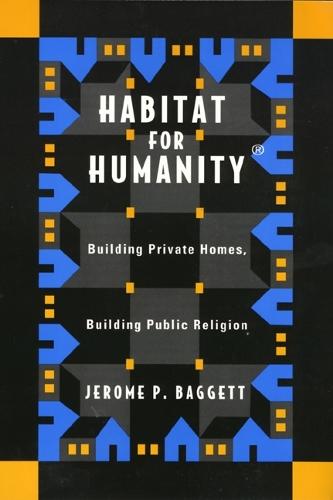
Habitat for Humanity\u00ae, a grassroots house-building ministry founded in 1976 by evangelical Christians, is one of the best-known and most widely popular nonprofit organizations in operation today. With approximately 1500 local Habitat affiliates in the United States and more than 85,000 homes primarily by mobilizing concerned citizens, who include about 250,000 American volunteers each year. The author tells the story of Habitat's development and the special fervor it evokes among volunteers and those for whom it builds houses. Through interviews with staff, he also provides a look into the organizational dynamics of Habitat, a non-profit whose religious mission for social change is inevitably affected by the instrumental, bottom-line orientation of the state and the market. Baggett argues that Habitat is an examine of a particular social form of religion, the paradenominational organization, that is uniquely adapted to the climate of the modern world. It is one of the vital forms that voluntarism takes today.
Full Product Details
Author: Jerome Baggett
Publisher: Temple University Press,U.S.
Imprint: Temple University Press,U.S.
Dimensions:
Width: 15.20cm
, Height: 2.00cm
, Length: 22.90cm
Weight: 0.386kg
ISBN: 9781566398039
ISBN 10: 1566398037
Pages: 312
Publication Date: 15 December 2000
Audience:
College/higher education
,
Professional and scholarly
,
Undergraduate
,
Postgraduate, Research & Scholarly
Format: Paperback
Publisher's Status: Active
Availability: Awaiting stock

The supplier is currently out of stock of this item. It will be ordered for you and placed on backorder. Once it does come back in stock, we will ship it out for you.
Reviews
Jerome Baggett has taken a searching look at Habitat for Humanity(R). Along with striking success he has found significant problems arising from differences in social class between volunteers and homeowners, the impingement of the market, and the individualism of the volunteer culture. His book is a major contribution to the self-understanding of Habitat and of religious volunteer groups in America generally. Those interested in civil society and the public role of religion will find this book indispensable. -Robert N. Bellah, co-author of Habits of the Heart This is an excellent book on Habitat for Humanity(R)-its vision, its appeal to volunteers, its construction of 'real religion.' Baggett brings to this analysis a theoretical grasp of the role of parachurch organizations, an appreciation for how building houses can take on religious and civic meaning for volunteers, and a sensitivity to the many Americans today looking for ways to become engaged in a hands-on, service-oriented activity. The book is both informative and a genuine pleasure to read. -Wade Clark Roof, J.F. Rowny Professor of Religion and Society, University of California at Santa Barbara Jerome Baggett's Habitat for Humanity(R) is an original and ground-breaking sociological study. In this first in-depth sociological investigation of Habitat for Humanity(R), Baggett also provides keen insights into voluntarism and faith-based special purpose groups which engage in social service. He asks: How does faith embrace and challenge our common citizen ideals? For, as the subtitle of the book suggests, building public religion should also get linked to our public citizenship together. -John A. Coleman, S.J., Casassa Professor of Social Values, Loyola Marymount University, and author of Public Discipleship: Para-Church Groups and Citizenship In describing the history, accomplishments, and popularity of Habitat for Humanity(R), Jerome Baggett has produced a significant contribution to our understanding of religion and volunteering in America. Compared with the downward trend that characterizes so many civic organizations, Habitat for Humanity(R) has been remarkably successful in attracting a growing number of participants. Baggett shows us some of the reasons why, especially the importance of social organization that is flexible, pragmatic, specialized, and rooted in broad nonsectarian religious values. -Robert Wuthnow, Princeton University, author of Loose Connections: Joining Together in America's Fragmented Communities In this engaging book, Jerome Baggett uses the case of Habitat for Humanity to shed empirical light on religion's relationship to civic participation... I recommend this well written, engaging book to all with an interest in the sociology of the voluntary sector and parachurch organizations. - Sociology of Religion ...an excellent qualitative analysis of Habitat for Humanity and lessons this faith-based organization can teach other grassroots organizations. -Journal of the American Planning Association
Jerome Baggett has taken a searching look at Habitat for Humanity(R). Along with striking success he has found significant problems arising from differences in social class between volunteers and homeowners, the impingement of the market, and the individualism of the volunteer culture. His book is a major contribution to the self-understanding of Habitat and of religious volunteer groups in America generally. Those interested in civil society and the public role of religion will find this book indispensable. --Robert N. Bellah, co-author of Habits of the Heart This is an excellent book on Habitat for Humanity(R)--its vision, its appeal to volunteers, its construction of 'real religion.' Baggett brings to this analysis a theoretical grasp of the role of parachurch organizations, an appreciation for how building houses can take on religious and civic meaning for volunteers, and a sensitivity to the many Americans today looking for ways to become engaged in a hands-on, service-oriented activity. The book is both informative and a genuine pleasure to read. --Wade Clark Roof, J.F. Rowny Professor of Religion and Society, University of California at Santa Barbara Jerome Baggett's Habitat for Humanity(R) is an original and ground-breaking sociological study. In this first in-depth sociological investigation of Habitat for Humanity(R), Baggett also provides keen insights into voluntarism and faith-based special purpose groups which engage in social service. He asks: How does faith embrace and challenge our common citizen ideals? For, as the subtitle of the book suggests, building public religion should also get linked to our public citizenship together. --John A. Coleman, S.J., Casassa Professor of Social Values, Loyola Marymount University, and author of Public Discipleship: Para-Church Groups and Citizenship In describing the history, accomplishments, and popularity of Habitat for Humanity(R), Jerome Baggett has produced a significant contribution to our understanding of religion and volunteering in America. Compared with the downward trend that characterizes so many civic organizations, Habitat for Humanity(R) has been remarkably successful in attracting a growing number of participants. Baggett shows us some of the reasons why, especially the importance of social organization that is flexible, pragmatic, specialized, and rooted in broad nonsectarian religious values. --Robert Wuthnow, Princeton University, author of Loose Connections: Joining Together in America's Fragmented Communities
Author Information
Jerome P. Baggett is Assistant Professor of sociology at Carroll College in Helena, Montana.