Overview
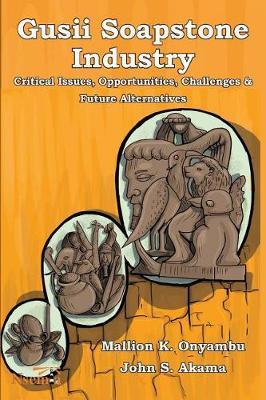
As is the case with most African indigenous industries, not much research has been done on the Gusii soapstone industry. Consequently, the main aim of this book is to fill the identified gap. Specifically, this book traces the origin of the Gusii soapstone industry, going through various stages, i.e. the Pre-Colonial, Colonial and Post-Colonial periods. Within this historical context, the book provides an elucidation of the social, economic, political and cultural factors that have impacted on the evolution and/or development of the soapstone industry. A critical issue captured in the book is the fact that, over the years, the soapstone handicraft products have been transformed from being items of utility for the local people to, mainly, becoming non-utility items that are sold to outsiders, particularly international tourists as unique pieces of indigenous handicraft and/or African art. However, it should be noted that, notwithstanding this transformation, indigenous cultural attributes and/or cultural themes that would have otherwise disappeared, due to increased impacts of globalization, are being preserved by the sculpturing of unique indigenous soapstone products. Furthermore, currently, the soapstone industry has become a major source of livelihood for the Gusii people of Tabaka in Southwestern Kenya.
Full Product Details
Author: Mallion K Onyambu ,
John S Akama
Publisher: Nsemia Inc.
Imprint: Nsemia Inc.
Dimensions:
Width: 15.20cm
, Height: 0.70cm
, Length: 22.90cm
Weight: 0.191kg
ISBN: 9781926906751
ISBN 10: 1926906756
Pages: 134
Publication Date: 11 October 2018
Audience:
General/trade
,
General
Format: Paperback
Publisher's Status: Active
Availability: Available To Order

We have confirmation that this item is in stock with the supplier. It will be ordered in for you and dispatched immediately.
Reviews
This book provides a lucid articulation of various facets (i.e., social, economic, cultural and political perspectives) of the Gusii soapstone industry, and the fundamental factors that have made the industry survive, over the years, notwithstanding the introduction of mass produced goods from the Western world. The conceptualization of the role of the indigenous industry in promoting sustainable livelihood is clearly brought out, and is presented within the broader milieu of the Gusii society. The book provides excellent reading for anyone interested in having proper perspectives on the history and the overall development of the Gusii soapstone industry. Elkanah Ong'esa, a world renowned artist and soapstone sculptor. As much as the soapstone sculptures are found in museums, art galleries, curio shops and people's homes in most major cities of the world, not much research and documentation of these unique indigenous industry initiatives has been done. In light of that, this book on the Gusii soapstone industry fills a critical niche and is quite handy for people from all walks of life and academia looking for up to date information on the Gusii soapstone industry. Dr. Margaret Barasa, Anthropolinguistic Expert, and Dean, Faculty of Arts and Social Sciences, Kisii University, Kenya. Most literature on African indigenous industries, such as soapstone mining, carving and marketing, is based on Eurocentric approach which looks at these industries and African art as exotic items for the pleasure of Western gentry and middleclass. Adopting an Afrocentric approach, this book provides a refreshing analysis of the history, transformation and growth of the Gusii soapstone industry; an indigenous initiative that has evolved, systematically, over the years, and has shown a lot of resiliency in the face of many complex challenges. The book is recommended to people who want to have a proper perspective of similar indigenous industries and the Gusii soapstone industry in particular. Matunda Nyanchama, Publisher. This book looks at the resilience of the soapstone industry in Gusii. It shows that the soapstone carvings as currently developed by the Gusii people may have its origin in ancient traditions that dates back to hundreds and perhaps thousands of years. It also gives a good historical analysis of the growth and development of the soapstone industry. It will goes a long way in illuminating critical aspects of the Gusii soapstone industry. Herman Kiriama, Senior Research Fellow, Kisii University, Kenya.
Author Information
Mallion K. Onyambu pursued her undergraduate studies in the early 1990s at Kenyatta University, Kenya where she graduated with Bachelor of Education, Arts Degree. After many years of teaching in Kenyan high schools, she enrolled and completed her Master's Degree in History from Moi University in 2013. She is currently pursuing PhD studies in History at the same institution. Her research interests are in areas of economic history, gender studies, land use policy and planning, and African history. Prof. John S. Akama, did his undergraduate studies in education at the University of Nairobi. He then proceeded to the USA for his Masters and PhD studies at Ohio University and Southern Illinois University, respectively. On returning to Kenya he joined Moi University as a Lecturer and rose to the rank of full Professor, teaching at both undergraduate and postgraduate levels. Over the years, Prof. Akama has conducted extensive research and has published widely in diverse areas such as culture, sociology and tourism and wildlife conservation. Prof. John S. Akama is the current Vice Chancellor of Kisii University. Professor Akama is the author of The Gusii of Kenya: Social, Economic, Cultural, Political and Judicial Perspectives (Nsemia Inc. 2017) and The Untold Story: Gusii Survival Techniques & Resistance to Colonial Rule (Kisii University Press, 2018).