Overview
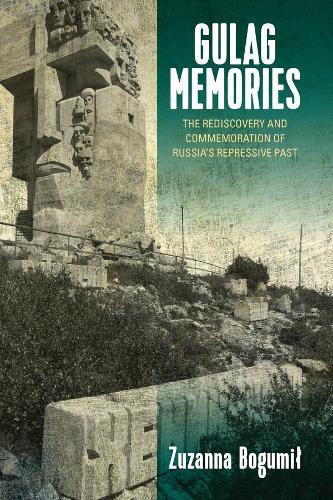
Though the institution of the Gulag was nominally closed over half a decade ago, it lives on as an often hotly contested site of memory in the post-socialist era. This ethnographic study takes a holistic, comprehensive approach to understanding memories of the Gulag, and particularly the language of commemoration that surrounds it in present-day Russian society. It focuses on four regions of particular historical significance—the Solovetsky Islands, the Komi Republic, the Perm region, and Kolyma—to carefully explore how memories become a social phenomenon, how objects become heritage, and how the human need to create sites of memory has preserved the Gulag in specific ways today.
Full Product Details
Author: Zuzanna Bogumił
Publisher: Berghahn Books
Imprint: Berghahn Books
ISBN: 9781800734371
ISBN 10: 1800734379
Pages: 248
Publication Date: 08 April 2022
Audience:
Professional and scholarly
,
Professional & Vocational
Format: Paperback
Publisher's Status: Active
Availability: In Print

This item will be ordered in for you from one of our suppliers. Upon receipt, we will promptly dispatch it out to you. For in store availability, please contact us.
Reviews
[The book's] considerable value as a contribution to Soviet and post-Soviet memory studies is undeniable. Bogumil's work should become a must-read for everyone who works in the field of the memory of political repressions. * Soviet & Post-Soviet Politics & Society Bogumil's work is a welcome contribution to our understanding that there are in fact several Russias standing eyeball to eyeball, and several memories of Russia's Stalinist past. Bogumil reminds us that the memory of the Holocaust was shaped over generations, so we may have to analyze this phenomenon in Russia in the longer run. For now, it is clear that the short-term remedy to circumvent any obligation to fully confront the meaning of the Gulag is to remember a brighter past or place the memory of Stalinism in the state's hands. * American Historical Review ...a rich, provocative study that will generate much discussion in post-Soviet memory studies. * The Russian Review Bogumil's book is an important development in prison camp anthropology - for, although there are quite a few books and articles dedicated to particular former Gulag sites and their post-Stalin and post-Soviet history, this is the first book to take a systemic (and well researched) approach to the memorialisation of the Gulag. * Australian Slavonic and East European Studies This is a captivating interdisciplinary book that analyzes the complex reawakening history of Gulag memory in the Russian Federation. It is key to all those interested in understanding the complexity of memory formation, and its political, social, and cultural nature. * Eurasian Geography and Economics Bogumil's contribution to the field sheds light on the ways in which the Gulag is understood and represented in Russia's often-neglected regions. * Ab Imperio Zuzanna Bogumil's thoroughly and well-researched book represents a major contribution to the field of her study and cannot be ignored by any serious scholar who is interested in sites of memory of communist terror in the post-Soviet world and in this memory in general. * Baltic Worlds
Bogumil's work is a welcome contribution to our understanding that there are in fact several Russias standing eyeball to eyeball, and several memories of Russia's Stalinist past. Bogumil reminds us that the memory of the Holocaust was shaped over generations, so we may have to analyze this phenomenon in Russia in the longer run. For now, it is clear that the short-term remedy to circumvent any obligation to fully confront the meaning of the Gulag is to remember a brighter past or place the memory of Stalinism in the state's hands. * American Historical Review ...a rich, provocative study that will generate much discussion in post-Soviet memory studies. * The Russian Review Bogumil's book is an important development in prison camp anthropology - for, although there are quite a few books and articles dedicated to particular former Gulag sites and their post-Stalin and post-Soviet history, this is the first book to take a systemic (and well researched) approach to the memorialisation of the Gulag. * Australian Slavonic and East European Studies This is a captivating interdisciplinary book that analyzes the complex reawakening history of Gulag memory in the Russian Federation. It is key to all those interested in understanding the complexity of memory formation, and its political, social, and cultural nature. * Eurasian Geography and Economics Bogumil's contribution to the field sheds light on the ways in which the Gulag is understood and represented in Russia's often-neglected regions. * Ab Imperio Zuzanna Bogumil's thoroughly and well-researched book represents a major contribution to the field of her study and cannot be ignored by any serious scholar who is interested in sites of memory of communist terror in the post-Soviet world and in this memory in general. * Baltic Worlds
Author Information
Zuzanna Bogumił, PhD, works at the Institute of Archaeology and Ethnology at the Polish Academy of Sciences. Her published works include the co-authored studies The Enemy on Display: The Second World War in Eastern European Museums (Berghahn 2015) and Milieux de mémoire in Late Modernity: Local Communities, Religion, and Historical Politics (Peter Lang 2019), and co-edited volume Memory and Religion from a Postsecular Perspective (Routledge 2022).