Overview
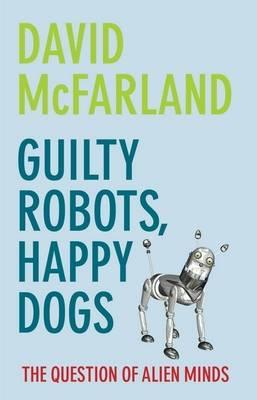
When we interact with animals, we intuitively read thoughts and feelings into their expressions and actions - it is easy to suppose that they have minds like ours. And as technology grows more sophisticated, we might soon find ourselves interpreting the behaviour of robots too in human terms.It is natural for us to humanize other beings in this way, but is it philosophically or scientifically justifiable? How different might the minds of animals or machines be to ours? As David McFarland asks here, could robots ever feel guilty, and is it correct to suppose your dog can truly be happy? Can we ever know what non-human minds might be like, or will the answer be forever out of our reach? These are central and important questions in the philosophy of mind, and this book is an accessible exploration of the differing philosophical positions that can be taken on the issue. McFarland looks not only at philosophy, but also examines new evidence from the science of animal behaviour plus the latest developments in robotics and artificial intelligence, to show how many different - and sometimes surprising - conclusions we can draw about the nature of 'alien minds'.
Full Product Details
Author: David McFarland (Emeritus Fellow of Balliol College, Oxford)
Publisher: Oxford University Press
Imprint: Oxford University Press
Dimensions:
Width: 12.80cm
, Height: 1.50cm
, Length: 19.50cm
Weight: 0.199kg
ISBN: 9780199219308
ISBN 10: 0199219303
Pages: 272
Publication Date: 12 March 2009
Audience:
General/trade
,
Professional and scholarly
,
General
,
Postgraduate, Research & Scholarly
Format: Paperback
Publisher's Status: Out of Print
Availability: In Print

Limited stock is available. It will be ordered for you and shipped pending supplier's limited stock.
Reviews
There is much food for thought here for both scientists and philosophers. * Daniel C. Dennett, Bioscience *
There is much food for thought here for both scientists and philosophers. Daniel C. Dennett, Bioscience
Author Information
David McFarland is Emeritus Fellow of Balliol College, Oxford, having retired from his post of University Reader in Animal Behaviour at the Department of Zoology in 2000. Since then he has held a post as Professor of Biological Robotics at the University of the West of England, and is currently President of Casa Cantarilla, an Association of Teachers in the Arts and Sciences in Spain. He has also held posts as Professor of Psychology at the University of Pennsylvania, and Lecturer in Psychology at the Universities of Durham and Oxford. He has published in the fields of animal behaviour, philosophy, physiology, psychology and robotics, and has written numerous books, most recently The Oxford Dictionary of Animal Behaviour (2006).