Overview
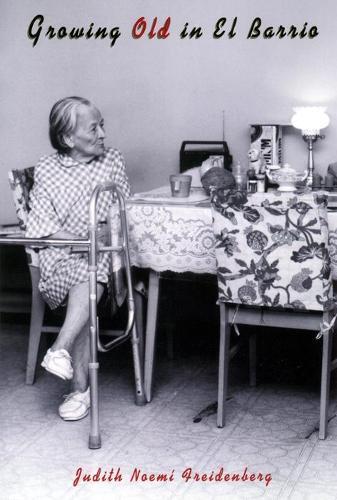
What is daily life like for an elderly person whose income barely covers basic needs? How is life constrained if that person is living within the same marginal enclave to which she first migrated decades ago? How does the implementation of national policies and programs affect the daily life of those growing old in Spanish Harlem? In Growing Old in El Barrio, Judith Freidenberg addresses these questions by examining the life-course and daily experiences of the elderly residents of El Barrio. She interweaves the economy of immigrant neighborhoods with the personal experiences of Latinos aging in Harlem--such as Doña Emiliana, who lived in Spanish Harlem from her migration in 1948 to her death in 1995. Freidenberg further links policy issues to social issues critical to the daily lives of this population. Combining extensive fieldwork interviews with historical and demographic population data, Growing Old in El Barrio paints an ethnographic picture of aging in Spanish Harlem and illustrates the emergence of New York as a city divided by ethnicity and class.
Full Product Details
Author: Judith Noemi Freidenberg
Publisher: New York University Press
Imprint: New York University Press
Dimensions:
Width: 15.20cm
, Height: 2.20cm
, Length: 22.90cm
Weight: 0.567kg
ISBN: 9780814727027
ISBN 10: 0814727026
Pages: 320
Publication Date: 01 August 2000
Audience:
College/higher education
,
Professional and scholarly
,
Undergraduate
,
Postgraduate, Research & Scholarly
Format: Hardback
Publisher's Status: Active
Availability: Manufactured on demand

We will order this item for you from a manufactured on demand supplier.
Reviews
(<p> The author believes that her role is to let informants construct their own definitions and cultural understandings rather than using standardized measure of poverty or relying alone on objective socioeconomic indicators. )-( Centro Journal ), ()
<p> The author believes that her role is to let informants construct their own definitions and cultural understandings rather than using standardized measure of poverty or relying alone on objective socioeconomic indicators.
<p> A compassionate and knowledgeable writer, Judith Freidenberg chronicles the amazing perseverance and resilience of the population of older women and men who live in El Barrio, while describing the internal diversity and social issues that cut across larger populations. Growing Old in El Barrio is an illuminating and important book. -Robert N. Butler M.D, President and CEO, International Longevity Center
The author believes that her role is to let informants construct their own definitions and cultural understandings rather than using standardized measure of poverty or relying alone on objective socioeconomic indicators. -Centro Journal An important contribution to the history and ethnography of El Barrio. Particularly valuable is the way in which Freidenberg humanizes her subjects who, as elderly and Latino, are often totally ignored or reduced to a mere statistic. -Arlene Davila,Syracuse University A compassionate and knowledgeable writer, Judith Freidenberg chronicles the amazing perseverance and resilience of the population of older women and men who live in El Barrio, while describing the internal diversity and social issues that cut across larger populations. Growing Old in El Barrio is an illuminating and important book. -Robert N. Butler M.D,President and CEO, International Longevity Center Makes a strong case for qualitative ethnography in developing policy. Freidenberg provides an excellent balance between quantitative and qualitative research, enriching both with a project that deepens our understanding of the problems of aging migrants. Its exceptional clarity recommends it for both students and policy makers. -June Nash,City University of New York The most important book to date on the life of urban Hispanic elderly, it provides a vivid understanding of life today in New York City's El Barrio. Freidenberg is especially successful in having the voices of her informants not only lay out the social construction of immigrant experience but using these materials to analyze the important policy implications of her work. -Jay Sokolovsky,University of South Florida
Makes a strong case for qualitative ethnography in developing policy. Freidenberg provides an excellent balance between quantitative and qualitative research, enriching both with a project that deepens our understanding of the problems of aging migrants. Its exceptional clarity recommends it for both students and policy makers. -June Nash,City University of New York An important contribution to the history and ethnography of El Barrio. Particularly valuable is the way in which Freidenberg humanizes her subjects who, as elderly and Latino, are often totally ignored or reduced to a mere statistic. -Arlene Davila,Syracuse University The author believes that her role is to let informants construct their own definitions and cultural understandings rather than using standardized measure of poverty or relying alone on objective socioeconomic indicators. -Centro Journal A compassionate and knowledgeable writer, Judith Freidenberg chronicles the amazing perseverance and resilience of the population of older women and men who live in El Barrio, while describing the internal diversity and social issues that cut across larger populations. Growing Old in El Barrio is an illuminating and important book. -Robert N. Butler M.D,President and CEO, International Longevity Center The most important book to date on the life of urban Hispanic elderly, it provides a vivid understanding of life today in New York City's El Barrio. Freidenberg is especially successful in having the voices of her informants not only lay out the social construction of immigrant experience but using these materials to analyze the important policy implications of her work. -Jay Sokolovsky,University of South Florida
The most important book to date on the life of urban Hispanic elderly, it provides a vivid understanding of life today in New York City's El Barrio. Freidenberg is especially successful in having the voices of her informants not only lay out the social construction of immigrant experience but using these materials to analyze the important policy implications of her work. -Jay Sokolovsky,University of South Florida An important contribution to the history and ethnography of El Barrio. Particularly valuable is the way in which Freidenberg humanizes her subjects who, as elderly and Latino, are often totally ignored or reduced to a mere statistic. -Arlene Davila,Syracuse University Makes a strong case for qualitative ethnography in developing policy. Freidenberg provides an excellent balance between quantitative and qualitative research, enriching both with a project that deepens our understanding of the problems of aging migrants. Its exceptional clarity recommends it for both students and policy makers. -June Nash,City University of New York The author believes that her role is to let informants construct their own definitions and cultural understandings rather than using standardized measure of poverty or relying alone on objective socioeconomic indicators. -Centro Journal A compassionate and knowledgeable writer, Judith Freidenberg chronicles the amazing perseverance and resilience of the population of older women and men who live in El Barrio, while describing the internal diversity and social issues that cut across larger populations. Growing Old in El Barrio is an illuminating and important book. -Robert N. Butler M.D,President and CEO, International Longevity Center
Author Information
A native of Argentina, JUDITH FREIDENBERG is Assistant Professor of Anthropology at the University of Maryland.