Awards
- Winner of Co-winner of the American Society for Public Administration, Section on Public Administration Research's best book award (United States).
- Winner of Public Administration Section: Herbert A. Simon Book Award (United States).
Overview
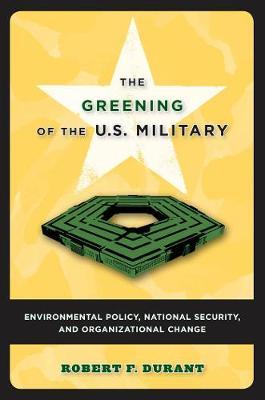
By the Cold War's end, U.S. military bases harbored nearly 20,000 toxic waste sites. All told, cleaning the approximately 27 million acres is projected to cost hundreds of billions of dollars. And yet while progress has been made, efforts to integrate environmental and national security concerns into the military's operations have proven a daunting and intrigue-filled task that has fallen short of professed goals in the post-Cold War era. In ""The Greening of the U.S. Military"", Robert F. Durant delves into this too-little understood world of defense environmental policy to uncover the epic and ongoing struggle to build an environmentally sensitive culture within the post-Cold War military. Through over 100 interviews and thousands of pages of documents, reports, and trade newsletter accounts, he offers a telling tale of political, bureaucratic, and intergovernmental combat over the pace, scope, and methods of applying environmental and natural resource laws while ensuring military readiness. He then discerns from these clashes over principle, competing values, and narrow self-interest a theoretical framework for studying and understanding organizational change in public organizations. From Dick Cheney's days as Defense Secretary under President George H.W. Bush to William Cohen's Clinton-era-tenure and on to Donald Rumsfeld's Pentagon, the battle over ""greening"" the military has been one with high-stakes consequences for both national defense and public health, safety, and the environment. Durant's polity-centered perspective and arguments will evoke needed scrutiny, debate, and dialogue over these issues in environmental, military, policymaking, and academic circles.
Full Product Details
Author: Robert F. Durant , Robert F. Durant , Robert F. Durant , Robert F. Durant
Publisher: Georgetown University Press
Imprint: Georgetown University Press
Dimensions:
Width: 15.20cm
, Height: 1.70cm
, Length: 22.90cm
Weight: 0.431kg
ISBN: 9781589011533
ISBN 10: 1589011538
Pages: 320
Publication Date: 18 May 2007
Audience:
Professional and scholarly
,
Professional & Vocational
Format: Paperback
Publisher's Status: Active
Availability: Manufactured on demand 
We will order this item for you from a manufactured on demand supplier.
Table of Contents
Preface Acronyms 1. A World Apart? 2. Greening, National Security, and the Postmodern Military 3. About-Face at the Pentagon? 4. Base Cleanups, Sovereign Impunity, and the Expansion of the Beaten Zone 5. Guns, Dogs, Fences, and Base Transfers 6. Missiles, Mayhem, and the Munitions Rule 7. Natural Resources Management, Miltary Training, and the Greening of the Drone Zone 8. Safety, Security, and Chemical Weapons Demilitarization 9. Pollution Prevention, Energy Conservation, and the Perils of Chateaux Generalship 10. Avoiding the Harder Right in the Post-Clinton Era? 11. Lessons for Practice and Theory Index
Reviews
The Greening of the U.S. Military helps to add energy, depth, and luster to academic studies of policy history, bureaucratic politics, and public management. --Michael Barzelay, professor of public management, London School of Economics and Political Science A very well-written book describing the attempts to instill a 'beyond compliance' environmental culture in the military and the forces that shape these efforts. In short, no book is as up-to-date and extensive or as theoretical. The scholarship is superior. --Denise Scheberle, professor of public and environmental affairs, University of Wisconsin-Green Bay Durant has provided keenly insightful analysis of governmental administration and policy in previous books, and here he goes again. The U.S. military maintains the most potentially destructive force of any organizational entity in the world, and the defense of the environment against destruction is one of the most important contemporary issues. Durant provides exceptionally valuable analysis of the convergence of these two topics, and of progress, and lack thereof, in meeting the crucial challenge of coordinating them. While doing so, he makes a highly significant contribution to analysis and understanding of organizational change in government. --Hal G. Rainey, Alumni Foundation Distinguished Professor, School of Public and International Affairs, The University of Georgia
Author Information
Robert F. Durant is professor of public administration and policy at American University. He has received numerous research awards, including the 2000 Best Book Award from the Public and Nonprofit Division of the Academy of Management; the Gladys M. Kammerer Award for the best book on U.S. national policy from the American Political Science Association; and the Charles H. Levine Memorial Award given jointly by the American Society for Public Administration and the National Association of Schools of Public Affairs and Administration. He is a fellow in the National Academy of Public Administration.
Tab Content 6
Author Website:
Countries Available
All regions
|