Overview
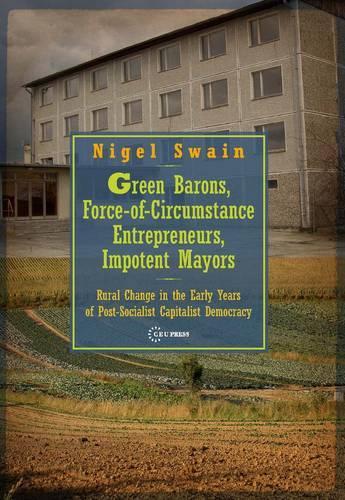
An exemplary study in comparative contemporary history, this monograph looks at rural change in six countries: Bulgaria, Czech Republic, Hungary, Poland, Romania and Slovakia. In the 1990s most of these nations experienced a fourth radical restructuring of agricultural relations in the twentieth century, and all went through the dramatic transition from communism to capitalism. The author analyzes attempts to activate democracy on a local level and recreate farming structures and non-agricultural businesses based on private ownership and private enterprise. He describes the emergence of a new business class that seeks to dominate local government structures; the recuperation of former communist farming entities by former managers; and the transformation of peasants into rural citizens, who nevertheless remain the underdogs. Swain exposes common features as well as specific divergences between the six countries; he portrays the winners, losers and engineers of transformations. He situates his themes in a wider context that will appeal to a broad range of social scientists and historians.
Full Product Details
Author: Nigel Swain
Publisher: Central European University Press
Imprint: Central European University Press
Dimensions:
Width: 15.20cm
, Height: 2.30cm
, Length: 22.90cm
Weight: 0.920kg
ISBN: 9786155225703
ISBN 10: 6155225702
Pages: 412
Publication Date: 10 October 2013
Audience:
College/higher education
,
Postgraduate, Research & Scholarly
Format: Hardback
Publisher's Status: Active
Availability: Manufactured on demand

We will order this item for you from a manufactured on demand supplier.
Reviews
"""After twenty years of extensive research and publications on diff erent aspects of rural change in postsocialist eastern Europe, Nigel Swain is unquestionably a leading scholar in this field. With his Green Barons, Force-of-Circumstance Entrepreneurs, Impotent Mayors, a volume on rural change in east central and southeastern Europe from 1989 until the mid-1990s, he offers a synthesis of his knowledge. This is to be treated as overwhelmingly good news... 'Green barons' and 'force-of-circumstance entrepreneurs' aptly describe the two most common careers in rural postsocialist eastern Europe. In a broader historical perspective, the postsocialist pattern of landholding was unique in that many owned land but few had the human, social, or cultural resources to embark on farming it privately and commercializing the products."" * Slavic Review *"
After twenty years of extensive research and publications on diff erent aspects of rural change in postsocialist eastern Europe, Nigel Swain is unquestionably a leading scholar in this field. With his Green Barons, Force-of-Circumstance Entrepreneurs, Impotent Mayors, a volume on rural change in east central and southeastern Europe from 1989 until the mid-1990s, he offers a synthesis of his knowledge. This is to be treated as overwhelmingly good news... 'Green barons' and 'force-of-circumstance entrepreneurs' aptly describe the two most common careers in rural postsocialist eastern Europe. In a broader historical perspective, the postsocialist pattern of landholding was unique in that many owned land but few had the human, social, or cultural resources to embark on farming it privately and commercializing the products. * Slavic Review *
Author Information
Nigel Swain is lecturer at the School of History, University of Liverpool. He is the author of Collective Farms which Work?, Cambridge University Press, 1985; Hungary: The Rise and Fall of Feasible Socialism, Verso, 1992; and Eastern Europe since 1945 (with Geoffrey Swain), Palgrave Macmillan, 1993.