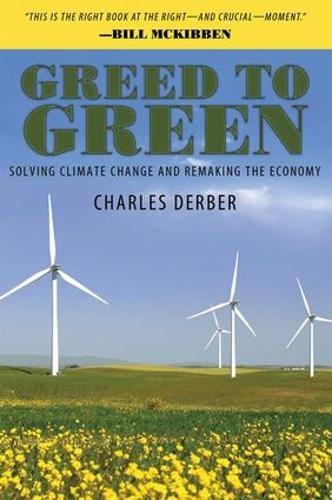
Full Product Details
Author: Charles Derber
Publisher: Taylor & Francis Inc
Imprint: Routledge
Dimensions:
Width: 15.60cm
, Height: 2.30cm
, Length: 23.40cm
Weight: 0.498kg
ISBN: 9781594518119
ISBN 10: 1594518114
Pages: 272
Publication Date: 28 February 2010
Audience:
College/higher education
,
General/trade
,
Tertiary & Higher Education
,
General
Format: Hardback
Publisher's Status: Active
Availability: In Print

This item will be ordered in for you from one of our suppliers. Upon receipt, we will promptly dispatch it out to you. For in store availability, please contact us.
Reviews
“Charles Derber’s urgent call to action on climate change connects to realistically upbeat ways to help resolve our energy, peace, and employment challenges. To read this book is to react with personal and social action."" —Ralph Nader ""There's no way to solve climate change without also shifting, in profound ways, our idea of what constitutes success and growth and progress. This is the right book at the right—and crucial—moment.” —Bill McKibben, author of The End of Nature and creator of the student-based ""Step It Up"" campaign to cut carbon emissions and of 350.org, today's leading climate change movement ""As this wonderfully inspiring book makes clear, the failure of the United States to achieve energy independence, eliminate potential oil wars, and truly address issues of social justice is a consequence of our corporate-dominated economy. Greed to Green brings home the fact that a people's movement to green the economy depends on creating a political system which subordinates the interests of big business to those of its citizens—and to the natural environment which sustains us all."" —Ross Gelbspan, Pulitzer Prize winner and author of The Heat Is On and Boiling Point ""Derber, professor of sociology at Boston College, makes a radical but persuasive argument that our current form of capitalism, with its short-term thinking, is the cause of climate change, and that we can't solve the latter without confronting the former. He contends that in order to be moved to action sufficient to avert calamitous global warming, we need to feel the crisis viscerally, not just understand it intellectually, and forge solutions that 'not only ward off the long-term catastrophe but also help solve today's most burning crises: economic deep recession, vanishing jobs, unstable oil prices, Middle East wars, rotten education, deteriorating public infrastructure, poverty, and financial insecurity.' Derber is optimistic about Obama's strategies but foresees 'enormous structural obstacles' to their implementation, and concludes that social justice and environmental movements—however riddled with weaknesses—are our 'best last hope for solving global warming on the urgent time scale required.' Despite the urgency and seriousness of his message, Derber conveys an appealing enthusiasm that may inspire concerned citizens to action rather than apathy or despair."" —Publisher’s Weekly “Bringing a sociological imagination to the climate change debate, activist and academic Derber argues that as a symptom of underlying capitalist disease, global warming cannot be solved by green technology alone: social and political innovation is also necessary. His critique is trenchant . . . Derber writes in a lively, “hurry-up” style reflecting, no doubt, the urgency of the global warming problem.” —Library Journal “Derber tackles a plethora of misconceptions about climate change, and his text is likely to have a profound impact due to the eloquent and comprehensible diction that he employs to explain complex socio-ecological interactions. Furthermore, his insightful analysis of the interconnections between the American short-term mindset, climate change, and the crisis-riddled economy addresses many of the misconceptions and lapses of awareness the general American public holds regarding both environmental and social justice.” --Critical Sociology 37(4) p 497-500
There's no way to solve climate change without also shifting, in profound ways, our idea of what constitutes success and growth and progress. This is the right book at the right-and crucial-moment. -- Bill McKibben Derber proposes a broad greening of our economy, politics and society, ingeniously relying on short term windows to enact long term changes. -- Juliet Schor, Professor of Sociology, Boston College, and author of Plenitude: The New Economics of True Wealth As this wonderfully inspiring book makes clear, the failure of the United States to achieve energy independence, eliminate potential oil wars. ... Greed to Green brings home the fact that a people's movement to green the economy depends on creating a political system which subordinates the interests of big business to those of its citizens. -- Ross Gelbspan, Pulitzer Prize winner and author of The Heat Is On and Boiling Point Charles Derber's urgent call to action on climate change connects to realistically upbeat ways to help resolve our energy, peace, and employment challenges. To read this book is to react with personal and social action. -- Ralph Nader 'Charles Derber is one of our most astute and eloquent social critics. . . His political analysis is persuasive and is enlivened by graceful prose.' -- Howard Zinn
Charles Derber's urgent call to action on climate change connects to realistically upbeat ways to help resolve our energy, peace, and employment challenges. To read this book is to react with personal and social action. -Ralph Nader There's no way to solve climate change without also shifting, in profound ways, our idea of what constitutes success and growth and progress. This is the right book at the right-and crucial-moment. -Bill McKibben, author of The End of Nature and creator of the student-based Step It Up campaign to cut carbon emissions and of 350.org, today's leading climate change movement As this wonderfully inspiring book makes clear, the failure of the United States to achieve energy independence, eliminate potential oil wars, and truly address issues of social justice is a consequence of our corporate-dominated economy. Greed to Green brings home the fact that a people's movement to green the economy depends on creating a political system which subordinates the interests of big business to those of its citizens-and to the natural environment which sustains us all. -Ross Gelbspan, Pulitzer Prize winner and author of The Heat Is On and Boiling Point Derber, professor of sociology at Boston College, makes a radical but persuasive argument that our current form of capitalism, with its short-term thinking, is the cause of climate change, and that we can't solve the latter without confronting the former. He contends that in order to be moved to action sufficient to avert calamitous global warming, we need to feel the crisis viscerally, not just understand it intellectually, and forge solutions that 'not only ward off the long-term catastrophe but also help solve today's most burning crises: economic deep recession, vanishing jobs, unstable oil prices, Middle East wars, rotten education, deteriorating public infrastructure, poverty, and financial insecurity.' Derber is optimistic about Obama's strategies but foresees 'enormous structural obstacles' to their implementation, and concludes that social justice and environmental movements-however riddled with weaknesses-are our 'best last hope for solving global warming on the urgent time scale required.' Despite the urgency and seriousness of his message, Derber conveys an appealing enthusiasm that may inspire concerned citizens to action rather than apathy or despair. -Publisher's Weekly Bringing a sociological imagination to the climate change debate, activist and academic Derber argues that as a symptom of underlying capitalist disease, global warming cannot be solved by green technology alone: social and political innovation is also necessary. His critique is trenchant ... Derber writes in a lively, hurry-up style reflecting, no doubt, the urgency of the global warming problem. -Library Journal Derber tackles a plethora of misconceptions about climate change, and his text is likely to have a profound impact due to the eloquent and comprehensible diction that he employs to explain complex socio-ecological interactions. Furthermore, his insightful analysis of the interconnections between the American short-term mindset, climate change, and the crisis-riddled economy addresses many of the misconceptions and lapses of awareness the general American public holds regarding both environmental and social justice. --Critical Sociology 37(4) p 497-500
Charles Derber's urgent call to action on climate change connects to realistically upbeat ways to help resolve our energy, peace, and employment challenges. To read this book is to react with personal and social action. -Ralph Nader There's no way to solve climate change without also shifting, in profound ways, our idea of what constitutes success and growth and progress. This is the right book at the right-and crucial-moment. -Bill McKibben, author of The End of Nature and creator of the student-based Step It Up campaign to cut carbon emissions and of 350.org, today's leading climate change movement As this wonderfully inspiring book makes clear, the failure of the United States to achieve energy independence, eliminate potential oil wars, and truly address issues of social justice is a consequence of our corporate-dominated economy. Greed to Green brings home the fact that a people's movement to green the economy depends on creating a political system which subordinates the interests of big business to those of its citizens-and to the natural environment which sustains us all. -Ross Gelbspan, Pulitzer Prize winner and author of The Heat Is On and Boiling Point Derber, professor of sociology at Boston College, makes a radical but persuasive argument that our current form of capitalism, with its short-term thinking, is the cause of climate change, and that we can't solve the latter without confronting the former. He contends that in order to be moved to action sufficient to avert calamitous global warming, we need to feel the crisis viscerally, not just understand it intellectually, and forge solutions that 'not only ward off the long-term catastrophe but also help solve today's most burning crises: economic deep recession, vanishing jobs, unstable oil prices, Middle East wars, rotten education, deteriorating public infrastructure, poverty, and financial insecurity.' Derber is optimistic about Obama's strategies but foresees 'enormous structural obstacles' to their implementation, and concludes that social justice and environmental movements-however riddled with weaknesses-are our 'best last hope for solving global warming on the urgent time scale required.' Despite the urgency and seriousness of his message, Derber conveys an appealing enthusiasm that may inspire concerned citizens to action rather than apathy or despair. -Publisher's Weekly Bringing a sociological imagination to the climate change debate, activist and academic Derber argues that as a symptom of underlying capitalist disease, global warming cannot be solved by green technology alone: social and political innovation is also necessary. His critique is trenchant . . . Derber writes in a lively, hurry-up style reflecting, no doubt, the urgency of the global warming problem. -Library Journal Derber tackles a plethora of misconceptions about climate change, and his text is likely to have a profound impact due to the eloquent and comprehensible diction that he employs to explain complex socio-ecological interactions. Furthermore, his insightful analysis of the interconnections between the American short-term mindset, climate change, and the crisis-riddled economy addresses many of the misconceptions and lapses of awareness the general American public holds regarding both environmental and social justice. --Critical Sociology 37(4) p 497-500
Author Information
Charles Derber is Professor of Sociology at Boston College. He is the author of Corporation Nation, Hidden Power and Greed to Green.