|
|
|||
|
||||
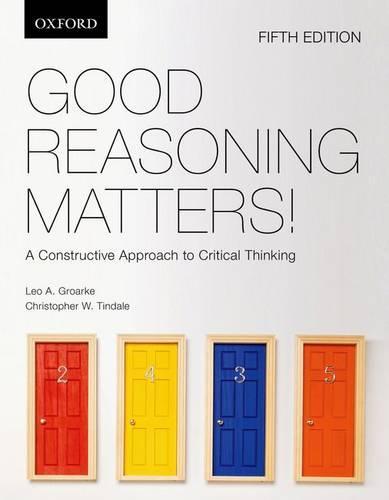
OverviewFull Product DetailsAuthor: Leo Groarke (Professor, Department of Philosophy, University of Windsor, Professor, Department of Philosophy, University of Windsor) , Christopher Tindale (Professor, Department of Philosophy, University of Windsor, Professor, Department of Philosophy, University of Windsor)Publisher: Oxford University Press, Canada Imprint: Oxford University Press, Canada Edition: 5th Revised edition Dimensions: Width: 17.80cm , Height: 1.80cm , Length: 22.80cm Weight: 0.674kg ISBN: 9780195445756ISBN 10: 0195445759 Pages: 480 Publication Date: 01 November 2012 Audience: College/higher education , Professional and scholarly , Undergraduate , Professional & Vocational Format: Paperback Publisher's Status: Active Availability: To order Stock availability from the supplier is unknown. We will order it for you and ship this item to you once it is received by us. Table of Contents1. Making Room for an Argument Why Make Room for an Argument? Defining Argument Arguers and Systems of Belief Audiences Opponents and Proponents 2. Bias: Reading Between the Lines Bias Detecting Illegitimate Biases Difficult Cases 3. Arguments, Weak and Strong Burden of Proof Strong Arguments Logical Consequence: Deductive and Inductive Validity Contextual Relevance Schemes and Counter-Schemes 4. Dressing Arguments Simple and Extended Arguments Inference Indicators: Distinguishing Arguments and Non-Arguments Arguments without Indicator Words Arguments and Explanations Argument Narratives 5. Argument Diagrams Argument Diagrams: Simple Arguments Diagramming Extended Arguments Linked and Convergent Premises Supplemented Diagram Diagrammng Your Own Arguments 6. Hidden Argument Components Speech Acts and the Principles of Communication Hidden Conclusions Hidden Premises Non-Verbal Elements in Argument: Flags and Demonstrations Symbols and Metaphors A Note on Argument Construction 7. Definitions: Saying What You Mean Using Words Precisely Vagueness and Ambiguity Formulating Definitions Rules for Good Definitions Expressing Your Intended Meaning 8. Weighing Evidence Acceptable, Unacceptable, or Questionable? Conditions of Acceptability Conditions of Unacceptability Internal Relevance Sufficiency Applying the Criteria 9. Looking for the Facts Generalizations Polling General Causal Reasoning 10. More Empirical Schemes and the Reasons of Science Particular Causal Reasoning Arguments from Ignorance Scientific Reasoning 11. Schemes of Value Slippery-Slope Arguments Arguments from Analogy Appeals to Precedent Two-Wrongs Reasoning 12. Ethotic Schemes Pro Homine Ad Populum Arguments Arguments from Authority Ad Hominem Arguments Against Authority Appeal to Eyewitness Testimony Guilt (and Honour) by Association Other Cases 13. Essaying an Argument The Good Evaluative Critique The Good Argumentative Essay A Student's Paper Conclusion Appendix A: Syllogisms: Classifying Arguments Categorical Statements Immediate Inferences Categorical Syllogisms Venn Diagrams Appendix B: Propositional Logic I Simple and Complex Propositions Disjunctions and Conditionals Translation Propositional Schemes and Proofs Appendix C: Propositional Logic II Conditional Proofs Reductio ad Absurdum Dilemmas De Morgan's Laws Summary: Rules of InferenceReviewsThe clear presentation of concepts is a strength of the text. There's ample explanation of core ideas as well as good motivation for why they matter. -- Adam Rawlings, Trent University The writing style is very engaging and clear. -- Megan Delehanty, University of Calgary The concepts and skills are generally accessible, with good use of examples and illustrations in developing the topics. -- Ahmad Rahmanian, University of New Brunswick The clear presentation of concepts is a strength of the text. There's ample explanation of core ideas as well as good motivation for why they matter. -- Adam Rawlings, Trent University The writing style is very engaging and clear. -- Megan Delehanty, University of Calgary The concepts and skills are generally accessible, with good use of examples and illustrations in developing the topics. -- Ahmad Rahmanian, University of New Brunswick Author InformationLeo A. Groarke is the president and vice-chancellor of Trent University. His research interests include the history of ideas, social and political philosophy, informal logic, and argumentation theory. He has published numerous books, chapters, and journal articles in these and other areas. Christopher W. Tindale is professor of philosophy at the University of Windsor. His research interests include argumentation theory, ethics, and ancient philosophy. He has published numerous book chapters and extensively in journals and is the author of Fallacies and Argument Appraisal (2007) and Rhetorical Argumentation (2004). He is co-editor of the journal Informal Logic. Tab Content 6Author Website:Countries AvailableAll regions |
||||