Overview
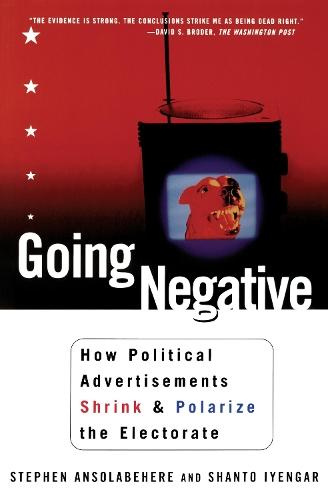
Political advertising has been called the worst cancer in American society. Ads cost millions, and yet the entire campaign season is now filled with nasty and personal attacks. In this landmark six-year study, two of the nation's leading political scientists show exactly how cancerous the ad spot has become. 16 illustrations.
Full Product Details
Author: Shanto Iyengar ,
Stephen Ansolabehere
Publisher: Simon & Schuster
Imprint: The Free Press
Edition: New edition
Dimensions:
Width: 15.60cm
, Height: 1.80cm
, Length: 23.40cm
Weight: 0.365kg
ISBN: 9780684837116
ISBN 10: 0684837110
Pages: 256
Publication Date: 07 October 1997
Audience:
College/higher education
,
Professional and scholarly
,
Undergraduate
,
Postgraduate, Research & Scholarly
Format: Paperback
Publisher's Status: No Longer Our Product
Availability: Out of print, replaced by POD

We will order this item for you from a manufatured on demand supplier.
Reviews
One of those books destined to be more talked about than read: Two political scientists offer an interesting take on negative advertising in election campaigns. Ansolabehere (MIT) and Iyengar (UCLA) showed both actual TV spots and ads that they designed themselves to 3,500 adults during six California races, then asked a battery of questions to gauge responses to positive and negative tones. The surprising conclusions: Attack ads impart valuable information to voters about candidates' positions; they tend to reinforce voters' partisan predispositions rather than persuade them to change their views, and thus are not truly manipulative; and their most significant effect is to decrease voter turnout, especially among independent voters, by magnifying cynicism about the entire system. The authors decry the loss of these generally centrist nonpartisan voters, which they claim has led to the polarization of the Democratic and Republican parties; they do not address the issue of whether the nation would really benefit from greater involvement by citizens who get most of their political information from 30-second television commercials. Their remedy - strengthening the two major parties - appears to largely contradict the book's most controversial finding, that decreased turnout actually benefits the GOP, whose prevailing ideology depends on hostility to government. Readers will continually have to struggle past the stolid prose and noisy charts; and those who doubt the efficacy of controlled experiments by social scientists will have to suspend disbelief; one must assume, for example, that people for whom $15 is sufficient inducement to drive across Los Angeles in order to watch television are representative of the national electorate. While some of the results here are intriguing, most readers will no doubt prefer having the contents filtered by their favorite pundits. (Kirkus Reviews)
Author Information
Stephen Ansolabehere is a professor of government at Harvard University.