Awards
- Winner of Choice Outstanding Academic Title 2017
- Winner of Outstanding Academic Title 2017
Overview
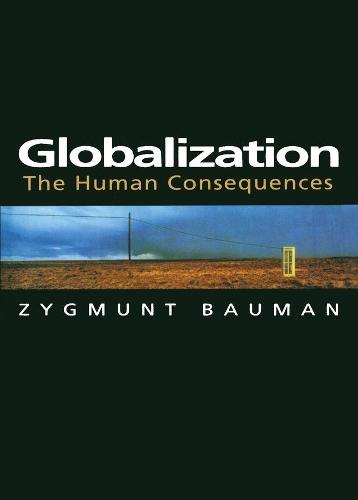
The word ""globalization"" is used to convey the hope and determination of order-making on a worldwide scale. It is trumpeted as providing more mobility-of people, capital, and information-and as being equally beneficial for everyone. With recent technological developments-most notably the Internet-globalization seems to be the fate of the world. But no one seems to be in control. As noted sociologist Zygmunt Bauman shows in this detailed history of globalization, while human affairs now take place on a global scale, we are not able to direct events; we can only watch as boundaries, institutions, and loyalties shift in rapid and unpredictable ways. Who benefits from the new globalization? Are people in need assisted more quickly and efficiently? Or are the poor worse off than ever before? Will a globalized economy shift jobs away from traditional areas, destroying time-honored national industries? Who will enjoy access to jobs in the new hierarchy of mobility? From the way the global economy creates a class of absentee landlords to current prison designs for the criminalized underclass, Bauman dissects globalization in all its manifestations: its effects on the economy, politics, social structures, and even our perceptions of time and space. In a chilling analysis, Bauman argues that globalization divides as much as it unites, creating an ever-widening gulf between the haves and the have-nots. Rather than the hybrid culture we had hoped for, globalization is creating a more homogenous world. Drawing on the works of philosophers, social historians, architects, and theoreticians such as Michel Foucault, Claude Lévi-Strauss, Alfred J. Dunlap, and Le Corbusier, Globalization presents a historical overview of the methods employed to create and define human spaces and institutions, from rural villages to sprawling urban centers. Bauman shows how the advent of the computer translates into the decline of truly public space. And he explores the dimensions of a world in which-through new technologies-time is accelerated and space is compressed, revealing how we have arrived at our current state of global thinking. Bauman's incisive methods of inquiry make Globalization an excellent antidote to the exuberance expressed by those who stand to benefit from the new pace and mobility of the modern life.
Full Product Details
Author: Zygmunt Bauman ,
Michael M. Weinstein ,
Nicholas Sun-keung Pang
Publisher: Columbia University Press
Imprint: Columbia University Press
Dimensions:
Width: 18.80cm
, Height: 1.10cm
, Length: 13.50cm
Weight: 0.184kg
ISBN: 9780231114295
ISBN 10: 023111429
Pages: 160
Publication Date: 31 August 2000
Audience:
Professional and scholarly
,
Professional & Vocational
Format: Paperback
Publisher's Status: Active
Availability: Manufactured on demand

We will order this item for you from a manufactured on demand supplier.
Language: English
Reviews
[A]nyone prepared to move beyond the seductiveness of libertarian ideology... will find Globalization as eloquent a summation of the problem as they are likely to encounter anywhere. -- Alan Ehrenhalt, Wilson Quarterly
Anyone prepared to move beyond the seductiveness of libertarian ideology... will find Globalization as eloquent a summation of the problem as they are likely to encounter anywhere. -- Alan Ehrenhalt Wilson Quarterly Utilizing the works of philosophers, historians, architects, and theoreticians, British sociologist Zygmunt Bauman takes a hard look at the history, ethics, and economic and social consequences of globalization, and finds that it will inevitably divide more than it unites. Globe and Mail A valuable introduction to the question of globalization, and, more importantly, sets a new agenda for sociological theory at the beginning of the twenty-first century. Acta Sociologica A powerful antidote to bland political-cultural pronouncements of the 'there is no alternative' variety. British Journal of Sociology Brooding brilliance... Bauman subtly lays out [globalization's] 'human consequences.' Independent
Author Information
Zygmunt Bauman is emeritus professor of sociology at the University of Leeds and the University of Warsaw. He is the author or editor of numerous books, including Liquid Times: Living in an Age of Uncertainty, Consuming Life, Does Ethics Have a Chance in a World of Consumers? and The Art of Life.