Overview
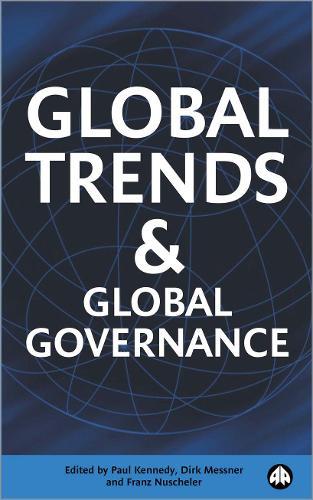
Which global issues have the most impact on our lives at the beginning of the 21st century? What's the relationship between developments in politics, ecology, the economy, security, and systems of global government, and how do we as individuals address the problems that they raise in an increasingly globalized world? Global Trends and Global Governance offers answers to these questions. It is a concise and practical guide that explains the key political, eonomic, ecological and social factors that shape the process of globalization, and the way that they affect the lives of all people around the world. Written in a clear and accessible style, it is an indispensible handbook for activists, civil servants, policy researchers, and anyone interested in getting involved in political action. Covering each of the subject areas chapter by chapter, and drawing on information from UN reports, the book is packed with useful facts and figures that elucidate these complex ideas. It includes analysis of the US economy and US foreign policy as part of a wider critique of UN-unilaterlism, revealing the need to establish more cooperative and inclusive forms of global politics. Public action, such as the organized protests in Seattle and Prague, and the demonstrations at the environment summit at the Hague, are now having an impact on the way that the world is governed. Addressing this changing situation, and the implications that it holds for human security, the contributors analyse ways in which we can evolve new ways of working together to cope with problems of a transnational nature.
Full Product Details
Author: Paul Kennedy ,
Dirk Messner ,
Franz Nuscheler
Publisher: Pluto Press
Imprint: Pluto Press
Dimensions:
Width: 13.50cm
, Height: 1.50cm
, Length: 21.50cm
Weight: 0.349kg
ISBN: 9780745317502
ISBN 10: 0745317502
Pages: 216
Publication Date: 20 December 2001
Audience:
College/higher education
,
Professional and scholarly
,
Undergraduate
,
Postgraduate, Research & Scholarly
Format: Paperback
Publisher's Status: Active
Availability: In Print

This item will be ordered in for you from one of our suppliers. Upon receipt, we will promptly dispatch it out to you. For in store availability, please contact us.
Reviews
The complex relationship among developments in politics, ecology, economics, security, and global governance systems is the focus of this book. The contributors strive to come up with prophetic answers about the direction in which the world is heading at the beginning of the twenty-first century. This insightful volume combines scholarly analysis with recommendations for political action. -- The Futurist These essays argue that global forces are increasing the risks of violence and instability. These risks, in turn, must be addressed by greater transnational cooperation. The book is most intriguing when the authors try to pin down the meaning of global governance, defined here as the sum total of world regulatory policies and mechanisms that guide the interaction of economies and societies. The book makes a reasoned case for a more rule-based governance system. -- Foreign Affairs Compact introductory review -- Future Survey This collection contains five essays sponsored by the German Development and Peace Foundation and a sixth that is a response to the Brandt Report, North-South: A Program for Survival (London, 1980). The end of the Cold War and the emergence of the political-economic phenomenon of transnationalism have had a significant effect on the distribution of natural and financial resources, commonly referred to as globalization. The authors note that demographic trends have combined with a view that wealth is maldistributed between the industrialized sector and much of the remainder of the world, and that societies no longer correspond to the historic concept of the nation-state but tend to overlap with one another, leading toward a world society. Economic indicators pointto greater unpredictability of financial markets providing necessary services. One essay also focuses on the increasing environmental degradation and resulting attempts to institute international regulatory instruments. There is a clarion call for the development of a rational approach to global governance to resolve issues of widening poverty and despair. Essential reading for those interested in international political economics, because of its content and its contribution to the debate over the dynamics of globalization. -- CHOICE
'Essential reading for those interested in international political economies, because of its content and its contribution to the debate over the dynamics of globalisation' -- CHOICE
Author Information
Paul Kennedy's best-selling book Preparing for the 21st Century, (Random House, 1993), puts him in the bestseller list of world historians. He is Professor of History and Director of International Security Studies, Institute for International Security Studies, Yale University. Dirk Messner is a leading German intellectual on issues of globalization, and a member of the scientific committee of the Development and Peace Foundation (founded by Willy Brandt in 1986). He is co-director of the Institute for Development and Peace at the University of Duisburg in Germany. Franz Nuscheler is a leading German intellectual on issues of globalization, and a member of the scientific committee of the Development and Peace Foundation (founded by Willy Brandt in 1986). He is co-director of the Institute for Development and Peace at the University of Duisburg in Germany.