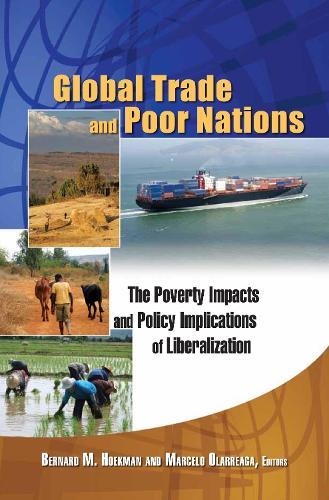
Full Product Details
Author: Marcelo Olarreaga ,
Bernard M. Hoekman ,
Ernesto Zedillo
Publisher: Bloomsbury Publishing Plc
Imprint: Brookings Institution
Dimensions:
Width: 15.80cm
, Height: 1.80cm
, Length: 23.40cm
Weight: 0.386kg
ISBN: 9780815736714
ISBN 10: 0815736711
Pages: 264
Publication Date: 27 July 2007
Audience:
Professional and scholarly
,
Professional & Vocational
Format: Paperback
Publisher's Status: Active
Availability: Manufactured on demand

We will order this item for you from a manufactured on demand supplier.
Reviews
"""No trade policy issue is more urgent than the connection between liberalization and poverty. This path-breaking volume examines the potential consequences of global trade reform for poor countries. The results are sobering. Significant benefits depend on complementary domestic initiatives well outside the realm of trade negotiations."" —Gary Clyde Hufbauer, Peterson Institute for International Economics |""This volume provides valuable analytical links between international trade and poverty alleviation. It is especially useful by emphasizing that trade liberalization, with or without a successful Doha Round, needs to be complemented by specific 'aid for trade' measures, domestic and international, if poor countries and poor people in poor countries are to share in the benefits of trade."" —Gustav Ranis, Yale University |""Contrary to the populist nonsense so fashionable among uninformed critics and a handful of economists, this book argues convincingly that trade liberalization is good for poor countries. But it also underlines the wisdom of complementary measures to assist these countries. This is an important book that will advance the anti-poverty agenda immeasurably. One hopes that Bono can read, not just sing!"" —Jagdish Bhagwati, Columbia University |""Detailed product-level analyses of the distributional implications of tariff changes combined with estimates of the impact of multilateral liberalization make this volume a significant contribution to better understanding the effects of trade liberalization on poverty in poor countries."" —Jaime De Melo, University of Geneva |""Well written and carefully laid out, this work is organized in three parts: an overview of the challenges of poverty reduction via trade reform and an estimation of the effects of global trade reform; the results of the seven country studies; and policy implications of trade liberalization....This book is unquestionably required reading for policy makers contemplating policy and trade reforms that can help their poor countries develop and in turn improve the lot of poor people living in these economies. Highly recommended."" — CHOICE"
No trade policy issue is more urgent than the connection between liberalization and poverty. This path-breaking volume examines the potential consequences of global trade reform for poor countries. The results are sobering. Significant benefits depend on complementary domestic initiatives well outside the realm of trade negotiations. -Gary Clyde Hufbauer, Peterson Institute for International Economics | This volume provides valuable analytical links between international trade and poverty alleviation. It is especially useful by emphasizing that trade liberalization, with or without a successful Doha Round, needs to be complemented by specific 'aid for trade' measures, domestic and international, if poor countries and poor people in poor countries are to share in the benefits of trade. -Gustav Ranis, Yale University | Contrary to the populist nonsense so fashionable among uninformed critics and a handful of economists, this book argues convincingly that trade liberalization is good for poor countries. But it also underlines the wisdom of complementary measures to assist these countries. This is an important book that will advance the anti-poverty agenda immeasurably. One hopes that Bono can read, not just sing! -Jagdish Bhagwati, Columbia University | Detailed product-level analyses of the distributional implications of tariff changes combined with estimates of the impact of multilateral liberalization make this volume a significant contribution to better understanding the effects of trade liberalization on poverty in poor countries. -Jaime De Melo, University of Geneva | Well written and carefully laid out, this work is organized in three parts: an overview of the challenges of poverty reduction via trade reform and an estimation of the effects of global trade reform; the results of the seven country studies; and policy implications of trade liberalization....This book is unquestionably required reading for policy makers contemplating policy and trade reforms that can help their poor countries develop and in turn improve the lot of poor people living in these economies. Highly recommended. - CHOICE
Well written and carefully laid out, this work is organized in three parts: an overview of the challenges of poverty reduction via trade reform and an estimation of the effects of global trade reform; the results of the seven country studies; and policy implications of trade liberalization...This book is unquestionably required reading for policy makers contemplating policy and trade reforms that can help their poor countries develop and in turn improve the lot of poor people living in these economies. Highly recommended. - CHOICE
Author Information
Bernard M. Hoekman is professor and director of the global economics research area at the Robert Schuman Centre for Advanced Studies, European University Institute, Florence, Italy, where he also serves as the dean of external relations. Ernesto Zedillo is director of the Yale Center for the Study of Globalization, and a professor of international economics and politics at Yale University. He was president of Mexico from 1994 to 2000.