Overview
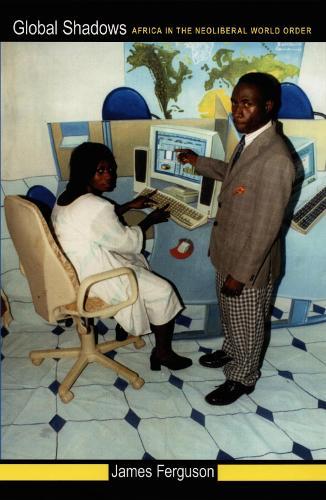
Both on the continent and off, ""Africa"" is spoken of in terms of crisis: as a place of failure and seemingly insurmountable problems, as a moral challenge to the international community. What, though, is really at stake in discussions about Africa, its problems, and its place in the world? And what should be the response of those scholars who have sought to understand not the ""Africa"" portrayed in broad strokes in journalistic accounts and policy papers but rather specific places and social realities within Africa? In Global Shadows the renowned anthropologist James Ferguson moves beyond the traditional anthropological focus on local communities to explore more general questions about Africa and its place in the contemporary world. Ferguson develops his argument through a series of provocative essays which open--as he shows they necessarily must--into interrogations of globalization, modernity, worldwide inequality, and social justice.He maintains that Africans in a variety of different social and geographical locations increasingly seek to make claims of membership within a global community, claims that contest the marginalization that has so far been the principal fruit of ""globalization"" for Africa. Ferguson contends that such claims demand new understandings of the global centred less on trans-national flows and images of unfettered connection than on the social relations that selectively constitute global society and on the rights and obligations that characterize it. Ferguson points out that anthropologists and others who have refused the category of Africa as empirically problematic have, in their devotion to particularity, allowed themselves to remain bystanders in the broader conversations about Africa. In Global Shadows, he urges fellow scholars into the arena, encouraging them to find a way to speak beyond the academy about Africa's position within an egregiously imbalanced world order.
Full Product Details
Author: James Ferguson
Publisher: Duke University Press
Imprint: Duke University Press
Dimensions:
Width: 15.20cm
, Height: 1.60cm
, Length: 22.90cm
Weight: 0.376kg
ISBN: 9780822337171
ISBN 10: 0822337177
Pages: 272
Publication Date: 28 February 2006
Audience:
Professional and scholarly
,
Professional & Vocational
Format: Paperback
Publisher's Status: Active
Availability: In Print

This item will be ordered in for you from one of our suppliers. Upon receipt, we will promptly dispatch it out to you. For in store availability, please contact us.
Reviews
Ferguson's is a substantial voice for and about contemporary Africa. Global Shadows is of general interest to Africanists and includes several essays that can be used productively in the classroom... Together, [the essays] make a statement that, in its collective impact, is even more perceptive than in its unconnected parts. -- Sandra T. Barnes, American Ethnologist Unlike many essay collections, Ferguson's adds up to a coherent whole, and is marked by his talent for providing fresh insights into stale or stagnant discussions... Without doubt, and regardless of one's perspective, Global Shadows is a major gift to the discipline. It is a confident, thorough, and thought-provoking book that raises important questions not only about the idea of Africa but also about the future of anthropology. -- Matthew Engelke, Journal of the Royal Anthropological Institute Ferguson's latest book is certainly a good read and presents a clear argument about Africa's engagement with the global system... This is an extremely useful book for anyone interested in understanding the complexities of Africa's role in a neoliberal world order. -- Rosaleen Duffy, Modern African Studies Global Shadows is one of the most thoughtful, provocative, intelligent books written about Africa in a very long time. It raises in the most profound possible way the question of what precisely Africa is in the twenty-first century: a place, a predicament, an imaginative object, a discursive trope, a 'place-in-the-world' whose economies and social orders, governance and geography, are undergoing bewilderingly complex transformations. James Ferguson challenges us to understand those transformations, this place-in-the-world, in an altogether fresh manner. -John Comaroff, University of Chicago Speaking rationally about Africa is not something that has ever come naturally. This book is a tour de force. James Ferguson shows that a radical critique of the most obtuse and cynical prejudices about Africa can be made without one repeating and perpetuating these prejudices under some other guise. -Achille Mbembe, author of On the Postcolony
Speaking rationally about Africa is not something that has ever come naturally. This book is a tour de force. James Ferguson shows that a radical critique of the most obtuse and cynical prejudices about Africa can be made without one repeating and perpetuating these prejudices under some other guise. Achille Mbembe, author of On the Postcolony Global Shadows is one of the most thoughtful, provocative, intelligent books written about Africa in a very long time. Without romancing the postcolonial moment--or minimizing the very real problems faced by the people of a continent often said to be eclipsed by, overshadowed in, the new global order--it raises in the most profound possible way the question of what precisely Africa is in the twenty-first century: a place, a predicament, an imaginative object, a discursive trope, a 'place-in-the-world' whose economies and social orders, governance and geography, are undergoing bewilderingly complex transformations. A must-read by a distinguished scholar, Global Shadows will be widely cited for many years to come. John Comaroff, University of Chicago ... Global Shadows is a major gift to the discipline. It is a confident, thorough and thought-provoking book that raises important questions not only abou the idea of Africa but also about the future of anthropology. --JRAI, Sept 2007
Speaking rationally about Africa is not something that has ever come naturally. This book is a tour de force. James Ferguson shows that a radical critique of the most obtuse and cynical prejudices about Africa can be made without one repeating and perpetuating these prejudices under some other guise. Achille Mbembe, author of On the Postcolony Global Shadows is one of the most thoughtful, provocative, intelligent books written about Africa in a very long time. Without romancing the postcolonial moment--or minimizing the very real problems faced by the people of a continent often said to be eclipsed by, overshadowed in, the new global order--it raises in the most profound possible way the question of what precisely Africa is in the twenty-first century: a place, a predicament, an imaginative object, a discursive trope, a 'place-in-the-world' whose economies and social orders, governance and geography, are undergoing bewilderingly complex transformations. A must-read by a distinguished scholar, Global Shadows will be widely cited for many years to come. John Comaroff, University of Chicago ... Global Shadows is a major gift to the discipline. It is a confident, thorough and thought-provoking book that raises important questions not only abou the idea of Africa but also about the future of anthropology. --JRAI, Sept 2007
Author Information
James Ferguson is Professor of Cultural and Social Anthropology at Stanford University. He is the author of Expectations of Modernity: Myths and Meanings of Urban Life on the Zambian Copperbelt and The Anti-Politics Machine: “Development,” Depoliticization, and Bureaucratic Power in Lesotho. He is a coeditor of Culture, Power, Place: Explorations in Critical Anthropology, also published by Duke University Press, and of Anthropological Locations: Boundaries and Grounds of a Field Science.