Overview
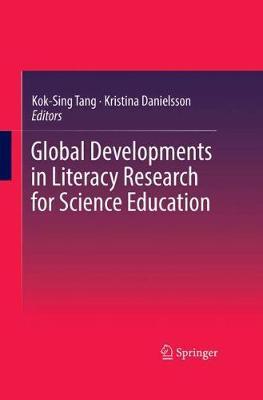
This book highlights recent developments in literacy research in science teaching and learning from countries such as Australia, Brazil, China, Finland, Germany, Hong Kong, New Zealand, Norway, Singapore, Spain, South Africa, Sweden, Taiwan, and the United States. It includes multiple topics and perspectives on the role of literacy in enhancing science teaching and learning, such as the struggles faced by students in science literacy learning, case studies and evaluations of classroom-based interventions, and the challenges encountered in the science classrooms. It offers a critical and comprehensive investigation on numerous emerging themes in the area of literacy and science education, including disciplinary literacy, scientific literacy, classroom discourse, multimodality, language and representations of science, and content and language integrated learning (CLIL). The diversity of views and research contexts in this volume presents a useful introductory handbook for academics,researchers, and graduate students working in this specialized niche area. With a wealth of instructional ideas and innovations, it is also highly relevant for teachers and teacher educators seeking to improve science teaching and learning through the use of literacy.
Full Product Details
Author: Kok-Sing Tang ,
Kristina Danielsson
Publisher: Springer International Publishing AG
Imprint: Springer International Publishing AG
Edition: 1st ed. 2018
Weight: 0.793kg
ISBN: 9783319691961
ISBN 10: 3319691961
Pages: 401
Publication Date: 31 January 2018
Audience:
Professional and scholarly
,
College/higher education
,
Professional & Vocational
,
Postgraduate, Research & Scholarly
Format: Hardback
Publisher's Status: Active
Availability: Manufactured on demand

We will order this item for you from a manufactured on demand supplier.
Author Information
Kok-Sing Tang is a senior lecturer at the Science & Mathematics Education Centre, School of Education at Curtin University. He was formerly an assistant professor at the National Institute of Education, Nanyang Technological University of Singapore. He holds a BA and MSc in Physics from the University of Cambridge and a MA and PhD in Education from the University of Michigan. His research examines the disciplinary literacy of science, which comprises the specialised ways of using and thinking with the language and representations of science to learn and participate in the discipline. In particular, he examines how disciplinary literacy is a necessary process skill in order to learn the content of physics and chemistry, and designs scaffolding strategies to help students learn disciplinary literacy. Before joining academia, Kok-Sing was a high school physics teacher and worked at the Singapore Ministry of Education in various areas such as science curriculum design, technology integration, and science teacher professional development. Kristina Danielsson is a professor at Department of Swedish, Linnaeus University, Sweden. She has a PhD in Scandinavian languages and was formerly professor in reading and writing development at Department of Language Education, Stockholm University. Her research deals with multimodal perspectives of disciplinary literacy, in particular in science. She has been part of a number of interdisciplinary research projects and developmental projects in elementary and secondary science classrooms. In these projects she has examined the literacy practices as well as the ways in which different semiotic resources are used to talk about science phenomena, and what consequences this might lead to regarding the opportunities given for students’ meaning-making in science. A recent developmental project deals with the possibilities of letting young learners explain science phenomena through their own creation of stop-motion films.