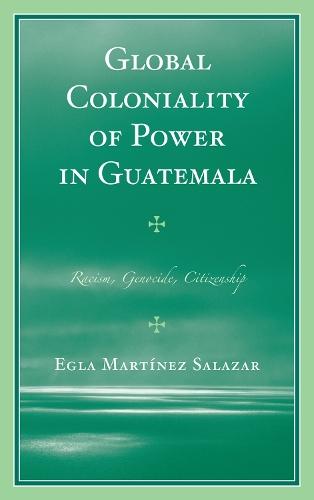
Full Product Details
Author: Egla Martínez Salazar
Publisher: Bloomsbury Publishing Plc
Imprint: Lexington Books
Dimensions:
Width: 15.90cm
, Height: 2.60cm
, Length: 23.50cm
Weight: 0.553kg
ISBN: 9780739141229
ISBN 10: 0739141228
Pages: 296
Publication Date: 20 July 2012
Audience:
Professional and scholarly
,
Professional & Vocational
Format: Hardback
Publisher's Status: Active
Availability: In Print

This item will be ordered in for you from one of our suppliers. Upon receipt, we will promptly dispatch it out to you. For in store availability, please contact us.
Reviews
Anchored in a tragic personal experience, Egla Martinez Salazar weaves together a theoretical-methodological frame of the current socio-historical configuration of Guatemala state and the persistence of Indigenous ways of thinking, doing, and living in Guatemala (where the author was born and raised and experienced devastating effects of the logic of coloniality). She shows how the ethno-racial homogeneity of the European nation-state has deadly consequences when enacted by people of European descent outside of Europe, and are confronted with heterogeneous ethno-racial populations as well as knowledges and ways of being that they do not understand. Genocide has been, through the history of modernity, a recurrent technology of order and homogeneity. Professor Martinez Salazar clearly shows that while the idea of citizenship works well within ethnically homogeneous states, it becomes a problem that carries into gender dynamics when it is implemented in ethnically heterogeneous colonial/modern nation-states. One of the strongest aspects of the book shows how racism works in everyday life -- in racializing proper names and cloths, entangling economic injustices, and exploiting labor and expropriation of land. The white supremacy that leads to European genocides outside and inside Europe (Namibia, the Holocaust), or the consequences of coloniality that engendered local genocides (Rwanda), was reproduced in the ex-colonies of South and Central America. Professor Martinez Salazar shows in great detail how the logic of coloniality works in the Guatemala state. Attentive to the colonial wound that she herself experienced, Martinez Salazar explains genocides and feminecides as logical consequences of coloniality, the hidden agenda of modernity. Guatemala is just one case of the agenda of modernity and its hidden darker side, coloniality. -- Walter D. Mignolo, author of The Darker Side of Western Modernity: Global Futures, Decolonial Options (2011). Speaking from an epistemic space of decolonial autoethnographic interrogations, Global Coloniality of Power in Guatemala: Racism, Genocide and Citizenship is a riveting tour de force that speaks truth to power the normalization of racial and sexual violence towards indigenous communities, students, and working class folks in Guatemala during the US backed civil war, and beyond. And not only does it call out the violence of the US backed genocide in Guatemala, it speaks to the ongoing colonialities of power that subject Mayan struggles for survival against a Ladino driven racial symbolic violence. It is riveting, brilliant, and a must read for those interested in indigenous struggles, human rights, subalternity and gender respect in the Americas. -- Arturo J. Aldama, Colorado University Boulder
Anchored in a tragic personal experience, Egla Martinez Salazar weaves together a theoretical-methodological frame of the current socio-historical configuration of Guatemala state and the persistence of Indigenous ways of thinking, doing, and living in Guatemala (where the author was born and raised and experienced devastating effects of the logic of coloniality). She shows how the ethno-racial homogeneity of the European nation-state has deadly consequences when enacted by people of European descent outside of Europe, and are confronted with heterogeneous ethno-racial populations as well as knowledges and ways of being that they do not understand. Genocide has been, through the history of modernity, a recurrent technology of order and homogeneity. Professor Martinez Salazar clearly shows that while the idea of citizenship works well within ethnically homogeneous states, it becomes a problem that carries into gender dynamics when it is implemented in ethnically heterogeneous colonial/modern nation-states. One of the strongest aspects of the book shows how racism works in everyday life -- in racializing proper names and cloths, entangling economic injustices, and exploiting labor and expropriation of land. The white supremacy that leads to European genocides outside and inside Europe (Namibia, the Holocaust), or the consequences of coloniality that engendered local genocides (Rwanda), was reproduced in the ex-colonies of South and Central America. Professor Martinez Salazar shows in great detail how the logic of coloniality works in the Guatemala state. Attentive to the colonial wound that she herself experienced, Martinez Salazar explains genocides and feminecides as logical consequences of coloniality, the hidden agenda of modernity. Guatemala is just one case of the agenda of modernity and its hidden darker side, coloniality. -- Walter D. Mignolo, author of The Darker Side of Western Modernity: Global Futures, Decolonial Options (2011).
This is a very clearly written, richly detailed polemic by a sociologist of contemporary Guatemalan society. Martinez Salazar (Carleton Univ., Canada) argues that a nation such as Guatemala, while ostensibly freed from the former bonds of colonialism, is still permeated by the racism, economic injustice, and patriarchy typical of colonial oppression and terror. She reviews Guatemalan history from conquest to the present, and then, often referring to interviews she conducted with people from various walks of life, documents enduring injustices. Martinez Salazar pays special attention to racism, exhibited not only by postcolonial elites, but by progressives and revolutionaries as well. She also explores the heavy toll that state power and genocide exacted from Maya women. And she traces the important international connections between state power and the great powers that have so powerfully influenced Guatemala's oppression of its own citizens. The author's emotionally moving documentation of individual episodes of oppression, rape, torture, and murder lead inexorably toward the conclusion that decolonial resistance--the continual struggle for economic, social, and cultural liberation--is still alive and necessary in Guatemala. Summing Up: Highly recommended. All levels/libraries. CHOICE The novelty of Martinez Salazar's work derives not from her arguments per se, but from the application of her arguments to the specific case of Guatemala. ... Global Coloniality of Power in Guatemala is an indispensable examination of how the logic of coloniality persists in contemporary power relations today. Through the integration of theoretical and analytical insights with Indigenous epistemologies, life histories, and personal accounts, Martinez Salazar admirable succeeds in contributing to the epistemic decoloniality. Journal of Anthropological Research Anchored in a tragic personal experience, Egla Martinez Salazar weaves together a theoretical-methodological frame of the current socio-historical configuration of Guatemala state and the persistence of Indigenous ways of thinking, doing, and living in Guatemala (where the author was born and raised and experienced devastating effects of the logic of coloniality). She shows how the ethno-racial homogeneity of the European nation-state has deadly consequences when enacted by people of European descent outside of Europe, and are confronted with heterogeneous ethno-racial populations as well as knowledges and ways of being that they do not understand. Genocide has been, through the history of modernity, a recurrent technology of order and homogeneity. Professor Martinez Salazar clearly shows that while the idea of citizenship works well within ethnically homogeneous states, it becomes a problem that carries into gender dynamics when it is implemented in ethnically heterogeneous colonial/modern nation-states. One of the strongest aspects of the book shows how racism works in everyday life - in racializing proper names and clothes, entangling economic injustices, and exploiting labor and expropriation of land. The white supremacy that leads to European genocides outside and inside Europe (Namibia, the Holocaust), or the consequences of coloniality that engendered local genocides (Rwanda), was reproduced in the ex-colonies of South and Central America. Professor Martinez Salazar shows in great detail how the logic of coloniality works in the Guatemala state. Attentive to the colonial wound that she herself experienced, Martinez Salazar explains genocides and feminecides as logical consequences of coloniality, the hidden agenda of modernity. Guatemala is just one case of the agenda of modernity and its hidden darker side, coloniality. -- Walter D. Mignolo, author of The Darker Side of Western Modernity: Global Futures, Decolonial Options (2011) Speaking from an epistemic space of decolonial autoethnographic interrogations, Global Coloniality of Power in Guatemala: Racism, Genocide and Citizenship is a riveting tour de force that speaks truth to power the normalization of racial and sexual violence towards Indigenous communities, students, and working class folks in Guatemala during the US backed civil war, and beyond. And not only does it call out the violence of the US backed genocide in Guatemala, it speaks to the ongoing colonialities of power that subject Maya struggles for survival against a Ladino driven racial symbolic violence. It is riveting, brilliant, and a must read for those interested in indigenous struggles, human rights, subalternity and gender respect in the Americas. -- Arturo J. Aldama, Colorado University Boulder
This is a very clearly written, richly detailed polemic by a sociologist of contemporary Guatemalan society. Martinez Salazar (Carleton Univ., Canada) argues that a nation such as Guatemala, while ostensibly freed from the former bonds of colonialism, is still permeated by the racism, economic injustice, and patriarchy typical of colonial oppression and terror. She reviews Guatemalan history from conquest to the present, and then, often referring to interviews she conducted with people from various walks of life, documents enduring injustices. Martinez Salazar pays special attention to racism, exhibited not only by postcolonial elites, but by progressives and revolutionaries as well. She also explores the heavy toll that state power and genocide exacted from Maya women. And she traces the important international connections between state power and the great powers that have so powerfully influenced Guatemala's oppression of its own citizens. The author's emotionally moving documentation of individual episodes of oppression, rape, torture, and murder lead inexorably toward the conclusion that decolonial resistance--the continual struggle for economic, social, and cultural liberation--is still alive and necessary in Guatemala. Summing Up: Highly recommended. All levels/libraries. CHOICE Anchored in a tragic personal experience, Egla Martinez Salazar weaves together a theoretical-methodological frame of the current socio-historical configuration of Guatemala state and the persistence of Indigenous ways of thinking, doing, and living in Guatemala (where the author was born and raised and experienced devastating effects of the logic of coloniality). She shows how the ethno-racial homogeneity of the European nation-state has deadly consequences when enacted by people of European descent outside of Europe, and are confronted with heterogeneous ethno-racial populations as well as knowledges and ways of being that they do not understand. Genocide has been, through the history of modernity, a recurrent technology of order and homogeneity. Professor Martinez Salazar clearly shows that while the idea of citizenship works well within ethnically homogeneous states, it becomes a problem that carries into gender dynamics when it is implemented in ethnically heterogeneous colonial/modern nation-states. One of the strongest aspects of the book shows how racism works in everyday life - in racializing proper names and clothes, entangling economic injustices, and exploiting labor and expropriation of land. The white supremacy that leads to European genocides outside and inside Europe (Namibia, the Holocaust), or the consequences of coloniality that engendered local genocides (Rwanda), was reproduced in the ex-colonies of South and Central America. Professor Martinez Salazar shows in great detail how the logic of coloniality works in the Guatemala state. Attentive to the colonial wound that she herself experienced, Martinez Salazar explains genocides and feminecides as logical consequences of coloniality, the hidden agenda of modernity. Guatemala is just one case of the agenda of modernity and its hidden darker side, coloniality. -- Walter D. Mignolo, author of The Darker Side of Western Modernity: Global Futures, Decolonial Options (2011). Speaking from an epistemic space of decolonial autoethnographic interrogations, Global Coloniality of Power in Guatemala: Racism, Genocide and Citizenship is a riveting tour de force that speaks truth to power the normalization of racial and sexual violence towards Indigenous communities, students, and working class folks in Guatemala during the US backed civil war, and beyond. And not only does it call out the violence of the US backed genocide in Guatemala, it speaks to the ongoing colonialities of power that subject Maya struggles for survival against a Ladino driven racial symbolic violence. It is riveting, brilliant, and a must read for those interested in indigenous struggles, human rights, subalternity and gender respect in the Americas. -- Arturo J. Aldama, Colorado University Boulder
This is a very clearly written, richly detailed polemic by a sociologist of contemporary Guatemalan society. Martínez Salazar (Carleton Univ., Canada) argues that a nation such as Guatemala, while ostensibly freed from the former bonds of colonialism, is still permeated by the racism, economic injustice, and patriarchy typical of colonial oppression and terror. She reviews Guatemalan history from conquest to the present, and then, often referring to interviews she conducted with people from various walks of life, documents enduring injustices. Martínez Salazar pays special attention to racism, exhibited not only by postcolonial elites, but by progressives and revolutionaries as well. She also explores the heavy toll that state power and genocide exacted from Maya women. And she traces the important international connections between state power and the great powers that have so powerfully influenced Guatemala's oppression of its own citizens. The author's emotionally moving documentation of individual episodes of oppression, rape, torture, and murder lead inexorably toward the conclusion that decolonial resistance--the continual struggle for economic, social, and cultural liberation--is still alive and necessary in Guatemala. Summing Up: Highly recommended. All levels/libraries. * CHOICE * Global Coloniality of Power in Guatemala is an original and intricately analytical reflection on power dynamics and systemic injustice in Guatemala in the context of historical and ongoing Western colonialism. Egla Martínez- Salazar masterfully unravels and explores both structural and quotidian violence and power imbalances in terms of class, race and gender, and, crucially, epistemic violence. . . .Global Coloniality is a remarkable endeavour which successfully brings together an analysis of power of the Global North and local elites, everyday experience of this violence, and the multiple resistances of those 'ejected' from humanity and their struggles for social and epistemic justice. * AlterNative: An International Journal of Indigenous Peoples * The novelty of Martínez Salazar's work derives not from her arguments per se, but from the application of her arguments to the specific case of Guatemala. ... Global Coloniality of Power in Guatemala is an indispensable examination of how the logic of coloniality persists in contemporary power relations today. Through the integration of theoretical and analytical insights with Indigenous epistemologies, life histories, and personal accounts, Martínez Salazar admirable succeeds in contributing to the epistemic decoloniality. * Journal of Anthropological Research * Anchored in a tragic personal experience, Egla Martínez Salazar weaves together a theoretical-methodological frame of the current socio-historical configuration of Guatemala state and the persistence of Indigenous ways of thinking, doing, and living in Guatemala (where the author was born and raised and experienced devastating effects of the logic of coloniality). She shows how the ethno-racial homogeneity of the European nation-state has deadly consequences when enacted by people of European descent outside of Europe, and are confronted with heterogeneous ethno-racial populations as well as knowledges and ways of being that they do not understand. Genocide has been, through the history of modernity, a recurrent technology of order and homogeneity. Professor Martínez Salazar clearly shows that while the idea of citizenship works well within ethnically homogeneous states, it becomes a problem that carries into gender dynamics when it is implemented in ethnically heterogeneous colonial/modern nation-states. One of the strongest aspects of the book shows how racism works in everyday life — in racializing proper names and clothes, entangling economic injustices, and exploiting labor and expropriation of land. The white supremacy that leads to European genocides outside and inside Europe (Namibia, the Holocaust), or the consequences of coloniality that engendered local genocides (Rwanda), was reproduced in the ex-colonies of South and Central America. Professor Martínez Salazar shows in great detail how the logic of coloniality works in the Guatemala state. Attentive to the colonial wound that she herself experienced, Martinez Salazar explains genocides and feminecides as logical consequences of coloniality, the hidden agenda of modernity. Guatemala is just one case of the agenda of modernity and its hidden darker side, coloniality. -- Walter D. Mignolo, author of The Darker Side of Western Modernity: Global Futures, Decolonial Options (2011) Speaking from an epistemic space of decolonial autoethnographic interrogations, Global Coloniality of Power in Guatemala: Racism, Genocide and Citizenship is a riveting tour de force that speaks truth to power the normalization of racial and sexual violence towards Indigenous communities, students, and working class folks in Guatemala during the US backed civil war, and beyond. And not only does it call out the violence of the US backed genocide in Guatemala, it speaks to the ongoing colonialities of power that subject Maya struggles for survival against a Ladino driven racial symbolic violence. It is riveting, brilliant, and a must read for those interested in indigenous struggles, human rights, subalternity and gender respect in the Américas. -- Arturo J. Aldama, Colorado University Boulder
Anchored in a tragic personal experience, Egla Martinez Salazar weaves together a theoretical-methodological frame of the current socio-historical configuration of Guatemala state and the persistence of Indigenous ways of thinking, doing, and living in Guatemala (where the author was born and raised and experienced devastating effects of the logic of coloniality). She shows how the ethno-racial homogeneity of the European nation-state has deadly consequences when enacted by people of European descent outside of Europe, and are confronted with heterogeneous ethno-racial populations as well as knowledges and ways of being that they do not understand. Genocide has been, through the history of modernity, a recurrent technology of order and homogeneity. Professor Martinez Salazar clearly shows that while the idea of citizenship works well within ethnically homogeneous states, it becomes a problem that carries into gender dynamics when it is implemented in ethnically heterogeneous colonial/modern nation-states. One of the strongest aspects of the book shows how racism works in everyday life - in racializing proper names and clothes, entangling economic injustices, and exploiting labor and expropriation of land. The white supremacy that leads to European genocides outside and inside Europe (Namibia, the Holocaust), or the consequences of coloniality that engendered local genocides (Rwanda), was reproduced in the ex-colonies of South and Central America. Professor Martinez Salazar shows in great detail how the logic of coloniality works in the Guatemala state. Attentive to the colonial wound that she herself experienced, Martinez Salazar explains genocides and feminecides as logical consequences of coloniality, the hidden agenda of modernity. Guatemala is just one case of the agenda of modernity and its hidden darker side, coloniality. -- Walter D. Mignolo, author of The Darker Side of Western Modernity: Global Futures, Decolonial Options (2011). Speaking from an epistemic space of decolonial autoethnographic interrogations, Global Coloniality of Power in Guatemala: Racism, Genocide and Citizenship is a riveting tour de force that speaks truth to power the normalization of racial and sexual violence towards Indigenous communities, students, and working class folks in Guatemala during the US backed civil war, and beyond. And not only does it call out the violence of the US backed genocide in Guatemala, it speaks to the ongoing colonialities of power that subject Maya struggles for survival against a Ladino driven racial symbolic violence. It is riveting, brilliant, and a must read for those interested in indigenous struggles, human rights, subalternity and gender respect in the Americas. -- Arturo J. Aldama, Colorado University Boulder
Author Information
Egla Martínez Salazar, holds a Masters in Environmental Studies (M.E.S.) and a Ph.D. in Sociology from York University, and is currently an Assistant Professor in the Institute of Interdisciplinary Studies, and in the Pauline Jewett Institute of Women’s and Gender Studies, both at Carleton University. Prior to working at Carleton, Egla worked in the Women’s Studies Program at McMaster University. Dr. Martínez Salazar did her previous education both in Guatemala and Mexico. Her research focuses on the following areas: modern coloniality/decoloniality, intersectional feminisms and critical approaches to human and citizenship rights, environmental justice, and Indigenous Epistemologies Dr. Martínez Salazar is currently working on the research project about the Contemporary Coloniality of Nature, and the Criminalization of Socio-Environmental Justice Struggles of Indigenous and non-Indigenous Impoverished Communities in Latin America.