|
|
|||
|
||||
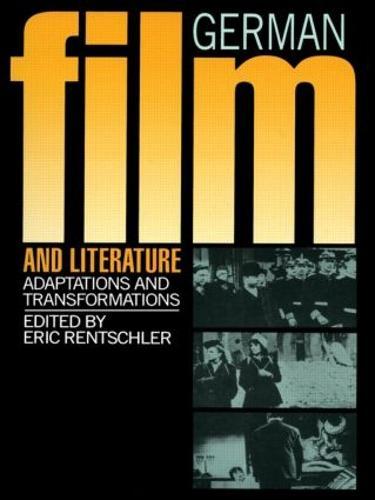
OverviewFirst Published in 1986. This collection of essays by an international team of scholars is the first sustained investigation in any language of the historical interactions between German film and literature. It is a book about adaptations and transformations, about why filmmakers adapt certain material at certain times. The major impetus at work is the desire to expand the field of adaptation study to include sociological, theoretical and historical dimensions, and to bring a livelier regard for intertextuality to the studies of German film and literature. It is concerned with the ways in which filmmakers in Germany- from Pabst and von Sternberg to Fassbinder, Herzog and Sanders-Brahms- have engaged and been engaged by, literary history. Full Product DetailsAuthor: Eric RentschlerPublisher: Taylor & Francis Ltd Imprint: Routledge Dimensions: Width: 15.60cm , Height: 1.90cm , Length: 23.40cm Weight: 0.730kg ISBN: 9780415239752ISBN 10: 0415239753 Pages: 396 Publication Date: 05 June 1986 Audience: College/higher education , General/trade , Tertiary & Higher Education , General Format: Paperback Publisher's Status: Active Availability: In Print This item will be ordered in for you from one of our suppliers. Upon receipt, we will promptly dispatch it out to you. For in store availability, please contact us. Table of ContentsIntroduction: theoretical and historical considerations 1 The first German art film: Rye's The Student of Prague (1913) 2 Dracula in the twilight: Murnau's Nosferatu (1922) 3 Lulu and the meter man: Pabst's Pandora's Box (1929) 4 Between two worlds: von Sternberg's The Blue Angel (1930) 5 Reading Ophiils reading Schnitzler: Liebelei (1933) 6 Kleist in the Third Reich: Ucicky's The Broken Jug (1937) 7 How Nazi cinema mobilizes the classics: Schweikart's Das Fraulein von Barnhelm (1940) 8 The other Germany in Zinnemann's The Seventh Cross (1944) 9 Postwar traumas in Klaren's Wozzeck (1947) 10 Semper fidelis: Staudte's The Subject (1951) German Film and Literature 11 A return to arms: Kautner's The Captain of K6penick (1956) 12 Specularity and spectacle in Schlondorff's Young Torless (1966) 13 Space of history, language of time: Kluge's Yesterday Girl (1966) 14 The invalidation of Arnim: Herzog's Signs of Life (1968) 15 Textuality and theatricality in Brecht and Straub/Huillet: History Lessons (1972) 16 A recast Goethe: Gunther's Lotte in Weimar (1975) 17 The tension of translation: Handke's The Left-Handed Woman (1977) 18 History, fiction, memory: Fassbinder's The Marriage of Maria Braun (1979) 19 The search for the Mother/Land in Sanders-Brahms's Germany, Pale Mother (1980) 20 Terms of dismemberment: the body inland/of Fassbinder's Berlin Alexanderplatz (1980)ReviewsAuthor InformationEric Rentschler is Associate Professor of German and Director of FilmStudies at the University of California, Irvine. Tab Content 6Author Website:Countries AvailableAll regions |
||||