Overview
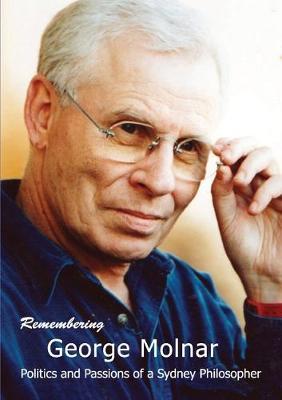
George Peter Molnar was born in Budapest in Hungary in 1934 into a prosperous Jewish family. Antisemitism was on the rise and the family changed its name from Meister to Molnar and converted to the Lutheran religion in a bid to avoid the anti Jewish laws which forbade Jews from conducting business or holding property. In 1949 George's father Imre and the rest of his family left for Australia from the Italian port of Trieste, leaving the little boy and his mother behind. Rosa and George experienced the horrors of antisemitism and occupation and only narrowly survived the holocaust, due to the intervention of Raoul Wallenberg. They arrived in Australia in 1951. Molnar was 17. He studied as a private study candidate for the Leaving Certificate and enrolled in Economics at Sydney University, but soon changed to Philosophy where he came under the influence of Professor John Anderson. He became a member of the Sydney Push, which counted Germaine Greer and Clive James among its members. After dropping out of university Molnar joined the poker players and pub and party going libertarians and began a lifelong obsession with gambling on the horses. In the early 1960s he went back to university, graduated, and for 11 years he lectured in philosophy where he took part in the split which saw the philosophy separate into two departments, general and traditional. In 1972 Molnar tutored at Oxford University and travelled to St Petersburg with his mother Rosa. He played a prominent role in opposing conscription to the Vietnam War, joined the Green Bans protest in Victoria Street, Woolloomooloo and helped to set up a kids' co-op in Glebe. Rosa died in 1976 and Molnar resigned from his university post and went to live in the UK, where he joined a political group, called Big Flame. While on holiday to Australia in 1979 he met Carlotta McIntosh who was to become his partner and lifelong friend. They lived in Leeds, Yorkshire from 1980 to 1982 before returning to Australia where they shared a squat in Darghan Street, Glebe. In 1983 Molnar joined the public service where he was to remain until his retirement 1999. Throughout this period he renewed his childhood fascination with philately and built up a substantial collection of maritime covers. He researched and wrote a maritime postal history of the Pacific and Orient Line and contributed articles on postal history of New South Wales to Philas publications. At the Department of Veterans Affairs he became the union rep for the the CPSU, Commonwealth Public Service Union, and wrote the manual on assessing disability claims by veterans. By the late 1990s Molnar had returned to philosophy, teaching first year students and in 1999 he became the John Anderson fellow. He died on 30 August 1999 after suffering a massive heart attack on the steps of Fisher Library at Sydney University at the age of 65. After his death McIntosh retrieved his unfinished manuscript on metaphysics from his computer and with the help of Marnie Hanlon, one of his former lovers, and Stephen Mumford, now Professor of Metaphysics at Durham University the book, Powers: A Study in Metaphysics was published by Oxford University Press. This collection of memoirs, George Molnar: Politics and Passions of a Sydney Philosopher was published on the 20th anniversary of his death by Carlotta McIntosh, editor and Katherine Cummings of Beaujohn Press. Contributors include: Carlotta McIntosh, Richard Archer, David Armstrong, Paul Crittenden, Katherine Cummings, Jean Curthoys, Max Farrer, André Frankovits, Chester Graham, Peter Jamieson, Geoffrey Lewis, Marion (was Hallwood) Manton, Stephen Mumford, Serge Martich Osterman, Noni Rutherford, Michal Tomazewski, Susan Varga, Nadia Wheatley, Deborah Worsley-Pine
Full Product Details
Author: Carlotta McIntosh
Publisher: Bookpod
Imprint: Bookpod
Dimensions:
Width: 14.80cm
, Height: 1.10cm
, Length: 21.00cm
Weight: 0.263kg
ISBN: 9780980365320
ISBN 10: 0980365325
Pages: 160
Publication Date: 12 December 2019
Audience:
General/trade
,
General
Format: Paperback
Publisher's Status: Active
Availability: Available To Order

We have confirmation that this item is in stock with the supplier. It will be ordered in for you and dispatched immediately.
Reviews
This is a loose collection of anecdotes about a Sydney philosopher who was also a leading personality of the city's demimonde in the second half of the last century. The book is a comprehensive and kaleidoscopic guide to this complex and still mysterious man who died exactly 20 years ago and this celebratory, sharply divergent compendium of sketches is as it should be: George Molnar had myriad passions and for an as-yet-unexplained reason had compartmentalized them in hermetically sealed mental boxes; hence, often his fellow enthusiasts in those disparate fields were not part of the same 'scene' and he knowingly kept them apart. Fortunately this book may trip off some explanation for this. Taken together, the stories give a fascinating insight into this intellectual, radical, counter culturalist, philosopher, Holocaust survivor, passionate raconteur, obsessive gambler, ardent amant, eclectic music enthusiast - from Gyorgi Ligeti to Bob Dylan - and paradoxically, a highly effective public servant in his later years. by Jack Rozycki Among the threadbare intelligentsia of the 1950s University of Sydney, George Molnar stood out for his libertarian contrary views on everything. He was a frequent contributor to the student newspaper honi soit, expounding in long essays his views and, in particular, the reasons why just about everyone else (Freud, Anderson, Ryle, Jung etc etc) had got things wrong. The book Remembering George Molnar is a collection of 20 short pieces by people who knew (and sometimes loved) George up to the time he died at the age of 65, fittingly in the University Library. Unusually for books of this kind, while affectionate, the writers are frank, even unsparing, of George as a thinker and as a person. As a lens focussed on a critical section of Australian university life and Sydney Bohemia at that time, it is hard to think of or even imagine a better set of insights. In addition, however, the book gives us a picture of an extraordinarily protean mind, with sections on George's contributions to philately (considerable), chess and cricket (not so spectacular), and his career as a public servant looking after the needs of war veterans. The great unknown for those who knew him was the dramatic history of his rescue with his mother from a Nazi death march by (probably) Raoul Wallenberg and their subsequent escape from Soviet colonised Hungary in 1949. This is an engrossing piece of reading. It has all the makings of a good film even this late in history. George was even then outshone by youths who would go on to become world figures in literature, criticism and art, especially Robert Hughes and Clive James. However he himself was a formative influence for several major figures in world and Australian letters and cinema - Germaine Greer and Albie Thoms among them. by Graham Mcdonald At a time when we shudder at governments that keep pushing for ever tougher measures to prevent any effective scrutiny of their assaults on human rights, social justice and our cultural and natural environments, we welcome the publication of Remembering George Molnar: Politics and Passions of a Sydney Philosopher (Beaujon Press, Tascott, 2019). Compiled and edited by Carlotta McIntosh, this engrossing collection of memoirs brings together marvellous writers like David Armstrong, Stephen Mumford, Nadia Wheatley, Jean Curthoys and Susan Varga to celebrate the life and work of a brilliant, feisty, charismatic and occasionally wicked public intellectual and ratbag activist who didn't mind getting arrested in support of radical causes. There is much to inspire us in this collection of voices from those who knew, worked with and loved George Molnar. by Alison Lyssa
This is a loose collection of anecdotes about a Sydney philosopher who was also a leading personality of the city's demimonde in the second half of the last century. The book is a comprehensive and kaleidoscopic guide to this complex and still mysterious man who died exactly 20 years ago and this celebratory, sharply divergent compendium of sketches is as it should be: George Molnar had myriad passions and for an as-yet-unexplained reason had compartmentalized them in hermetically sealed mental boxes; hence, often his fellow enthusiasts in those disparate fields were not part of the same 'scene' and he knowingly kept them apart. Fortunately this book may trip off some explanation for this. Taken together, the stories give a fascinating insight into this intellectual, radical, counter culturalist, philosopher, Holocaust survivor, passionate raconteur, obsessive gambler, ardent amant, eclectic music enthusiast - from Gyorgi Ligeti to Bob Dylan - and paradoxically, a highly effective public servant in his later years. by Jack Rozycki Among the threadbare intelligentsia of the 1950s University of Sydney, George Molnar stood out for his libertarian contrary views on everything. He was a frequent contributor to the student newspaper honi soit, expounding in long essays his views and, in particular, the reasons why just about everyone else (Freud, Anderson, Ryle, Jung etc etc) had got things wrong. The book Remembering George Molnar is a collection of 20 short pieces by people who knew (and sometimes loved) George up to the time he died at the age of 65, fittingly in the University Library. Unusually for books of this kind, while affectionate, the writers are frank, even unsparing, of George as a thinker and as a person. As a lens focussed on a critical section of Australian university life and Sydney Bohemia at that time, it is hard to think of or even imagine a better set of insights. In addition, however, the book gives us a picture of an extraordinarily protean mind, with sections on George's contributions to philately (considerable), chess and cricket (not so spectacular), and his career as a public servant looking after the needs of war veterans. The great unknown for those who knew him was the dramatic history of his rescue with his mother from a Nazi death march by (probably) Raoul Wallenberg and their subsequent escape from Soviet colonised Hungary in 1949. This is an engrossing piece of reading. It has all the makings of a good film even this late in history. George was even then outshone by youths who would go on to become world figures in literature, criticism and art, especially Robert Hughes and Clive James. However he himself was a formative influence for several major figures in world and Australian letters and cinema - Germaine Greer and Albie Thoms among them. by Graham Mcdonald At a time when we shudder at governments that keep pushing for ever tougher measures to prevent any effective scrutiny of their assaults on human rights, social justice and our cultural and natural environments, we welcome the publication of Remembering George Molnar: Politics and Passions of a Sydney Philosopher (Beaujon Press, Tascott, 2019). Compiled and edited by Carlotta McIntosh, this engrossing collection of memoirs brings together marvellous writers like David Armstrong, Stephen Mumford, Nadia Wheatley, Jean Curthoys and Susan Varga to celebrate the life and work of a brilliant, feisty, charismatic and occasionally wicked public intellectual and ratbag activist who didn't mind getting arrested in support of radical causes. There is much to inspire us in this collection of voices from those who knew, worked with and loved George Molnar. by Alison Lyssa