Overview
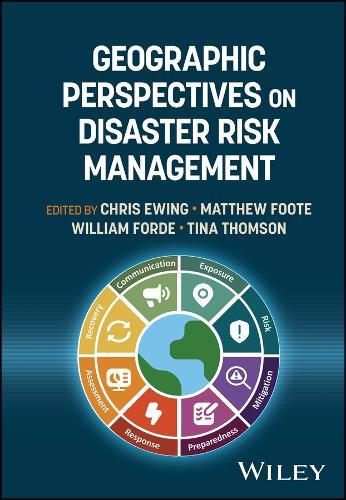
A holistic view of geospatial data and analysis across the risk management lifecycle Geospatial data and analytical tools are widely used for disaster management, insurance, humanitarian response, and defence—yet methodologies remain siloed. Geographic Perspectives on Disaster Risk Management, written by a team of experienced practitioners in catastrophe risk analytics and geospatial studies, connects these sectors by comparing approaches, identifying common challenges, and distilling cross-sector best practices for preparation, response, recovery, and mitigation. Structured around the disaster risk cycle, the book addresses exposure and vulnerability mapping, risk preparedness and mitigation strategies, event monitoring, damage assessment, resilience building, and risk communication. It draws on data sources ranging from local traffic cameras to geostationary satellites and includes case studies illustrating real-world applications alongside outcome-based evaluations of current practices and future developments in disaster risk assessment. Readers will also find: Cross-sector comparison of methodologies from international development, emergency response, insurance, defence, and commercial geospatial analytics Practical case studies demonstrating real-world challenges and solutions in disaster preparation, monitoring, damage assessment, and recovery operations Outcome-based evaluation of common approaches to emergency risk management, identifying strengths and limitations of current practice Coverage of future developments in data availability, analytical techniques, and climate risk assessment relevant to evolving environmental uncertainty Guidance on risk communication and decision-making frameworks that translate geospatial analysis into actionable operational and financial strategies Designed for professionals in disaster management, emergency response, and the insurance industry, as well as researchers and advanced students in the geosciences, this book provides a structured, practice-oriented resource for applying geographic perspectives to quantify, communicate, and reduce disaster risk across sectors.
Full Product Details
Author: Chris Ewing ,
Matthew Foote ,
William Forde ,
Tina Thomson
Publisher: John Wiley & Sons Inc
Imprint: John Wiley & Sons Inc
ISBN: 9781119751441
ISBN 10: 1119751446
Pages: 464
Publication Date: 28 May 2026
Audience:
College/higher education
,
Postgraduate, Research & Scholarly
Format: Hardback
Publisher's Status: Forthcoming
Availability: Awaiting stock

Author Information
CHRIS EWING is Head of Business Development for Impact Forecasting, the catastrophe model development centre of Aon. He has 20 years’ experience across risk management, (re)insurance, engineering, and humanitarian sectors. He holds a BSc in Physical Geography and an MSc in Geographical Information Science. Chris is a Chartered Geographer (GIS) from the Royal Geographical Society and a co-founder and Chair of the Disaster Risk Management Professional Practice Group. MATTHEW FOOTE has over 30 years’ experience in insurance, disaster risk financing, cartography, earth observation, and catastrophe risk analytics. He serves as UK Principal Representative to the GEO Programme Board and was the first chair of the GRMA Strategic Advisory Board. He is a fellow of the Royal Geographical Society and a co-founder of its Disaster Risk Management Professional Practice Group. WILLIAM FORDE is a specialist in geospatial analytics and catastrophe risk. Drawing on senior leadership experience at global consulting firms and a leading GIS vendor, he helps insurers and regulators translate complex data into actionable insights for hazard management and resilience. He holds an MSc in Remote Sensing and a BA in Anthropology and Geogaphy from University College London and is a Fellow of the Royal Geographical Society, where he co-founded its Disaster Risk Management Professional Practice Group. TINA THOMSON, PHD, has held senior leadership roles in analytics, research, and digital solutions spanning a career across Catastrophe Model Vendors, Property & Casualty Insurance, Reinsurance, and Reinsurance Brokers. Tina is passionate about the application of scientific concepts, emerging industry trends and new technologies. She holds a PhD in Geomatic Engineering from University College London. She is a Fellow of the Remote Sensing and Photogrammetry Society and a Chartered Geographer with the Royal Geographical Society, where she co-founded the Professional Practice Group for Disaster Risk Management.