|
|
|||
|
||||
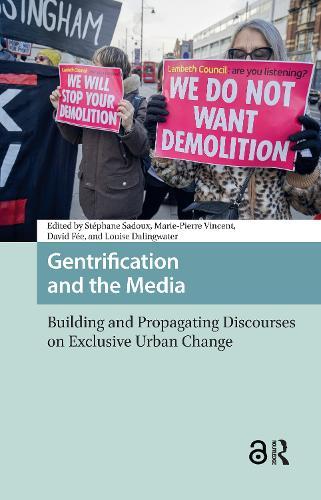
OverviewGentrification is extensively discussed in the media, where coverage can describe changing neighbourhoods and analyse the causes and consequences of such change. The media are also arenas in which the voices of those who advocate or resist gentrification can be heard. How can this profusion of content be examined? What methods can be used to critically address the role of the media in constructing and propagating discourses on gentrification? Central to this book is the idea that new research should engage with the theoretical and methodological issues that emerge when media products are used as a corpus to study gentrification. Full Product DetailsAuthor: Stéphane Sadoux , Marie-Pierre Vincent , David Fée , Louise DalingwaterPublisher: Amsterdam University Press Imprint: Amsterdam University Press Weight: 0.700kg ISBN: 9789463720991ISBN 10: 9463720995 Pages: 294 Publication Date: 14 April 2025 Audience: Professional and scholarly , Professional & Vocational Format: Hardback Publisher's Status: Active Availability: In Print This item will be ordered in for you from one of our suppliers. Upon receipt, we will promptly dispatch it out to you. For in store availability, please contact us. Table of ContentsAcknowledgements 1. Introduction: Gentrification and the Media – Stéphane Sadoux, Marie-Pierre Vincent, David Fée, Louise Dalingwater PART 1: Comparing and contrasting discourses on gentrification 2. The Local and International Press and the Gentrification of Western Leipzig (Germany): Between Promotional Narratives of Social Transformations and Late Discovery of the Negatives Consequences of Gentrification – Antonin Girardin 3. Crime and Gentrification in News Reporting – Aurora Wallace 4. Discussion – Martine Drozdz PART 2: Place-making through evolving narratives 5. Gentrification as entertainment: New Orleans as seen on HGTV – Ella Howard 6. Shaping and diverting public space regulation: newspaper coverage of an eviction in a BID, Washington, DC – Nacima Baron 7. Discussion – Japonica Brown-Saracino PART 3: Fuelling and orchestrating gentrification 8. The eviction of ethnicity and class in the media coverage of commercial gentrification in the 18th arrondissement of Paris – Pierre Joffre 9. Constructing the authenticity of gentrified districts? Newspaper coverage of Belleville (Paris) and El Raval (Barcelona) – Marina Montaner 10. Acknowledging the interplay between religion and gentrification in the press? “Muslim enclaves” in Goutte d’Or (Paris) and El Raval (Barcelona) – Victor Albert-Blanco 11. Discussion – Yankel Fijalkow PART 4: Voicing alternative narratives and resisting gentrification 12. The “I am Denver” Chief Storytelling Office: critical co-creative media to change the dominant narrative of gentrification? – Simon Renoir 13. Citizen journalism and gentrification: local community views and discourses on urban change in Brixton, London, 2011-2022 – Stéphane Sadoux 14. Popular vs. independent local newspapers and anti-gentrification resistance: mixed representations of the 2015 Cereal Killer Cafe attack in London – Marie-Pierre Vincent 15. Discussion - Matthew Hardy Conclusion INDEXReviewsAuthor InformationStéphane Sadoux is a town planner and an historian. He graduated from the Universities of Oxford, Newcastle-upon-Tyne and Grenoble. He is a past Director of Unité de Recherche AE&CC at the Grenoble School of Architecture (ENSAG), Université Grenoble Alpes (UGA). He is currently leading UGA’s Excellence in Architecture programme (LabEx). Marie-Pierre Vincent is a senior lecturer of British studies at Paris 1–Panthéon Sorbonne and affiliated with the European Centre of Sociology and Political Science. Her thesis focused on anti-gentrification resistance in Hoxton/Shoreditch in London (2008–2019). Her work also relates to art and anti-gentrification activism, political discourse and gentrification, and socio-cultural diversity. David Fée is professor of British Studies at the University of Sorbonne Nouvelle in Paris. He specializes in housing policy in the UK. He has co-edited several books including Lessons from the British and French New Towns: Paradise Lost (Emerald, 2021). Louise Dalingwater is professor of British Studies at Sorbonne University, Paris. She specializes in the service sector, notably financial services and public services. Some of her work has looked at the spatial dimension of service industries such as financial service location. Tab Content 6Author Website:Countries AvailableAll regions |
||||