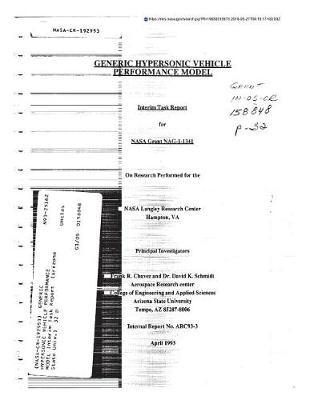
Generic Hypersonic Vehicle Performance Model

Author:   National Aeronaut Administration (Nasa)
Publisher:   Createspace Independent Publishing Platform
ISBN:  

9781722255732


Pages:   36
Publication Date:   03 July 2018
Format:   Paperback
Availability:   Available To Order   Availability explained
We have confirmation that this item is in stock with the supplier. It will be ordered in for you and dispatched immediately.

Our Price $47.49 Quantity:  
Add to Cart

Share |

Generic Hypersonic Vehicle Performance Model


Overview

An integrated computational model of a generic hypersonic vehicle was developed for the purpose of determining the vehicle's performance characteristics, which include the lift, drag, thrust, and moment acting on the vehicle at specified altitude, flight condition, and vehicular configuration. The lift, drag, thrust, and moment are developed for the body fixed coordinate system. These forces and moments arise from both aerodynamic and propulsive sources. SCRAMjet engine performance characteristics, such as fuel flow rate, can also be determined. The vehicle is assumed to be a lifting body with a single aerodynamic control surface. The body shape and control surface location are arbitrary and must be defined. The aerodynamics are calculated using either 2-dimensional Newtonian or modified Newtonian theory and approximate high-Mach-number Prandtl-Meyer expansion theory. Skin-friction drag was also accounted for. The skin-friction drag coefficient is a function of the freestream Mach number. The data for the skin-friction drag coefficient values were taken from NASA Technical Memorandum 102610. The modeling of the vehicle's SCRAMjet engine is based on quasi 1-dimensional gas dynamics for the engine diffuser, nozzle, and the combustor with heat addition. The engine has three variable inputs for control: the engine inlet diffuser area ratio, the total temperature rise through the combustor due to combustion of the fuel, and the engine internal expansion nozzle area ratio. The pressure distribution over the vehicle's lower aft body surface, which acts as an external nozzle, is calculated using a combination of quasi 1-dimensional gas dynamic theory and Newtonian or modified Newtonian theory. The exhaust plume shape is determined by matching the pressure inside the plume, calculated from the gas dynamic equations, with the freestream pressure, calculated from Newtonian or Modified Newtonian theory. In this manner, the pressure distribution along the vehicle after body expa...

Full Product Details

Author:   National Aeronaut Administration (Nasa)
Publisher:   Createspace Independent Publishing Platform
Imprint:   Createspace Independent Publishing Platform
Dimensions:   Width: 21.60cm , Height: 0.20cm , Length: 27.90cm
Weight:   0.109kg
ISBN:  

9781722255732


ISBN 10:   1722255730
Pages:   36
Publication Date:   03 July 2018
Audience:   General/trade ,  General
Format:   Paperback
Publisher's Status:   Active
Availability:   Available To Order   Availability explained
We have confirmation that this item is in stock with the supplier. It will be ordered in for you and dispatched immediately.

Table of Contents

Reviews

Author Information

Tab Content 6

Author Website:  

Countries Available

All regions
Latest Reading Guide

April RG 26_2


Shopping Cart
Your cart is empty
Shopping cart
Mailing List