Overview
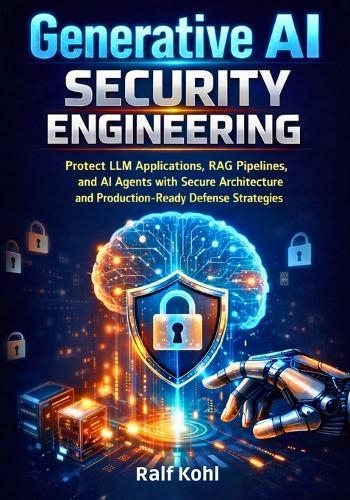
Generative AI Security Engineering: Protect LLM Applications, RAG Pipelines, and AI Agents with Secure Architecture and Production-Ready Defense Strategies Your LLM application works. But is it secure under real-world pressure? Generative AI is no longer experimental. Large language models now power enterprise search, customer support automation, internal copilots, analytics pipelines, and autonomous AI agents connected to live systems. They access proprietary data. They retrieve dynamic context. They generate outputs that influence decisions and trigger downstream actions. When these systems fail, they fail at scale. Prompt injection can override trusted instructions. RAG pipelines can expose confidential data through retrieval leakage. AI agents can invoke tools beyond their intended authority. Insufficient monitoring can allow subtle anomalies to evolve into major security incidents. Performance alone is not production readiness. Security architecture is. Generative AI Security Engineering is a practical, production-focused blueprint for protecting LLM applications, retrieval-augmented generation (RAG) pipelines, and AI agents with deterministic control and layered defense strategies. This book moves beyond high-level safety discussions and into real engineering discipline. It shows you how to design containment around probabilistic models so your systems remain powerful without becoming unpredictable liabilities. You will learn how to: Prevent prompt injection and semantic manipulation attacks Harden RAG pipelines against data poisoning and unauthorized retrieval Enforce metadata-scoped access control in vector databases Separate model reasoning from execution authority in AI agents Implement structured output validation and policy enforcement Design multi-stage verification and risk scoring systems Build safe-state transitions and fail-closed containment mechanisms Deploy structured logging, anomaly detection, and SIEM/SOAR integration Embed AI security into DevSecOps workflows and enterprise governance frameworks Instead of reacting to incidents after deployment, you will design systems that anticipate failure modes and contain them by architecture. The book presents clear patterns for trust boundary definition, inference validation, action authorization, and runtime monitoring-principles that apply whether you are using OpenAI APIs, enterprise LLM platforms, or custom-built generative systems. Written for engineers, architects, security practitioners, and technical leaders, this guide treats generative AI security as a first-class engineering discipline. It reflects the reality of production environments where compliance, confidentiality, and operational stability cannot be compromised. Model intelligence attracts attention. Secure architecture sustains trust. If you are building LLM-powered applications, retrieval-augmented generation systems, or autonomous AI agents in production, this book provides the production-ready defense strategies required to operate safely at scale. Design with containment in mind. Deploy with confidence. Build generative AI systems that are not only intelligent, but resilient under pressure.
Full Product Details
Author: Ralf Kohl
Publisher: Independently Published
Imprint: Independently Published
Dimensions:
Width: 17.80cm
, Height: 1.60cm
, Length: 25.40cm
Weight: 0.513kg
ISBN: 9798249331313
Pages: 294
Publication Date: 22 February 2026
Audience:
General/trade
,
General
Format: Paperback
Publisher's Status: Active
Availability: Available To Order

We have confirmation that this item is in stock with the supplier. It will be ordered in for you and dispatched immediately.